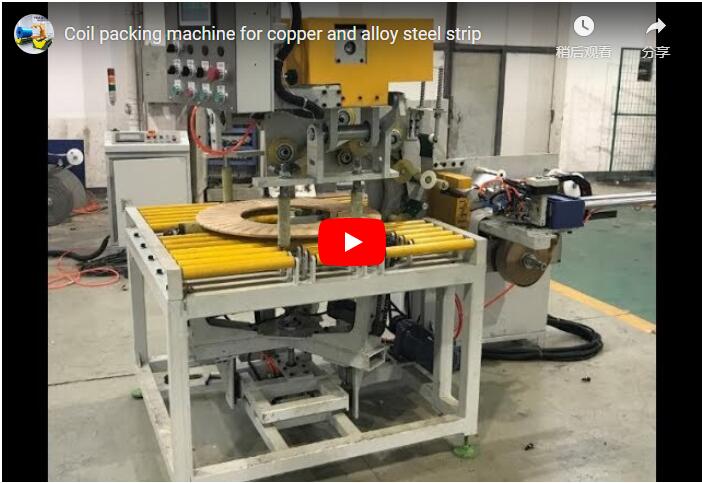
Executive summary This 68 s clip follows bright stainless slit coils through one of our packing lines: a turnstile, a 90° tilter, an eye-through film wrapper, a label unit and a gantry stacker. Most output losses on a line like this come from three places: a station waiting on consumables, film tension that does not follow coil size, and a manual step left between two automatic ones. We design against all three before we quote a cycle.
Table of Contents
- What the clip shows, station by station
- Why stainless coils change the design brief
- Eye-through wrap coverage: set it at the OD
- Where a coil line loses output
- Stacking wrapped coils on skids
- Selection checklist for a stainless coil packing line
- Controls and safety
- Engineering FAQ
- Next step
- Related reading
- Sources
What the clip shows, station by station
The recording runs 68 s and moves down the line in process order. The times below are read from the clip.
| Clip time | Station | What happens |
|---|---|---|
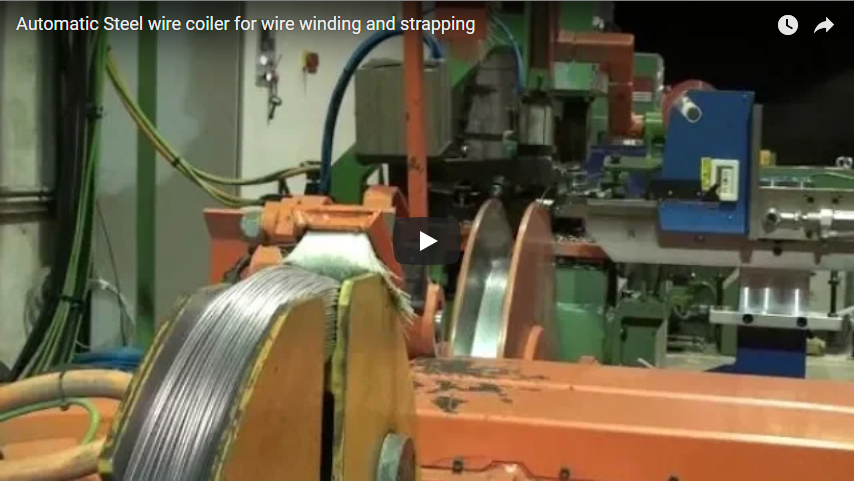
| 0–9 s | Turnstile | Slit coils hang eye-horizontal on the arms of a slewing turnstile; the arms index one coil to the transfer point. |
| 10–19 s | 90° tilter | A yellow cradle takes the coil upright, turns it through 90° and lays it eye-to-sky on the roller table (slit coil upending and eye-through wrapping covers this hand-over in detail). |
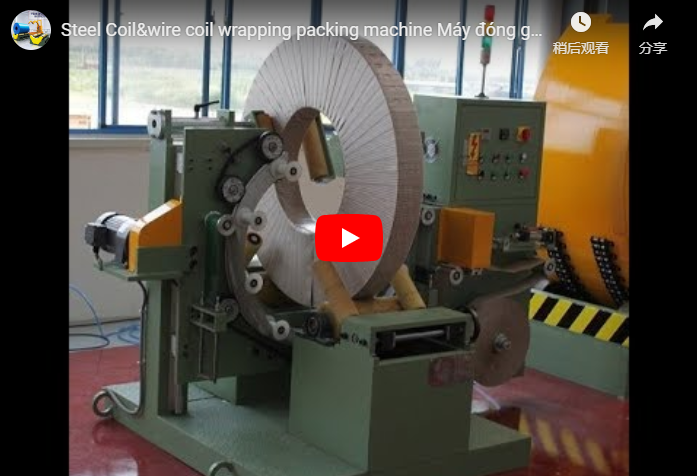
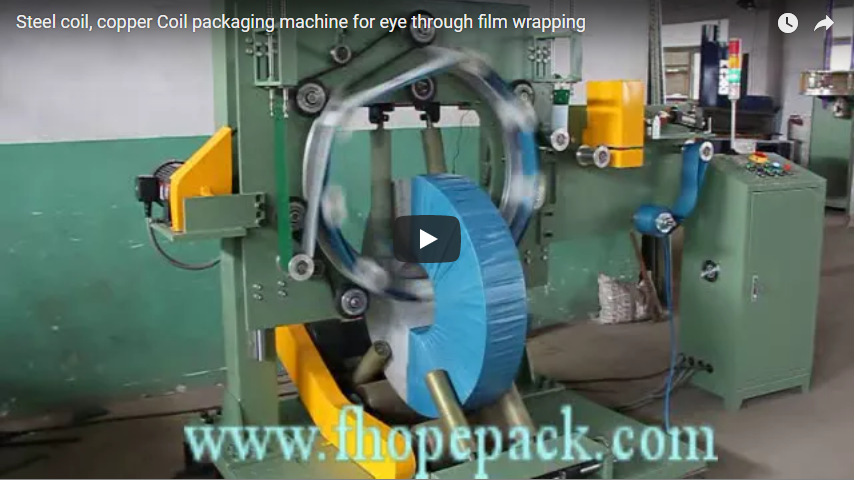
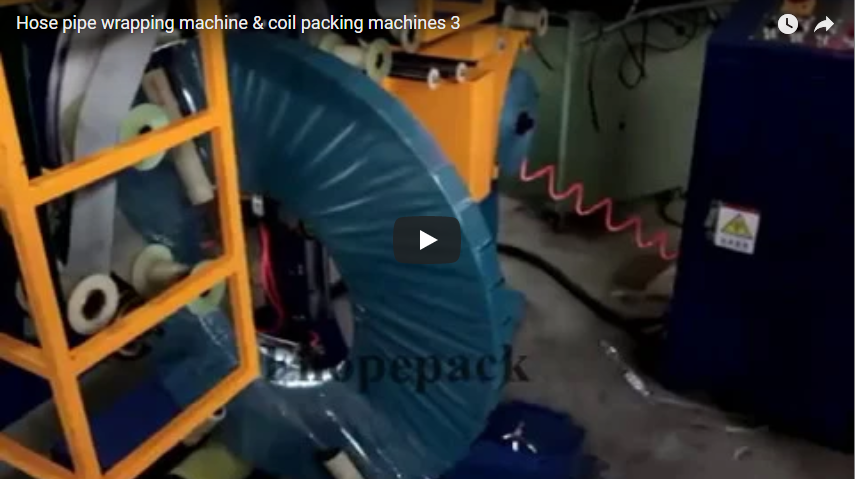
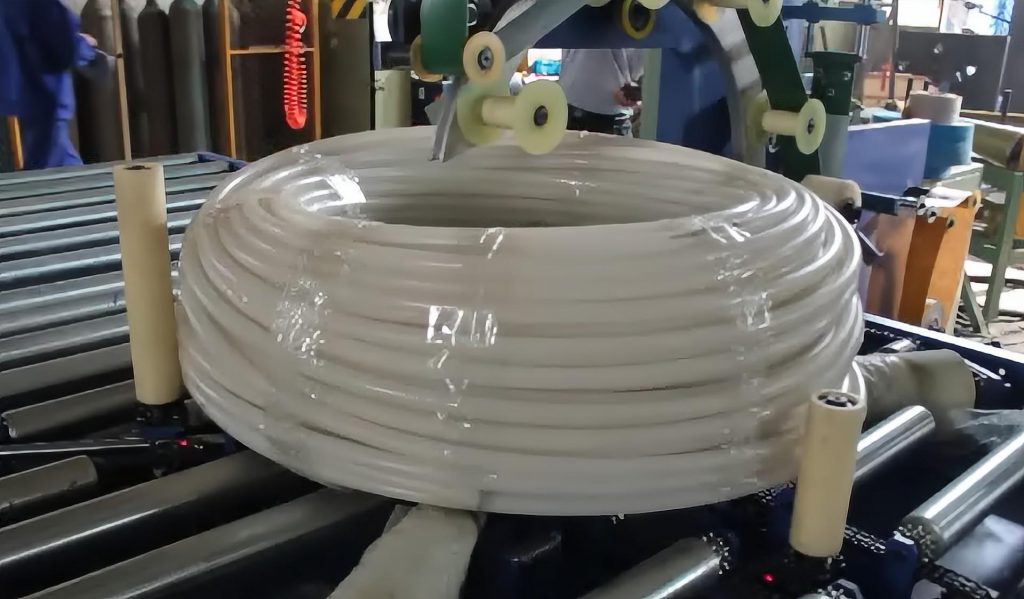
| 22–38 s | Eye-through wrapper | The film ring passes through the coil eye while driven rollers turn the coil, so film covers the OD, both faces and the bore. |
| 40–50 s | Label unit | The wrapped coil stops beside a label unit on the roller conveyor for identification. |
| 54–68 s | Gantry stacker | A gripper lifts each wrapped coil and builds stacks of two and three coils on timber skids at the floor positions. |
No operator lifts or turns a coil in the sequence shown, which removes the manual handling step where most edge damage starts.
Why stainless coils change the design brief
A bright stainless surface shows every scuff. On carbon steel a light roller mark is often accepted; on stainless it can turn into a claim. So the brief changes at each contact point.
- Tilter cradle: the coil should settle onto the cradle, not slide. We set the cradle speed and the end-of-stroke slowdown for the heaviest coil on the order.
- Roller table and wrapper rollers: the coil turns on these rollers for the whole wrap. The roller surface material is part of the proposal, not an afterthought.
- Stacker gripper: the jaws close on the wrapped coil, so the film is already a protective layer. Gripping force is matched to coil weight and width. Our line family covers stainless, copper, aluminium, cold-rolled and galvanised coils. For stainless we tune the contact surfaces and gripping settings, not the frame.
Eye-through wrap coverage: set it at the OD
On an eye-through wrapper each ring turn lays one band of film across the coil section. Between turns the coil rotates a little, so the next band lands beside the last.
Bands crowd together at the bore and spread apart at the OD. If the OD is covered, the bore is covered more heavily. So we set coil rotation from the OD.
- Advance per ring turn at the OD (mm) = film width (mm) × (1 − overlap).
- Ring turns per full layer = OD circumference (mm) ÷ advance per ring turn (mm).
- OD circumference (mm) = OD (mm) × 3.14.
Illustrative customer inputs, not values from the clip:
| Item | Value |
|---|---|
| Coil OD | 1200 mm |
| OD circumference (1200 × 3.14) | 3768 mm |
| Film width | 100 mm |
| Target overlap at the OD | 50% |
| Advance per ring turn (100 × 0.5) | 50 mm |
| Ring turns per layer (3768 ÷ 50) | about 75 |
Our line programs store these settings per coil specification. The operator selects the program; centering, wrapping tension and overlap follow it. That is the main defence against uneven tension when coil sizes change during a shift.
Where a coil line loses output
Buyers often ask which failure point matters most: downtime, tension or manual steps. They are linked, and the slowest station decides.
1. Stops for consumables. If a film or label change stops one station while the turnstile keeps feeding, coils queue. We plan film-change access and buffer positions at layout stage.
2. Tension that does not follow the coil. One fixed tension setting for every size gives loose film on a small coil or necking on a wide one. Programmed tension and overlap per coil size remove most of this.
3. A manual step between automatic stations. If labels are applied by hand, the line runs at the speed of the person. In the clip every hand-over is done by machine.
Line rate in coils per hour = 3600 ÷ seconds per coil at the slowest station. We time each station from your coil sizes and close the figure on the proposal; a short demo clip is not a rated cycle.
Stacking wrapped coils on skids
The last 14 s of the clip show the gantry stacker. Coils go eye-to-sky onto timber skids, two or three high in the stacks shown. The stack positions sit on the floor around the stacker, so a forklift can take a finished stack while the next one builds.
Our quote form for coil lines takes a maximum stacking height of 6 coils. The working stack height comes from coil weight, coil width, the skid you ship on and your forklift capacity. Final package direction, eye-to-sky or eye-to-wall, is also set at this stage; this line ships eye-to-sky.
Selection checklist for a stainless coil packing line
- Coil OD, ID, width and weight range, and the largest coil on the order.
- How coils arrive from the slitter: turnstile, coil car or crane.
- Final package direction: eye-to-sky or eye-to-wall.
- Wrap material and overlap you specify; film width you already buy.
- Label content and whether data comes from ERP or MES.
- Strapping need: PET or steel strap, and through-the-eye or circumferential.
- Stack height, skid type and forklift access around the stacker.
- Target coils per hour from your slitter output, not from a demo clip.
Controls and safety
The standards that apply depend on the destination market. For CE markets, ISO 12100 sets the risk-assessment method and EN 415-10 covers general requirements for packaging machines, which fixes guarding and the emergency-stop arrangement.
The turnstile, the tilter cradle, the wrapping ring and the stacker gripper are the moving hazards. The stacker area is fenced, and film or label changes are done with the station stopped.
Engineering FAQ
Q: Is film tension the main cause of output loss on a coil line? A: No. Wrong tension causes package defects. Output loss comes mainly from consumable stops, manual steps and a station slower than the rest. Programmed tension per coil size fixes the first; buffers and machine hand-overs fix the others.
Q: How do we set overlap on an eye-through wrapper? A: Set coil rotation from the OD. Film bands crowd together at the bore, so the required overlap at the OD covers the whole section. Advance per ring turn = film width × (1 − overlap).
Q: Which coil orientations does this line handle? A: Coils arrive eye-horizontal on the turnstile, tilt 90° to eye-to-sky on the roller table, and stay eye-to-sky through wrapping, labelling and stacking.
Q: How high can wrapped coils be stacked? A: Our quote form takes up to 6 coils. The clip shows stacks of two and three. The working height depends on coil weight, width, skid and forklift.
Q: How do we get a coils-per-hour figure? A: Coils per hour = 3600 ÷ seconds per coil at the slowest station. We time each station from your coil sizes and write the result on the proposal.
Next step
We size a stainless coil packing line in three steps:
- Submit your layout drawing with the coil OD, ID, width, weight, label content and output target, to info@fhopepack.com.
- Receive a proposal within 48 hours, including the turnstile, tilter, eye-through wrapper, label unit and stacker, with the cycle checked against your slitter output.
- Book a site survey so we confirm the coil arrival point, the line direction and forklift access to the stack positions.
Related reading
- Stainless Steel Coil Stretch Wrapping and Stacking
- Slit Coil Packing Line for Service Centers: Strapping, Eye-Through Wrapping and Stacking
- Coil Wrapping Machine with Taping and Barcode Label Printer
- Automatic Coil Packing Line
Sources
- Station sequence and clip times: the video on YouTube (68 s; @Fhopepack)
- Line family, materials, programs, stacking height on the quote form, package direction: Automatic Coil Packing Line
- Standards scope: ISO 12100:2010; EN 415-10:2014
- Proposal timing: approved house CTA (proposal within 48 hours)
Last reviewed: 2026-10-06