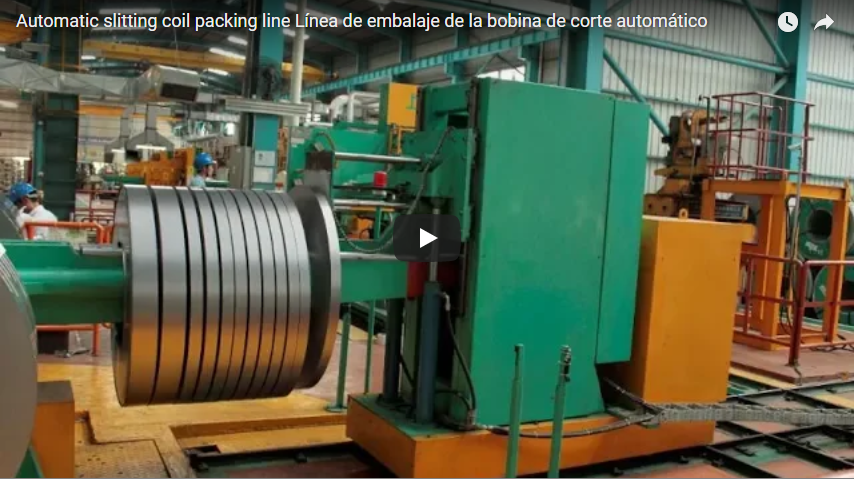
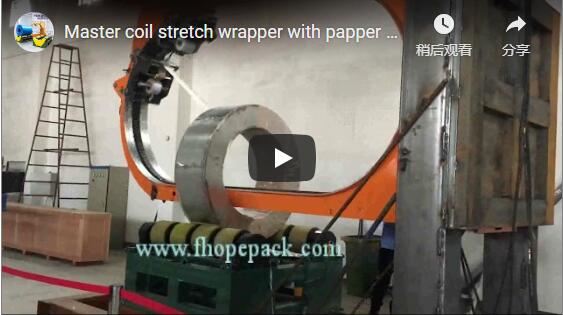
Executive summary This line turns slit coils from a slitting line through eye-vertical tilting, through-the-eye wrapping, operator control stations, and station-to-station conveyor transfer. Packing slit coils eye-vertical makes them stable and easy to stack.
Table of Contents
- What the machine does
- Why pack eye-vertical
- Line pace
- What we set per line
- Selection checklist
- Safety
- Engineering FAQ
- Next step
- Related reading
- Sources
What the machine does
| Step | What happens |
|---|---|
| Tilting | Upenders turn coils to eye-vertical |
| Wrapping | A wrapper covers each coil through the eye |
| Control | Operators at the control stations |
| Conveying | Coils move station to station on conveyors |
| Stacking | Coils stack at the line end |
An automated vertical slit coil packing line runs as a continuous transfer from the slitting line exit to finished storage. Slit coils from the slitter are held on a multi-arm turnstile, and a down-ender picks individual coils and tilts them 90 degrees to the eye-vertical position. The line then integrates coil down-ending, PET strapping, orbital through-the-eye wrapping, and automated stacking [manufacturer rating].
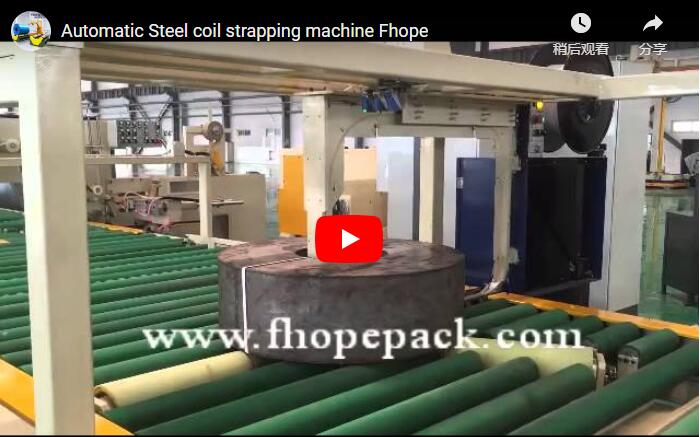
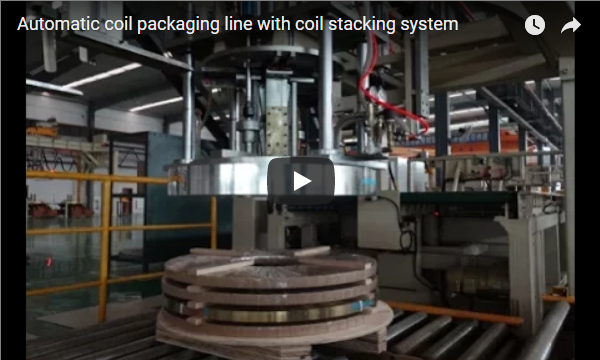
After tilting, driven conveyors index each flat-lying coil into the strapping and wrapping cells. The orbital wrapper feeds stretch film, paper, or VCI anti-corrosion film through the internal eye and over the outer circumference. The wrapped coil then indexes to a weighing, labeling, and stacking station, where coils are stacked onto pallets ready for forklift transport.
Why pack eye-vertical
- Stable. A flat coil cannot roll.
- Stackable. Narrow coils stack several high.
- Compact. Eye-vertical coils take less floor space.
- Pallet ready. Stacks sit straight on pallets.
Slit steel coils have narrow strip widths relative to their outside diameters, so they are unstable when resting eye-horizontal and can roll under momentum. In the eye-vertical position the coil rests on its broad flat side face, which gives natural stability, moisture protection, and secure handling through the warehouse [manufacturer rating].
For coils with outside diameters between 300 mm and 500 mm and unit weights between 250 kg and 350 kg, eye-vertical placement allows clean application of high-tension PET strapping combined with moisture-resistant through-the-eye wrapping [manufacturer rating].
Line pace
Worked example (illustrative).
| Item | Value |
|---|---|
| Coils per slitting cut (illustrative) | 12 |
| Cuts per hour (illustrative) | 5 |
| Coils per hour, 12 × 5 | 60 |
| Time per coil, 3,600 ÷ 60 | 60 s |
The 60-second takt time is the target average across all inline stations. In plant layouts, the cycle splits across dedicated stations so the slitter exit does not stall:
- Down-ending cycle: the 90-degree tilting stroke runs at about 60 s per coil [manufacturer rating].
- Strapping cycle: automatic PET strapping heads run feed, tension, seal and cut within ≤15–38 s per strap [manufacturer rating], so two or three radial straps fit inside the single-coil pace window.
- Wrapping and stacking: across standard product lines, packing throughput runs 20–40 coils/hr for narrow slit coils (widths 8–500 mm) and 5–8 coils/hr for wide formats (widths 450–1,900 mm) [manufacturer rating].
What we set per line
| Setting | Depends on |
|---|---|
| Tilter | Coil weight |
| Wrapping | Layers and overlap |
| Stacking | Stack height |
| Conveyor | Coils per hour |
Each packing line is configured around specific coil dimensions and throughput targets:
- Tilter: down-ender capacities scale from narrow coil frames handling 30 kg–4,000 kg, to heavy-duty hydraulic tilters for 4,000 kg–11,000 kg, and custom mill systems up to 25,000 kg–33,000 kg [manufacturer rating]. Horn extension strokes are matched to slitting widths (up to about 1,800 mm) [manufacturer rating].
- Wrapping: programmable controllers (Siemens S7-1200 or S7-1500F) set the orbital ring speed and film overlap [manufacturer rating]. Media ranges from stretch film to VCI film or composite fabrics for export moisture protection [manufacturer rating].
- Stacking: stacking stations take mechanical clamping forks, vacuum lifters, or magnetic plates, with payloads up to 6,000 kg per pallet at stack heights of 1,000 mm including the pallet [manufacturer rating].
- Conveyor: roller conveyors use 100 mm rollers in conveying widths up to 1,600 mm [manufacturer rating]. Rollers handling sensitive cold-rolled, stainless or non-ferrous strip are PU-coated to protect the surface [manufacturer rating].
Selection checklist
- Coil OD, ID, width and weight.
- Coils per cut.
- Cuts per hour.
- Film layers.
- Stack height.
- Layout.
Safety
- Keep clear of moving stations.
- Stay outside the fence while the line runs.
- Lock out before clearing a jam.
- For CE markets, the machine is designed to ISO 12100 and EN 415-10.
Heavy-duty lines add perimeter fencing, light curtains at loading apertures, interlocked service gates and LOTO lockout points across pneumatic, hydraulic and electrical supplies [manufacturer rating].
Engineering FAQ
Q: What does vertical packing mean? A: Coils are handled, wrapped and stacked eye-vertical, resting flat on their side faces.
Q: Why eye-vertical? A: Flat coils cannot roll, stack cleanly on pallets, and present a uniform profile for through-the-eye wrapping.
Q: What pace must the line keep? A: The line pace must match the slitting head. In the worked example the takt is 60 s per coil, with buffers between stations. Standard automated narrow coil lines deliver 20–40 coils/hr [manufacturer rating].
Q: Can strapping be added? A: Yes, before wrapping. A radial PET or steel strapping station is integrated after the down-ender.
Q: Does it take a whole cut? A: Yes. A four-arm turnstile with internal retaining shoes can hold the complete batch of coils from one cut [manufacturer rating].
Q: Which standards apply? A: For CE markets, ISO 12100 and EN 415-10.
Next step
We match a slit coil packing line in three steps:
- Submit your layout drawing with coil sizes, coils per cut and cuts per hour, to info@fhopepack.com.
- Receive a proposal within 48 hours with the machine data and layout.
- Book a site survey so we confirm the slitter exit.
Related reading
- Slit Coil Handling to Stacking Line
- Steel Coil Packaging Line: The Complete Process Step by Step
- Hands-Free Slit Coil Packing: Safety Zones
- Slit coil packing line
Sources
- Machine content: FHOPE engineering team, 2026-10-10
- Machine in action: our video on YouTube
- Line pace: our worked example, illustrative values
- Standards scope: ISO 12100:2010; EN 415-10:2014
- Proposal timing: approved house CTA (proposal within 48 hours)
- Line specifications: Examining slit coil handling and packaging line
- System data: Automatic Slit Coil Packaging System
- Configuration grades: Vertical coil packaging line
Last reviewed: 2026-10-29