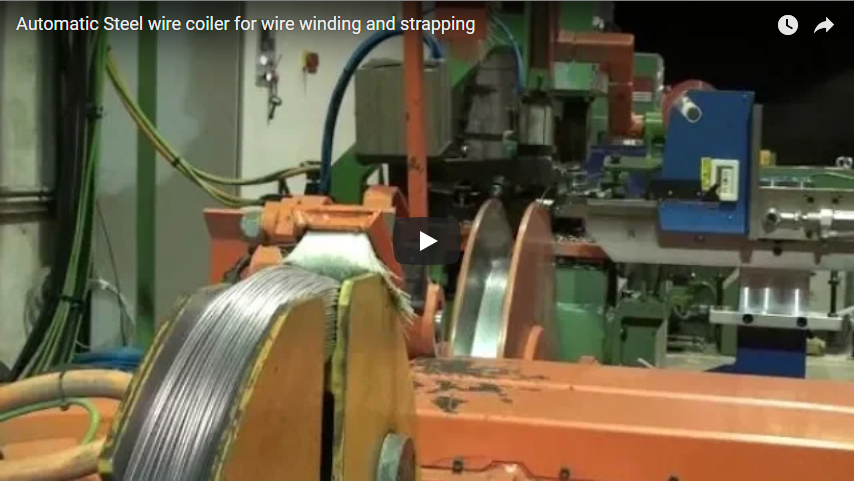
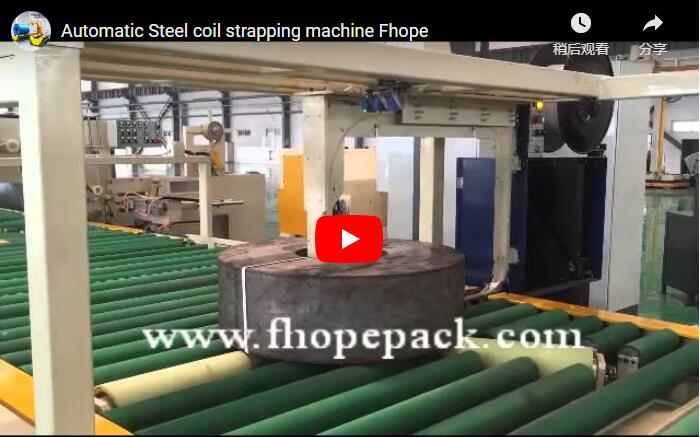
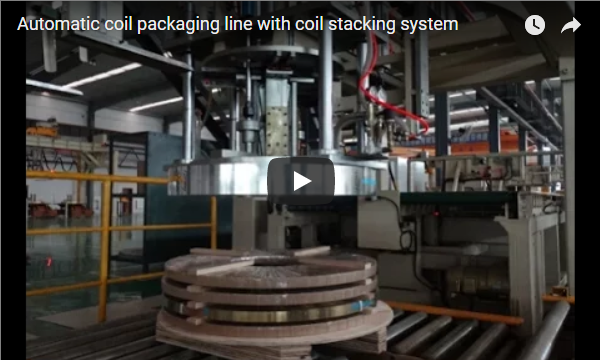
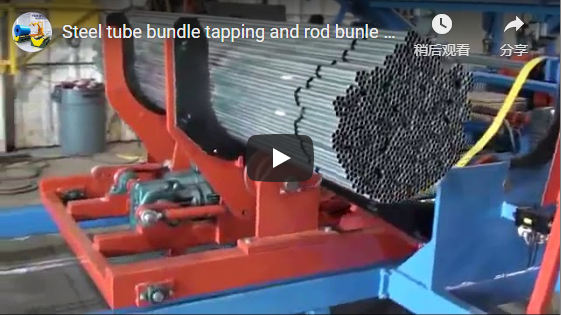
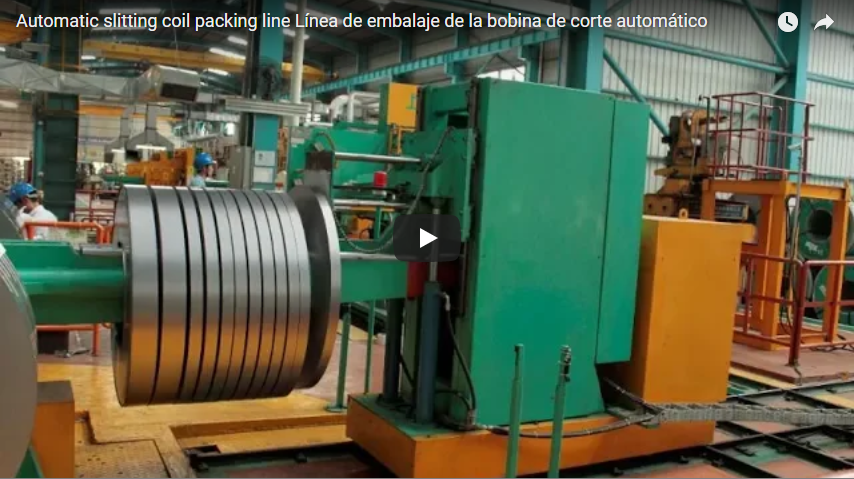
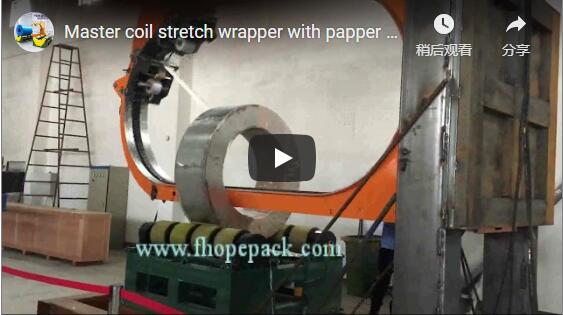
Executive summary This clip runs through the complete process on one of our steel coil packaging lines. A teal upender turns the coil, an orbital ring wraps it eye-through on a green conveyor line while operators check it, and a blue gantry places the finished coils on wooden pallets. Below we list every step with an illustrative time, so you can see where a coil spends its time.
Table of Contents
- What the clip shows
- The complete process
- Time per coil
- What we set per line
- Selection checklist
- Safety
- Engineering FAQ
- Next step
- Related reading
- Sources
What the clip shows
| Step | What you see |
|---|---|
| Workshop | Our lines in assembly |
| Upending | A teal upender turns the coil |
| Wrapping | An orbital ring wraps the coil eye-through on a green line |
| Checking | Operators check the coil at the wrapper |
| Stacking | A blue gantry places coils on wooden pallets |
The complete process
- Infeed. The coil arrives from the slitter or the store.
- Upending. The upender turns it to the position the line needs.
- Strapping. Radial straps through the eye secure the coil before wrapping, where specified (not shown in this clip).
- Wrapping. The ring wraps the coil eye-through.
- Stacking. The gantry places coils on pallets.
- Outfeed. Pallets leave for forklift pick-up.
Time per coil
Worked example (illustrative).
| Step | Time (illustrative) |
|---|---|
| Upend | 40 s |
| Strap | 30 s |
| Wrap | 70 s |
| Stack | 35 s |
| Total time in the line, 40 + 30 + 70 + 35 | 175 s |
| Line pace set by the wrap | 70 s per coil |
What we set per line
| Setting | Depends on |
|---|---|
| Upender | Coil weight and position |
| Strapping | Straps per coil |
| Wrapping | Layers and overlap |
| Stacking | Pallet and stack pattern |
Selection checklist
- Coil OD, ID, width and weight.
- Coils per slitting cut.
- Straps per coil.
- Film layers.
- Stack pattern and pallet size.
- Coils per hour.
Safety
- Keep clear of the upender, strapping head and wrapping ring while they move.
- Stay outside the fenced stacking area.
- Lock out before clearing a jam.
- For CE markets, the machine is designed to ISO 12100 and EN 415-10.
Engineering FAQ
Q: What are the steps? A: Infeed, upending, strapping, wrapping, stacking and outfeed.
Q: How long is a coil in the line? A: 175 s of total time in the line in the worked example, while the line pace is 70 s per coil.
Q: What sets the line pace? A: The slowest station; the 70 s wrap in the worked example.
Q: Can strapping be left out? A: Yes, if the coil does not need it.
Q: Which pallets does the gantry use? A: Wooden pallets as in the clip, or your own pallet size.
Q: Which standards apply? A: For CE markets, ISO 12100 and EN 415-10.
Next step
We match a steel coil packaging line in three steps:
- Submit your layout drawing with coil sizes, weights and coils per hour, to info@fhopepack.com.
- Receive a proposal within 48 hours with the machine data and layout.
- Book a site survey so we confirm the floor layout.
Related reading
- How Does a Two-Stage Automatic Steel Coil Packaging and Stacking Line Work?
- Slit Coil Handling to Stacking Line
- Automatic Steel Coil Stacking and Palletizing Gantry
- Slit coil packing line
Sources
- Machine content: FHOPE engineering team, 2026-10-10
- Clip: the video on YouTube
- Time per coil: our worked example, illustrative values
- Standards scope: ISO 12100:2010; EN 415-10:2014
- Proposal timing: approved house CTA (proposal within 48 hours)
Last reviewed: 2026-10-10