Executive summary
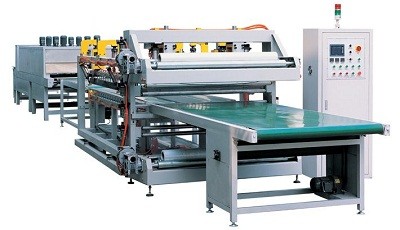
An automatic film sealing machine closes PE film around doors, panels and flat stacks as they run along a conveyor. A heated seal bar on a vertical frame comes down, seals and cuts the film, and the package can then pass through a shrink tunnel for a tight finish. We build these sealers for door, panel and board lines.
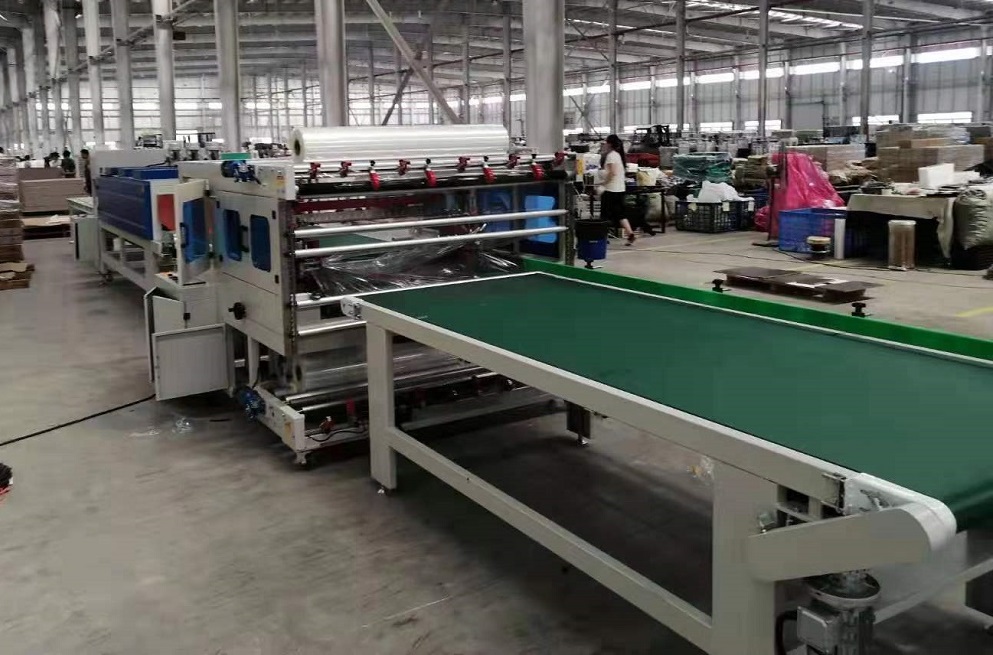
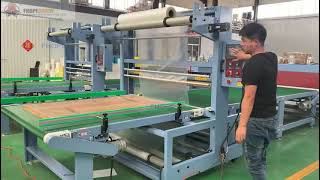
The machine is laid out in a straight line: a film roll stand on the infeed side, a belt conveyor through the middle, a vertical frame carrying the sealing head, and the control cabinet at the far end. A guard covers the sealing head. The product here is a flat paper stack, which runs the same way as a door leaf or panel.
The cabinet carries a display, push-buttons, a rotary knob and a red emergency stop. The film is pulled over the product, and the sealing head comes down to press and seal it around the stack.
Table of Contents
- Why doors and panels are film sealed
- How the sealing head works
- Film type and film width
- Adding a shrink tunnel
- Line speed and output per hour
- Typical data
- Selection checklist
- Safety
- Engineering FAQ
- Next step
- Related reading
- Sources
Why doors and panels are film sealed
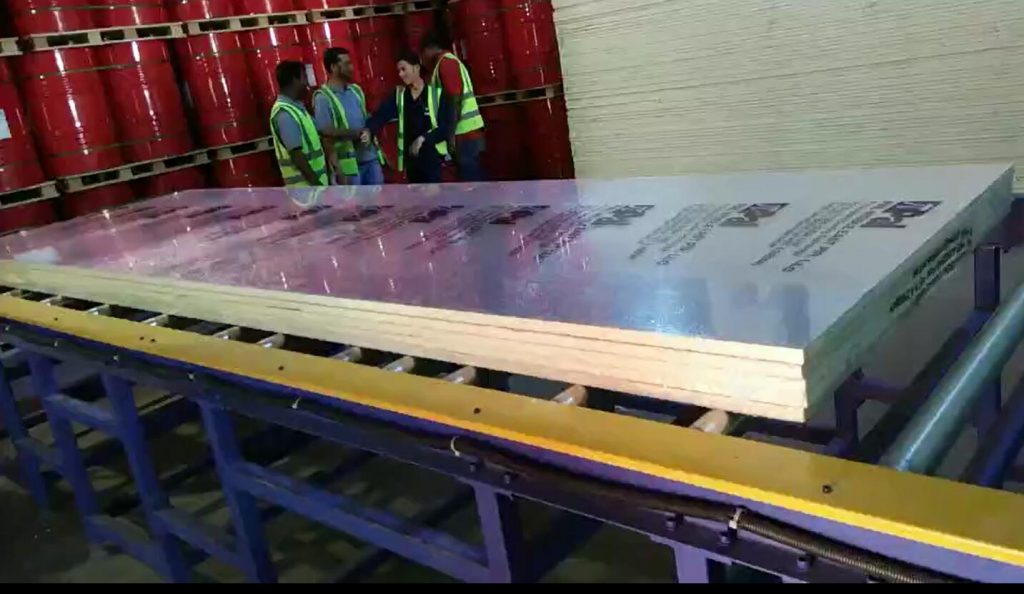
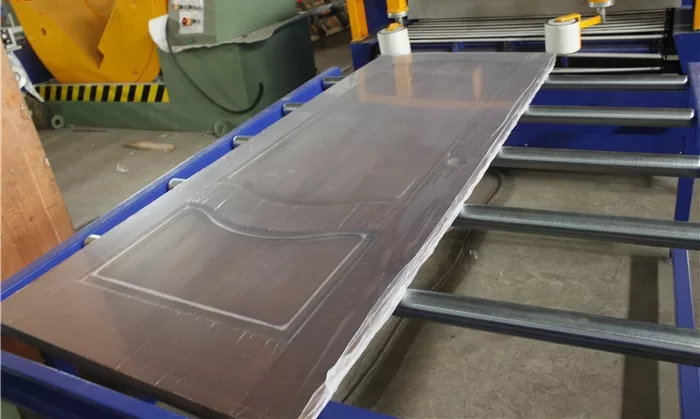
Doors, panels and paper stacks are wide, flat and easy to mark: corners chip, faces scratch and dust settles in storage or transit. A sealed PE film package keeps the face clean and holds loose sheets together.
Sealing by hand is slow, seal quality varies person to person, and wide products need two people. An automatic sealer gives the same package on every piece at line speed.
How the sealing head works
The sealing system is a permanently heated seal bar with an exchangeable blade, not an impulse wire, so there is no cooling wait between cycles. The PLC checks the bar temperature, so the seal is the same from the first piece to the last.
- Photocell detection. A photocell detects the leading edge and fixes the position.
- Film feed. Film is drawn off the roll and around the product as the conveyor carries it into the frame. One centre-folded roll or separate upper and lower rolls is set by product size at quote.
- Seal and cut. The bar comes down, seals the film behind the product and cuts it from the next piece.
- Adjustable height. Sealing height is adjustable, so thin panels and thick stacks run on the same machine.
Anti-cut protection stops the bar if a product is under it. The seal is smokeless and leaves no film residue when the temperature is right.
Film type and film width
The machine runs PE film from rolls — 1,700 mm wide on our door panel sealer, for products up to 1,200–1,300 mm wide. A simple check: film width ≥ product width + product thickness + two seal margins. A wide, thin door needs less margin than a thick stack.
| Product | Film choice |
|---|---|
| Painted or veneered doors | thicker PE, smooth face against the product |
| Paper and board stacks | standard PE, tight seal to hold the sheets |
| Panels for long transport | thicker film, full shrink for a tight package |
Shrink film thickness is 40–100 micron, and 30–150 micron is available.
Adding a shrink tunnel
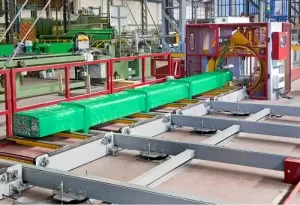
The sealer can work alone, or feed a hot-air shrink tunnel. The PE film shrinks tightly against the panel surfaces, and pressing rollers at the exit press the film flat. Cooling fans cool the package after shrinking. Temperature and conveyor speed are adjustable, and insulation cuts power use. Insulated recirculating heating with rapid post-shrink cooling is proven on motion-sealer door lines [manufacturer rating].
Line speed and output per hour
Time per piece = (product length + gap) ÷ line speed. Film per piece = product length + gap. Take a 2.1 m door with a 0.5 m gap at 8 m/min (example):
| Check | Calculation | Result |
|---|---|---|
| Time per door | (2.1 + 0.5) ÷ 8 × 60 | 19.5 s |
| Doors per hour | 3,600 ÷ 19.5 | about 184 |
| Film per door, per roll | 2.1 + 0.5 | 2.6 m |
| Film per hour, per roll | 184 × 2.6 | about 478 m |
The shrink tunnel usually sets the line speed, because the film needs time in the heat; the sealer alone can run faster.
Typical data
Figures from our door panel sealing and shrinking quotations; your exact data is confirmed at quote.
| Item | Sealing part | Shrinking part |
|---|---|---|
| Product width | max 1,200–1,300 mm | n/a |
| Product length | up to 4,000 mm | n/a |
| Product thickness | 10–200 mm | n/a |
| Product weight | 10–100 kg | n/a |
| Working table height | about 800 mm | n/a |
| Conveyor speed | about 0–12 m/min | about 0–8 m/min |
| Power | about 5.5 kW | about 30 kW |
| Tunnel size | n/a | L 2,500 × W 1,500 × H 300 mm |
| Temperature | PLC controlled seal bar | 100–220 °C |
| Compressed air | 6–8 kgf/cm² (about 0.6–0.8 MPa) | n/a |
Infeed and outfeed conveyors are 2,000 mm long each; air consumption per cycle is confirmed at quote. A narrower line for doors 700–1,100 mm wide and 20–100 mm thick uses a tunnel 1,400 mm wide and 200 mm high.
Selection checklist
- Product width, length and thickness range.
- Product weight and surface finish.
- Pieces per shift.
- Sealing only, or sealing plus shrink tunnel.
- Film type and thickness.
- Manual or automatic infeed from the production line.
Safety
The machine is designed to EN ISO 12100:2010 for risk assessment, EN 415-10 for packaging machine safety and EN 60204-1 for electrical equipment. The seal bar is hot and moves down with force, so a guard covers the sealing head and anti-cut protection stops the bar if a product is under it. Guarding and CE documents are agreed per project.
Engineering FAQ
Q: Can one machine seal doors of different thickness? A: Yes. Sealing height is adjustable, from 10 mm panels to 200 mm stacks.
Q: Do I need the shrink tunnel? A: Sealing alone keeps dust off. Add the tunnel when you need a tight, smooth package for long transport.
Q: How wide must the film be? A: Product width plus thickness plus two seal margins; ours is 1,700 mm film for panels up to 1,200–1,300 mm wide. Thin-gauge PE of 30–45 microns is a door-category reference on motion-type heads [manufacturer rating].
Q: How many doors per hour? A: Use (length + gap) ÷ line speed; a 2.1 m door at 8 m/min gives about 184 an hour.
Q: Can it connect to my production line? A: Yes. Auto and manual feed modes plus photocell detection let it take products straight from the line.
Next step
- Send your product sizes, weights and pieces per shift to info@fhopepack.com.
- We choose sealing only or sealing plus shrink, and the film width.
- We reply within 24 hours with a proposal and quotation.
Related reading
- Automatic door shrinking machine (product)
- Door shrinking machine with motion sealer (product)
- Door/panel sealing and shrinking machine
- Door panel film covering and sealing machine
- Automatic panel sealing and shrinking machine
Sources
- FHOPE quotations: automatic door panel sealing and shrinking machine (FHOPE-1200)
- EN ISO 12100:2010; EN 415-10; EN 60204-1
- Door category reference: Door Shrinking Machine with Motion Sealer (product)
Last reviewed: 2026-10-29