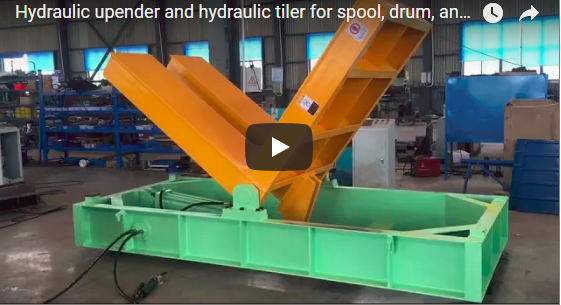
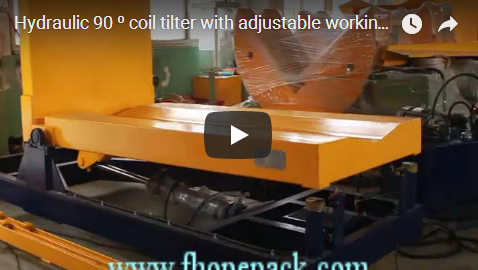
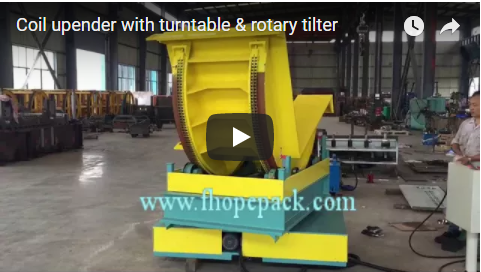
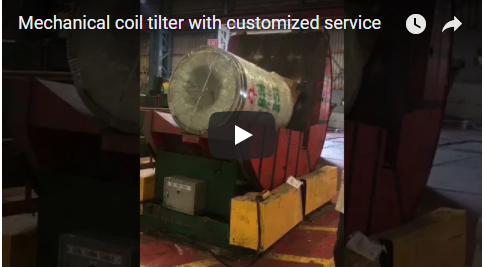
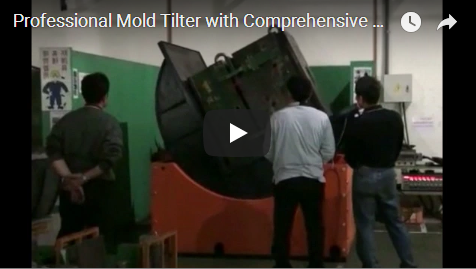
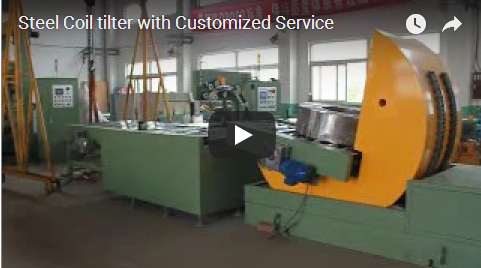
Executive summary This video shows a FHOPE wire spool tilter/upender completing a full tilt cycle: two yellow V-shaped arms close on a workpiece, the whole assembly rotates roughly 90–120° around its base, and the piece ends upright on a platform at the end of one arm — all in about 20 seconds of footage. The clip demonstrates the closing, rotating, and discharge-posture stages clearly, but it does not show rated load, rotation angle limits, cycle time, or safety certifications. Those items should be confirmed with the manufacturer before purchase.
Why a wire spool tilter matters
Wire, cable, hose, and strap are usually wound and stored on spools lying flat. Shipping, stacking, or feeding those spools downstream often requires flipping them 90 degrees — from eye-horizontal to eye-vertical, or the reverse. Done by hand, that flip is slow and risky: spools of wire are heavy, awkward to grip, and prone to unrolling if they are dropped or tilted the wrong way. A dedicated tilter/upender takes the lifting and rotation out of the operator’s hands and replaces them with a controlled, guided motion.
That is exactly the job the machine in this video is built for. The footage is short — roughly 20 seconds — but it covers the complete working sequence of a V-arm tilter, from open arms to final discharge posture. If you are evaluating a tilter for wire spools, cable reels, or similar coils, this page walks through what the video actually shows, what it deliberately does not show, and which questions you should raise with FHOPE before specifying a machine.
The machine in action, step by step
The video follows one complete cycle. Here is the sequence as it appears on screen, with approximate timestamps based on the sampled frames:
| Stage | Time (approx.) | What happens |
|---|---|---|
| 1. Ready position | 0–4 s | The two yellow V-shaped arms are open, forming roughly a 90° angle. The base is a white painted steel structure. No motion. |
| 2. Loading | ~6 s | A small, light-brown rectangular block is placed into the cavity between the arms. |
| 3. Clamping | 6–10 s | Both arms swing inward simultaneously — the right arm toward the lower left, the left arm toward the lower right — and close around the workpiece, holding it in the V-shaped groove. |
| 4. Tilting | 12–16 s | The whole assembly rotates counterclockwise around a pivot at the base. The left arm rises while the right arm lowers; the workpiece stays secured in the V-groove through the rotation. |
| 5. Discharge posture | 18–20 s | The mechanism completes roughly a 90–120° tilt and stops. The left arm points nearly vertically upward and the right arm extends horizontally forward, leaving the workpiece standing upright on the platform at the right arm’s end, ready to be taken away. |
Two things stand out in this sequence. First, the clamping and rotation are combined in one mechanism — the same V-arms that grip the load also carry it through the tilt, so there is no transfer between stations. Second, the motion is smooth and controlled throughout: the workpiece never appears loose or shifting inside the groove between the clamp-close stage and the final posture.
Direct observation notes
The following notes stay close to what is visible in the footage, with only grammar-level edits:
- The machine has a white painted metal base (appearing to be welded steel plate construction) and two bright yellow V-shaped arms made of flat steel plate with bent edges for stiffening — visually heavy industrial steelwork.
- The two symmetric V-arms can rotate relative to each other around the base axis.
- A dual-side roller/support structure at the bottom provides support and load-bearing for the rotation.
- The end of the right arm carries a yellow lifting ring, possibly for hoisting or positioning.
- Black-and-yellow diagonal warning striping is attached to the inner edges of the arms at the central clamping area, marking the pinch zone.
- A control panel with several buttons and indicator lights is visible on a green cabinet in the background (frames around 16–20 s). Its specific layout and functions cannot be identified from the footage; no digital display or touchscreen is visible.
- The demonstration workpiece is a light-brown, rectangular block with a rough surface — roughly 15 × 10 × 8 cm estimated from comparison with the arm width — with no visible markings. It rotates from horizontal, through inclined, to vertical over the course of the cycle.
- No readable text, nameplates, watermarks, or on-screen captions appear anywhere in the footage.
- No conveyor, robot, or other auxiliary handling unit appears; loading and unloading are manual.
What the video shows (with time references)
- Around t≈0–4s the machine is at rest: the yellow V-shaped clamp arms are open (roughly a 90° angle between left and right arm) on a white base, with green equipment and a blue ring shape visible behind.
- Around t≈6–10s the right arm swings down-left as the left arm swings down-right, the arms closing together in the center to clamp a light-brown cuboid block (carton/wood) — a smooth close-and-clamp stage.
- Around t≈12–14s with the arms fully closed the whole assembly rotates counter-clockwise about the base pivot (left arm rising, right arm lowering), entering the tilt/dump phase while the block stays fixed in the V groove.
- Around t≈16–20s the assembly completes the roughly 90–120° tilting action to a near-vertical posture (left arm up, right arm horizontal and reaching forward), with the block resting on the platform at the front of the right arm, ready to unload; the motion then stops.
What the video does not show
The footage proves the mechanism works, but a purchase decision needs more than that. The following items are simply not observable in the clip and must be confirmed with the manufacturer:
- Rated load capacity — the maximum weight the arms can clamp and tilt. The demo object is small and light; a real wire spool may weigh far more.
- Exact rotation angle — the observed tilt is roughly 90–120°. Whether the machine can rotate to a full 180° is not shown.
- Full cycle time — the video is about 20 seconds, but it may be edited or slowed; actual feed-to-discharge cycle time is not established.
- Drive system — motor power, gearbox ratios, or hydraulic parameters are not visible or labeled.
- Machine model name and nameplate — the title “FHOPE Wire Spool Tilter Upender” is the article title, not a plate on the machine; no model identification appears on screen.
- Safety certifications — no CE, ISO, or other certification marks are visible.
- Emergency stop — no independent e-stop button or pull-cord switch is observed in the frames. Whether one exists, and where it is mounted, should be verified.
- Interlocks and guarding — the work area is open, with no physical fence or light curtain. Any electrical interlocking is impossible to confirm visually.
Where this machine fits
Based on the structure shown — V-groove clamping arms, base-pivot rotation, manual load/unload — this type of tilter suits these situations well:
- Flipping spools of wire, cable, hose, or strapping between horizontal and vertical orientation.
- Workshops where spools arrive or ship eye-horizontal but are used eye-vertical (or vice versa).
- Applications where manual flipping is unsafe or inconsistent — heavy spools, awkward center-of-gravity, risk of the coil unrolling.
- Single-piece, small-batch handling rather than continuous high-volume lines, since loading and unloading are manual in the configuration shown.
It is a poor fit — or at least needs configuration review — if you need automatic infeed/outfeed, if your spool diameters vary widely (the V-groove must suit the diameter), or if your loads exceed the machine’s rated capacity, which as noted is not shown in the video.
Safety notes for operators
The machine as shown has an open working area with no guarding beyond the warning striping on the arms. That makes operator discipline essential:
- Never reach into the clamping area while the arms are moving — the closing V-arms are a pinch point, which is exactly what the black-and-yellow striping marks.
- Keep the tilt path clear. The entire assembly rotates; make sure no one stands within the sweep during a cycle.
- Center the load before starting. The V-groove guides the workpiece, but an off-center or undersized piece may not clamp evenly. Confirm your spool’s weight distribution and diameter against the machine’s specification.
- Confirm the e-stop location before first use. Since none is visible in the footage, ask the manufacturer where the emergency stop is mounted and how the machine behaves on power loss (for example, whether the arms hold position or drift).
Questions to ask before buying
Use this checklist when you contact the supplier. Every item below is something the video cannot answer:
- What is the maximum rated load, and what spool diameter range does the V-arm accommodate?
- Can the clamping arms be customized for different spool diameters or center-hole sizes?
- What is the rotation angle range — 90°, 120°, or up to 180°?
- What is the drive type (electric/hydraulic), and what happens on power failure — does the load hold?
- Where are the emergency stop and any interlocks located?
- What safety standards does the machine comply with (e.g., CE marking)?
- What are the lead time, installation, and commissioning arrangements?
FAQ
Is the machine automatic? The cycle shown — clamp, tilt, hold at discharge position — runs by machine power, but loading and unloading are manual in the video. No conveyor or robotic infeed is shown. If you need automatic feeding, confirm available options with the manufacturer.
What can it handle besides the block shown in the demo? The title indicates wire spools, and the V-groove arm design is characteristic of tilters for coils, reels, and spools of wire, cable, hose, and similar products. The demo workpiece in the footage is a small rectangular block, not an actual spool — so the fit for your specific spool size and weight should be verified with FHOPE.
How long does one tilt cycle take? The visible footage spans about 20 seconds from open arms to discharge posture, but the video may be edited. Actual cycle time is not established — check with the manufacturer.
Is there an emergency stop? No e-stop is visible in the sampled frames. This is a safety-critical item: confirm the e-stop location and the machine’s power-loss behavior with the manufacturer before operating.
Frequently overlooked points during evaluation
Beyond the checklist, three details from the footage deserve attention when you compare tilters:
Arm construction. The yellow arms in the video are formed from flat plate with bent, reinforced edges — a detail worth checking on any quote, since arm rigidity determines whether heavy spools are carried stably through the tilt.
Roller/support base. The rotation rides on a bottom roller and support structure rather than a single central pin alone. This spreads the load during rotation and is a meaningful structural difference between serious tilters and light-duty flip tables.
Lifting ring on the arm end. The yellow ring at the end of the right arm suggests the machine can be hoisted or precisely positioned during installation — practical if your floor layout changes or if the unit needs relocating between cells.
Related reading
If you are building or upgrading a coil and cable handling process, these pages cover the neighboring equipment:
- Coil upender — upenders for larger coil turning applications
- Cable packing machine — wrapping and packing for cable coils
- Wire coil wrapping machine — protective wrapping after coiling
- Automatic packing line — integrated lines combining handling, wrapping, and packing
Next step
The video answers the “how does it move” question; your application answers the “will it work for my spools” question. Send FHOPE your spool dimensions, weight, and required orientation change, and ask for a specification sheet that covers the load rating, rotation angle, drive type, and safety features listed above. Start the conversation through the contact page — and if your handling need goes beyond tilting, the related pages above will help you frame the full requirement.
Source and method: this article is based on the product video embedded above. All observations come from a vision-model analysis of frames sampled from the footage; the video contains background music only, with no narration or speech to transcribe. Claims not observable in the video are explicitly flagged for confirmation with the manufacturer.