Executive summary
Coils of steel, aluminum and strip material store and ship lying flat, but many downstream steps need them upright, and turning a heavy coil by hand or by crane and slings is slow and risks the coil edges. This coil upender combines a turntable and a rotary tilter: the turntable spins the coil to reposition it, and the rotary arm tips it between horizontal and vertical in a controlled arc. We build coil upenders with turntable and rotary tilter. Load range and motion are confirmed per project.
Table of Contents
- Why coils need controlled turning
- What the machine does
- Turntable and rotary tilter
- The tilting motion
- What the footage shows
- Typical configuration
- Selection checklist
- Operation and safety
- Engineering FAQ
- Next step
- Related reading
- Sources and standards
Why coils need controlled turning
A steel or aluminum coil lies flat for storage and transport, and stands upright for unwinding and processing. Turning a heavy coil between those positions by hand or with an overhead crane and slings is slow, and a swinging load risks the crew and the coil edges. An upender makes the change mechanically.
The machine rotates the load in a controlled arc with the coil resting on shaped surfaces rather than hanging from straps. That controlled motion is what keeps the coil edge and the crew safe. Load range and its turning are confirmed per project.
What the machine does
The machine couples two functions: a turntable base that spins the coil to reposition it, and a rotary tilter whose arc-shaped arm tips the load between horizontal and vertical. Working together, the machine can spin a coil and tilt it, serving several stations along a coil packing or processing line.
The operator runs the cycle from a panel while the arm and turntable move the load under power. Motion sequence and handling range are confirmed per project.
Turntable and rotary tilter
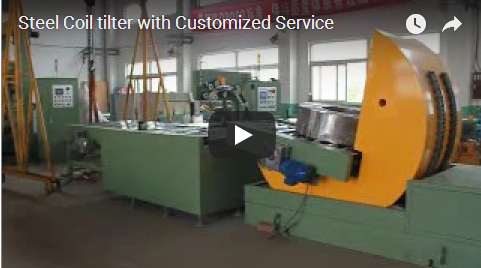
The turntable is a rotating base that turns the coil in place, and the rotary tilter is the large arc-shaped arm that carries the load through the angle change. Combining the two means one machine repositions and orients a coil instead of two separate stations.
On the line, the turntable takes over where a coil must be turned for presentation, and the tilt takes over where the coil must stand upright. The combined motion keeps handling in one control loop. Motion set is confirmed per project.
The tilting motion
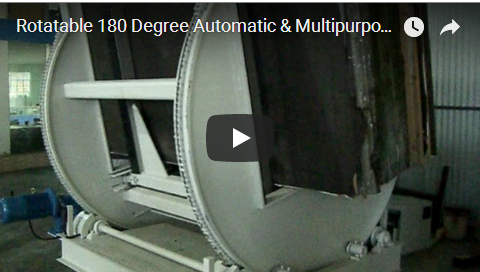
The demonstration runs the tilting motion through its travel. The arc-shaped arm starts open and low, rotates steadily to the tilted position, and returns to horizontal without stops or jerks. The turntable completes the repositioning that goes with the tilt.
The smooth, continuous travel is the point of the demonstration: the load swings under control from one orientation to the other. Turntable spin and tilt angle are confirmed per project.
What the footage shows
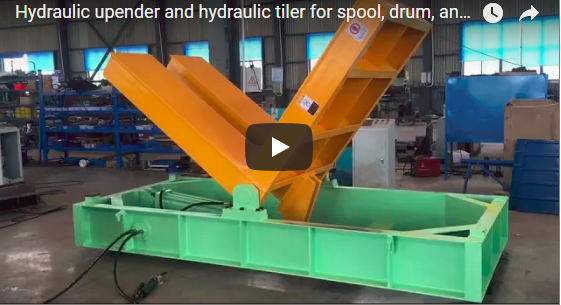
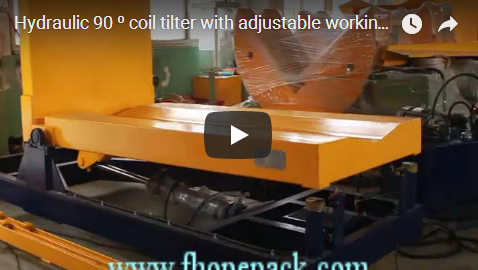
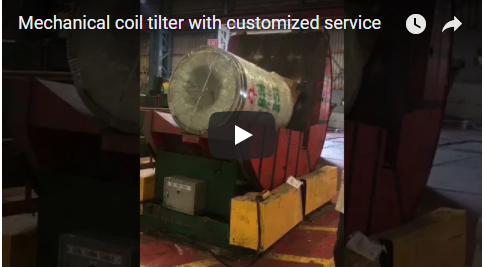
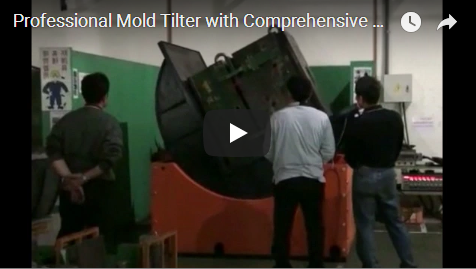
Our footage shows a coil upender running a full rotation cycle with its turntable and rotary tilter. It is a general demonstration, so your load range and motion needs are confirmed with us per project.
Typical configuration
Figures below list functional design boundaries rather than numeric values, and are confirmed per project.
| Parameter | Typical range, confirmed per project |
|---|---|
| Load | steel, aluminum, strip coils |
| Turntable | rotating base |
| Tilter | arc arm, angle change |
| Motion | spin and tilt |
| Operation | panel driven |
| Electrical supply | 380 V three phase 50 Hz, or 220 V single phase for light machines, selected per project |
Selection checklist
| Question | Confirm per project |
|---|---|
| Load range | coil widths, weights |
| Turntable | diameter, spin range |
| Tilter | tilt angle, holding |
| Motion | sequence, cycle |
| Control | PLC and HMI options |
| Electrical supply | voltage, phase and frequency on site |
Operation and safety
Run the sequence from the panel and the machine spins and tilts the load under power. Keep clear of the turntable, tilting arm and load path while the machine runs, with guarding and emergency stops at the operator position. The load rests on shaped surfaces through the motion.
Routine checks cover the turntable drive, tilt arm, holding surfaces, sensors and control, per the machine manual. Confirm the motion sequence against the load before each run so coils turn without damage.
Engineering FAQ
Q: What does this machine do? A: It spins a coil on a turntable and tilts it between horizontal and vertical with a rotary tilter.
Q: Why not crane flip? A: A swinging load risks the crew and the coil edges; the machine moves the load under control.
Q: What are the two functions? A: A turntable for rotation and a rotary tilter for the angle change.
Q: Does the operator touch the load? A: No, the motion runs from the panel while the load rests on the machine.
Q: What does the footage prove? A: A smooth full rotation and tilt cycle on the turntable and rotary tilter.
Next step
- Email us at info@fhopepack.com with your coil range and motion needs.
- We send an upender proposal and a layout drawing within 48 hours.
- We arrange a site survey to confirm load range and motion requirements.
Related reading
- Steel coil upender vertical packing machine
- Hydraulic tilter and hydraulic upender
- Coil upender equipment overview
- FHOPE packing machinery product lines
Sources and standards
- ISO 12100:2010 Safety of machinery, general principles for design and risk assessment
- EN 415-10:2014 Safety of packaging machines, general requirements
- EN ISO 13849-1:2023 Safety of machinery, safety-related parts of control systems
FHOPE coil upender with turntable and rotary tilter demonstration video. Reviewed as a general demonstration; load range and motion confirmed per project.
Last reviewed: 2026-10-11