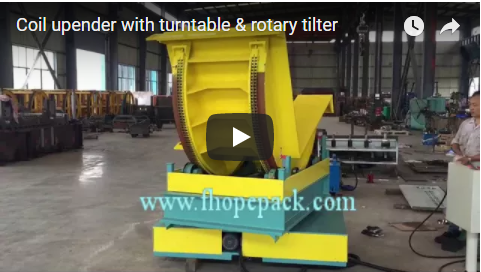
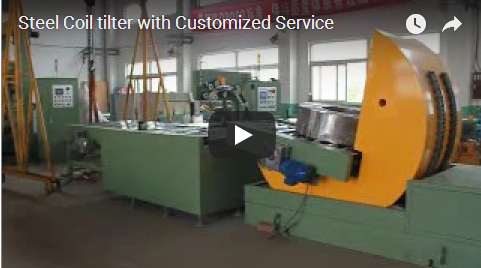
Executive summary This test run in our workshop shows our rotating coil upender with no load. An orange L-shaped table with a V cradle tilts through 90°, and the whole table turns on its base, so a coil can be loaded from one side and leave from another. Our rotating models FPCT-05, FPCT-10 and FPCT-40 cover loads from 2,000 kg to 40 t with a turn time of 60–90 s. Below we explain the two motions, the data and a worked example for coils per hour.
Table of Contents
- What the clip shows
- Why add a rotary base
- Rotating coil upender data
- Coils per hour
- Selection checklist
- Safety
- Engineering FAQ
- Next step
- Related reading
- Sources
What the clip shows
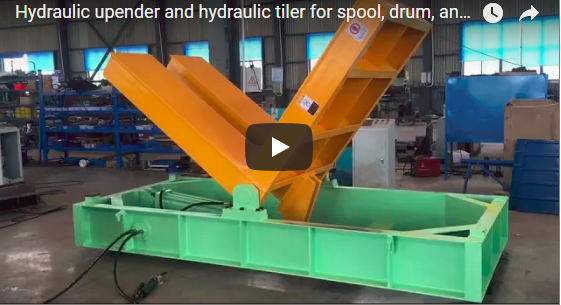
The clip is a test run in our workshop, with the machine unloaded.
| Step | What you see |
|---|---|
| Start | An orange L-shaped table with a V-shaped cradle sits on a dark grey base frame |
| Tilt | The table tilts through 90°, so the V cradle and the flat table swap between horizontal and vertical |
| Rotate | The table turns on the base, so the open side of the cradle faces a new direction |
| Repeat | The tilt and turn are run again to show both motions together |
The two motions are separate: the tilt changes the coil eye from horizontal to vertical, and the turn changes which side the coil is loaded or taken from.
Why add a rotary base
- Loading from one side, unloading from another. A crane or forklift can load the coil from the aisle, and the base turns so the coil leaves towards the next machine.
- Tight bays. The machine turns the coil instead of the forklift turning round it, which helps where there is little space.
- Eye-to-sky or eye-to-side. The 90° tilt sets the coil for a decoiler or for vertical storage, and the turn sets its direction.
- Stop at any angle. Position locking lets the table hold at any angle during the tilt.
Rotating coil upender data
Our published data for the rotating coil upender:
| Item | Published value |
|---|---|
| Models | FPCT-05, FPCT-10, FPCT-40 |
| Max load | 2,000 kg to 40 t |
| Upending angle | 90° |
| Base rotation | Base frame with rotating table for 180°; base function listed as 360° turning for the flipping table |
| Table | Flat table L1,500 × W1,500 mm; V table L1,500 × W1,500 mm (customised) |
| Main turn time | 60–90 s per piece |
| Drive | Worm speed reducer, inverter soft start and stop |
| Safety | Electric and mechanical displacement limits; position locking at any angle |
| Power | About 4.0 / 5.0 / 15 kW, 380 V 50 Hz 3-phase |
For a standard tilt-only upender, our FPCT range covers 2–50 t with cycle times of 50–100 s and a 2-year warranty.
Coils per hour
Worked example (illustrative). At a turn time of 90 s, one machine completes 3,600 ÷ 90 = 40 turns per hour. If each coil needs one tilt and one return, that is about 20 coils per hour, before crane or forklift time is added.
Selection checklist
- Coil weight, OD, ID and width.
- Tilt direction and whether you need the rotary base.
- Loading and unloading directions in your bay.
- Flat table, V table or both.
- Coils per hour.
- Floor condition, since the base has levelling adjustment for uneven floors.
Safety
The table tilts a heavy coil and the base turns it, so the swept area must be kept clear. We fit electric and mechanical travel limits, position locking and a separate control panel, and guard the zone to the risk assessment. For CE markets we apply ISO 12100:2010 and EN 415-10:2014.
Engineering FAQ
Q: What does the rotary base add to a coil upender? A: It turns the table so the coil can be loaded from one side and taken off from another.
Q: How far does the table tilt? A: 90°, between eye-horizontal and eye-vertical.
Q: What loads can it take? A: Our rotating models cover 2,000 kg to 40 t.
Q: How long does one turn take? A: About 60–90 s per piece.
Q: Can it stop part way? A: Yes. Position locking lets the table stop at any angle.
Q: What table sizes are standard? A: Flat and V tables of L1,500 × W1,500 mm, customised to the coil.
Q: How many coils per hour? A: About 20 coils per hour at 90 s per motion with one tilt and one return.
Q: Which standards apply? A: For CE markets, ISO 12100 and EN 415-10.
Next step
We size a coil upender with rotary base in three steps:
- Submit your layout drawing with coil weight and sizes, loading and unloading directions and coils per hour, to info@fhopepack.com.
- Receive a proposal within 48 hours with the machine data and layout.
- Book a site survey so we confirm the floor, crane and forklift access.
Related reading
- Hydraulic Coil Tilter for 90° Turning
- Coil Upender with Transfer Trolley
- Rail-Mounted Coil Transfer Car with 360° Cradle
- Rotating coil upender data
Sources
- Clip (our test run): the video on YouTube
- Models, load, angle, base, tables, turn time, drive, safety and power: Rotating coil upender data
- FPCT range and warranty: Coil upender range
- Coils per hour: our worked arithmetic
- Standards scope: ISO 12100:2010; EN 415-10:2014
- Proposal timing: approved house CTA (proposal within 48 hours)
Last reviewed: 2026-10-10