Executive summary
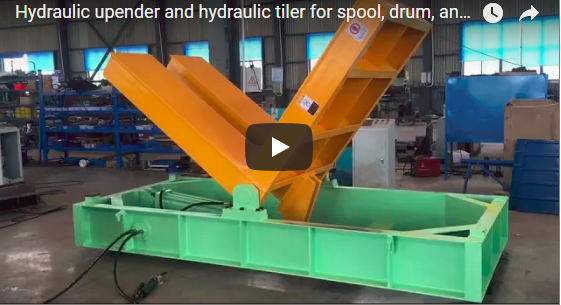
A hydraulic 90° coil tilter, also called a hydraulic coil upender, turns a coil between eye-horizontal and eye-vertical on hydraulic cylinders. The adjustable working table lets one machine take a range of coil sizes instead of one fixed size. Our hydraulic FPCT range runs from 2 t to 50 t, with tilt times of 50–100 s depending on model. Table size is set to your coil range and confirmed at quote.
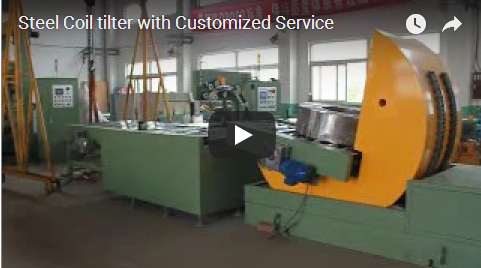
Plants that run several coil widths and diameters need a tilter that adapts. The adjustable working table is what makes that possible. On this design the table is an L-shaped steel frame with a backstop plate: the coil rests on the backstop while upright, then lies on the table face once the turn is complete. The hydraulic power unit sits beside the base, away from the pivot.
Table of Contents
- Why hydraulic for coil tilting
- What the adjustable working table does
- Hydraulic coil tilter models
- Choosing a model: worked example
- Selection checklist
- Safety: EN 415-10 and ISO 12100
- Engineering FAQ
- Next step
- Related reading
- Sources
Why hydraulic for coil tilting
Hydraulic cylinders give a smooth, even turn and a soft stop, which matters with a heavy coil whose mass shifts over the pivot. Hydraulics also carry high loads in a compact frame, so the range reaches 50 t.
Tilt speed and system pressure are adjustable on the hydraulic unit, so a light coil and a heavy coil can each turn at a safe rate. The working pressure for your coil range is confirmed at quote.
What the adjustable working table does
A fixed table fits one coil size well and others badly. An adjustable table is set to the coil, so the coil sits centred on the pivot.
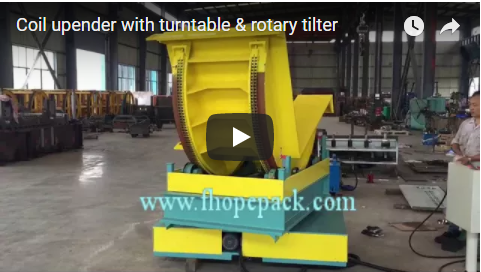
A centred coil keeps its centre of gravity close to the pivot line, so it turns evenly and puts less eccentric load on the pivot bearings and cylinders. How the table is set (fixed stops, spacers or a powered adjustment) is matched to how often your coil size changes and confirmed at quote. The table can also form part of a conveying system, so coils run in and out of a packing line.
Hydraulic coil tilter models
| Model | Capacity | Power | Tilt time |
|---|---|---|---|
| FPCT-02 | 2 t | 1.5 kW | 50–70 s |
| FPCT-05 | 5 t | 1.5 kW | 50–80 s |
| FPCT-10 | 10 t | 3.2 kW | 60–90 s |
| FPCT-20 | 20 t | 4.5 kW | 60–90 s |
| FPCT-30 | 30 t | 6.5 kW | 60–90 s |
| FPCT-50 | 50 t | 11.5 kW | 60–100 s |
Machine weight, table size and hydraulic unit size are confirmed at quote for your coil range.
Choosing a model: worked example
Pick the smallest model whose capacity covers your heaviest coil. If your heaviest coil is between two models, step up.
For example, a plant whose heaviest coil is between 10 t and 20 t chooses FPCT-20. The adjustable table then covers the lighter, smaller coils in the same range. Across the range tilt times run 50–100 s. Plan the total cycle as loading time, plus tilt time, plus unloading time, plus the return tilt. For example, with the FPCT-20 at 60–90 s per tilt, two tilts alone take 2–3 minutes before loading and unloading are added.
Selection checklist
- Heaviest and lightest coil weight.
- Coil OD, ID and width range.
- Direction of turn: to vertical, to horizontal or both.
- Loading method: crane, forklift or conveyor.
- Cycles per hour.
- Line connections and floor space.
Safety: EN 415-10 and ISO 12100
When integrated into packing lines, tilters follow EN 415-10, with the risk assessment done to ISO 12100. Displacement restrictors limit the turn, a positioning lock holds the table, and the E-stop is on the panel. Guarding is set for each layout. The machines are CE marked and built under ISO 9001.
Engineering FAQ
Q: Can one tilter handle different coil sizes? A: Yes. That is the job of the adjustable working table.
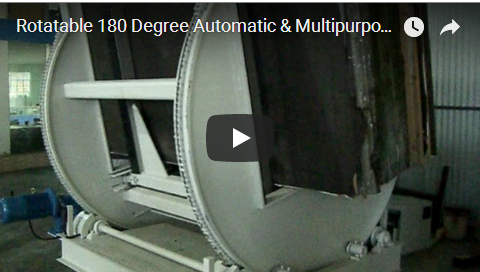
Q: Can it turn 180°? A: Yes, on a turnover version; this model turns 90°.
Q: What maintenance does the hydraulic unit need? A: Check the oil level and look for leaks at hoses, fittings and cylinder seals as part of routine checks, and keep the oil and filter clean. The service intervals for oil and filter changes are given in the machine manual.
Q: What warranty applies? A: Two years.
Next step
- Send your coil weight and size range to info@fhopepack.com.
- We match the model and set the table.
- We reply within 24 hours with a proposal and quotation.
Related reading
- Hydraulic coil upender (product)
- Custom engineered upenders and tilt tables (product)
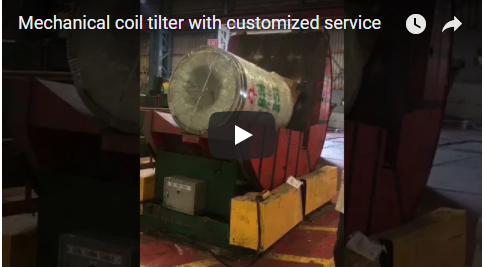
- Mechanical coil tilter with customized service
- Multipurpose automatic coil tilter with slide table
Sources
- FHOPE product pages: hydraulic coil upender; custom engineered upenders
- Our hydraulic coil tilter shown above
Last reviewed: 2026-10-19