Executive summary Doors and panels are packed in shrink film so the faces stay clean and the edges protected from the factory to the building site. Our door and panel shrink packaging machine draws film from rolls over the door on the conveyor, seals it with a lowering frame, and passes it on to shrink. Film width follows from the door width and thickness. Both are set per project.
Table of Contents
- What the video shows
- How the door shrink packaging machine works
- Film width for doors and panels
- Doors and panels on one machine
- Controls and safety
- Selection checklist for a door and panel shrink packaging machine
- Engineering FAQ
- Next step
- Related reading
- Sources
What the video shows
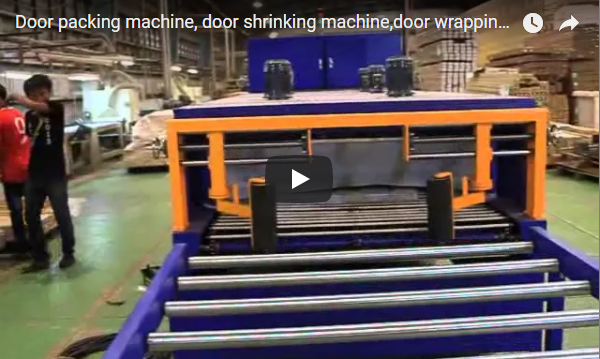
A wooden door is fed onto the conveyor of our blue and yellow machine, and the camera follows the long machine body. The upper frame comes down while film from the rolls is drawn over the door.
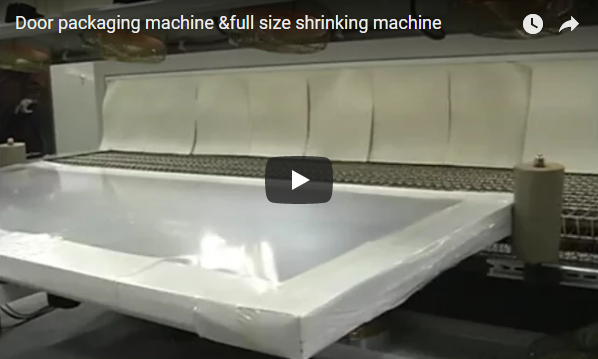
The frame lifts, the door moves forward partly covered, and the frame comes down again to pull the film tight and close it. The door then leaves fully covered in clear film.
How the door shrink packaging machine works
| Step | What happens |
|---|---|
| Feed | The door runs onto the conveyor |
| Cover | Film from the rolls is drawn over the door |
| Seal | The upper frame lowers and seals the film |
| Index | The frame lifts and the door moves on for the next seal |
| Shrink | The covered door passes on to shrink tight |
The frame works in steps along the door, so long doors are sealed in more than one stroke.
Film width for doors and panels
The film must reach across the face and down both edges, with enough left to seal. Illustrative example for a 900 mm wide, 40 mm thick door:
| Item | Value |
|---|---|
| Door width | 900 mm |
| Both edges, 2 × 40 | 80 mm |
| Seal allowance each side (illustrative) | 50 mm |
| Film width, 900 + 80 + 2 × 50 | 1,080 mm |
Thicker doors and panels need wider film for the same face width. We set the film width from your largest door.
Doors and panels on one machine
| Product | What to tell us |
|---|---|
| Solid doors | Width, length, thickness and weight |
| Glazed doors | Whether the glass needs extra protection |
| Flat panels | Width, length and thickness |
| Mixed sizes | The largest and smallest, so film and frame suit both |
One machine can pack doors and panels when its frame and film suit the full size range. For long profiles and panels, see our profile and panel bagging and shrinking line. For a deeper look at tunnel length and doors per hour, see our door shrink wrap machine article below.
Controls and safety
The sealing frame comes down with heat and force. Keep hands off the conveyor under the frame while it runs, and clear jams only with the machine stopped.
The standards that apply depend on the destination market. For CE markets, ISO 12100 sets the risk-assessment method and EN 415-10 sets general requirements for packaging machines.
Selection checklist for a door and panel shrink packaging machine
- Door and panel width, length and thickness, smallest to largest.
- Heaviest piece.
- Pieces per hour.
- Film type and thickness.
- Hand or automatic feeding.
- Floor space and power supply.
Engineering FAQ
Q: What film width does a door need? A: Door width plus both edges plus seal allowance. Our 900 mm wide, 40 mm thick door needs about 1,080 mm.
Q: Can it pack panels as well as doors? A: Yes, when the frame and film suit the full size range.
Q: What sizes do you need for solid doors? A: Width, length, thickness and weight.
Q: Why does the frame seal in steps? A: It seals along the door stroke by stroke, so long doors are covered in more than one stroke.
Q: Does a thicker door need wider film? A: Yes. Each extra millimetre of thickness adds two millimetres of film width.
Q: What happens after sealing? A: The covered door passes on to shrink tight.
Next step
We plan your door packaging machine in three steps:
- Submit your layout drawing with door and panel sizes and output to info@fhopepack.com.
- Receive a proposal within 48 hours, with the film and frame plan.
- Book a site survey to check the line layout and floor space.
Related reading
- Door shrink wrap machine
- Video: door and wooden board shrink wrapping machine
- Video: door wrapping machine with a horizontal orbital wrapper
Sources
- Machine content: FHOPE engineering team, 2026-10-04
- Film width example: our worked example, illustrative values
- Machine in action: our video on YouTube
- Standards scope: ISO 12100:2010, EN 415-10:2014
Last reviewed: 2026-10-04