Executive summary
A horizontal wrapping machine for doors and panels moves each door flat along a conveyor through a turning ring. The ring carries a stretch film roll around the door, so film spirals along its whole length and covers faces and edges in one pass. We build two ranges: a panel wrapper for doors and boards up to 3,000 mm long, and a larger furniture wrapper. This page explains how ring speed, overlap and conveyor speed fit together, and how to work out cycle time and film use per door.
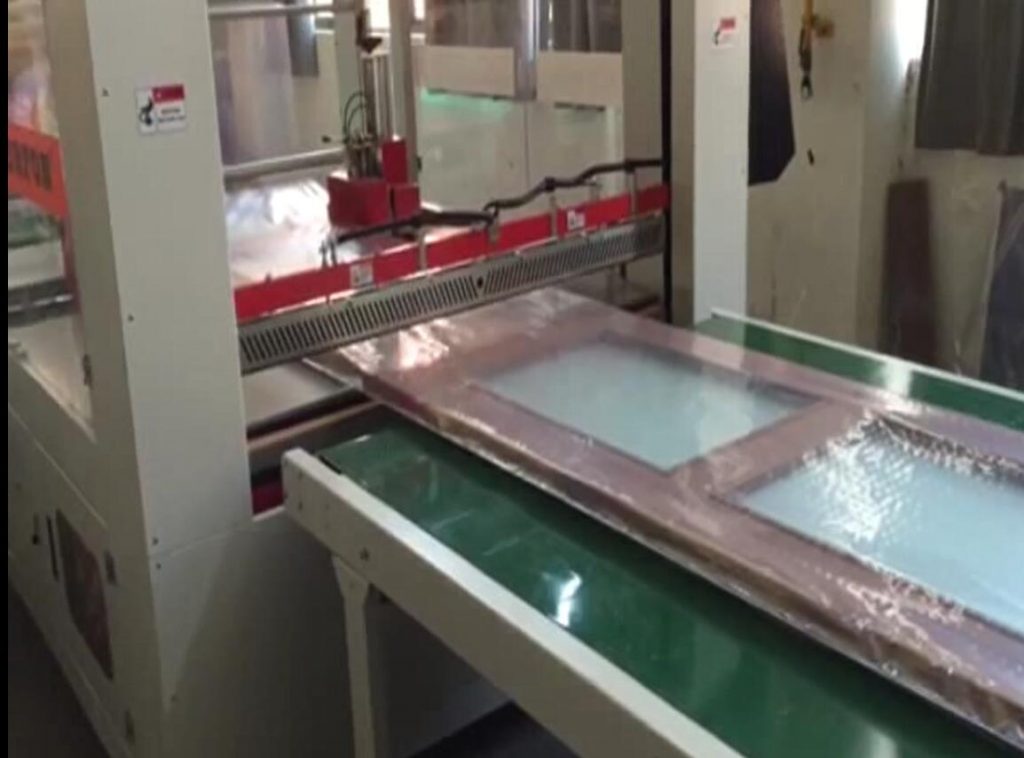
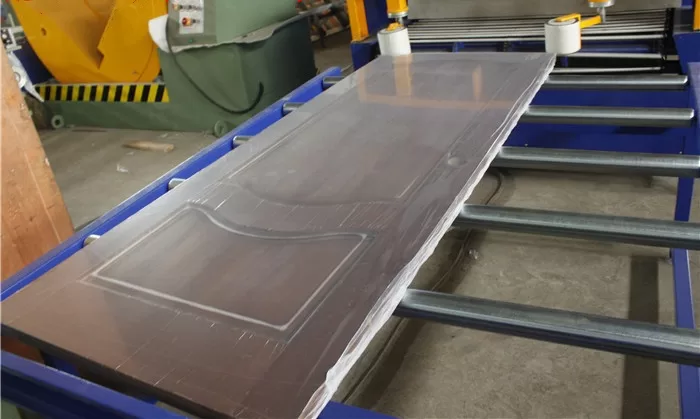
A large flat door panel rides in on a green belt conveyor and passes through a silver orbital ring. The film roll on the ring turns around the panel while the conveyor carries it forward, then the wrapped panel runs out on the far side. Wire mesh guarding closes off the ring area.
Table of Contents
- Why wrap doors horizontally
- How the wrapping cycle works
- Two model ranges
- Ring speed, overlap and conveyor speed
- Cycle time and film per door
- Protecting edges and glass
- Selection checklist
- Safety
- Engineering FAQ
- Next step
- Related reading
- Sources
Why wrap doors horizontally
Doors and panels are long, flat and easy to scratch. Lying flat on a conveyor, they do not need to be stood up or turned, and the ring wraps them from end to end without anyone handling the film. Compared with a shrink line, a horizontal stretch wrapper needs no heat tunnel.
How the wrapping cycle works
- Infeed: the door is placed flat on the infeed conveyor.
- Start: a sensor sees the leading edge and the film end is held.
- Wrap: the ring turns and the conveyor moves the door through it, so the film spirals along the door.
- End: extra reinforcing turns can be set at the leading and trailing ends; then the film is cut and the tail pressed down. The number of end turns is set in the program.
- Outfeed: the wrapped door runs out for stacking.
Both ranges run in manual or automatic mode.
Two model ranges
| Item | Panel wrapping machine | Furniture wrapping machine |
|---|---|---|
| Product length | 2,000–3,000 mm | over 1,500 mm |
| Product width | 1,000–1,500 mm | 800–1,800 mm |
| Product height | 300–1,400 mm | 800–1,800 mm |
| Weight | confirmed at quote | 20–200 kg |
| Ring speed | 20–50 r/min | 10–60 r/min |
| Conveyor speed | confirmed at quote | 4–12 m/min |
| Film | 300–500 mm wide, OD 100–180 mm, ID 76 mm | 200–300 mm wide, OD 100–250 mm, ID 50 mm |
| Overlap | 20–90 % adjustable | by ring and conveyor speed |
| Power | about 10.5 kW, 380 V 3PH 50 Hz | about 3.5 kW, 380 V 60 Hz 3 phase |
The furniture wrapper has a ring ID over 1,400 mm and a footprint of about 6,300 × 2,500 × 2,500 mm. A stack of doors can go through as one pack if it fits the product height.
Ring speed, overlap and conveyor speed
Advance per ring turn = film width × (1 − overlap). Conveyor speed = advance per turn × ring speed. With 400 mm film at 50 % overlap, each turn advances 200 mm. At 40 r/min that is 0.2 × 40 = 8 m/min on the conveyor (example only). More overlap means more film layers and better protection, but a slower conveyor.
Cycle time and film per door
The panel wrapper’s minimum product height is 300 mm, so single thin doors are wrapped as stacks. For a stack of six 2,100 × 1,000 × 50 mm doors, 300 mm high, with the settings above (example only):
| Check | Calculation | Result |
|---|---|---|
| Wrap time per stack | 2.1 ÷ 8 × 60 | about 16 s |
| Ring turns | 2.1 ÷ 0.2 | about 11 |
| Stack perimeter | 2 × (1.0 + 0.3) | 2.6 m |
| Film laid per stack | 11 × 2.6 | about 29 m |
| Film per door | 29 ÷ 6 | about 4.8 m |
Add loading and unloading to the wrap time to get doors per hour. Pre-stretch on the film carriage reduces the film taken from the roll.
Protecting edges and glass
- Put corner or edge protectors on before the door enters the ring.
- Set film tension low for glazed doors so the film does not press on glass edges.
- Use higher overlap where the door ships without a carton.
Selection checklist
- What are your largest and smallest door sizes?
- Single doors or stacks?
- How many doors per hour?
- Which film width and protection level?
- Do you need edge protectors or paper added in line?
- Which power supply do you have?
Safety
The machine is designed to EN ISO 12100:2010 for risk assessment, EN 415-10 for packaging machine safety and EN 60204-1 for electrical equipment. The turning ring is the main hazard, so it runs inside mesh guarding with interlocked access.
Engineering FAQ
Q: How long a door can it wrap? A: The panel wrapper takes 2,000–3,000 mm; longer products go on the furniture range, sized per project.
Q: How do I set the overlap? A: Ring speed and conveyor speed set it; the panel wrapper adjusts 20–90 %.
Q: How much film per door? A: Ring turns × product perimeter. About 29 m for the example stack above, or about 4.8 m per door.
Q: Can it wrap glass doors? A: Yes, with edge protectors and low film tension.
Next step
- Send your door sizes, weights and doors per hour to info@fhopepack.com.
- We size the ring, conveyors and film.
- We reply within 24 hours with a proposal and quotation.
Related reading
- Panel wrapping machine (product)
- Furniture wrapping machine (product)
- Door and panel shrink packaging machine
Sources
- FHOPE product pages: panel wrapping machine; furniture wrapping machine
- EN ISO 12100:2010; EN 415-10; EN 60204-1
- The door panel wrapping line shown above
Last reviewed: 2026-10-19