Executive summary
Doors and furniture panels leave the factory finished, and every scuff in the warehouse is a claim. Our shrink packaging machine for doors and panels wraps each piece in film, seals it on three sides and passes it through a shrink tunnel. The film pulls tight onto the surface, and the sealed pack keeps out dust and damp.
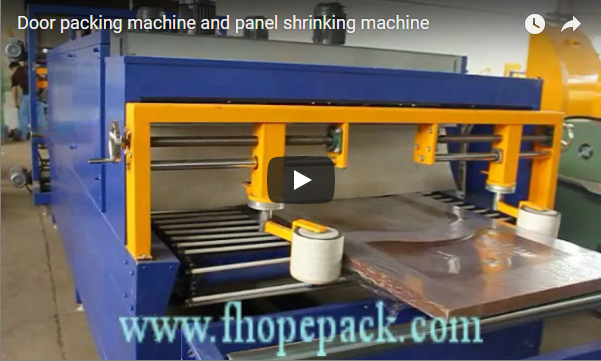
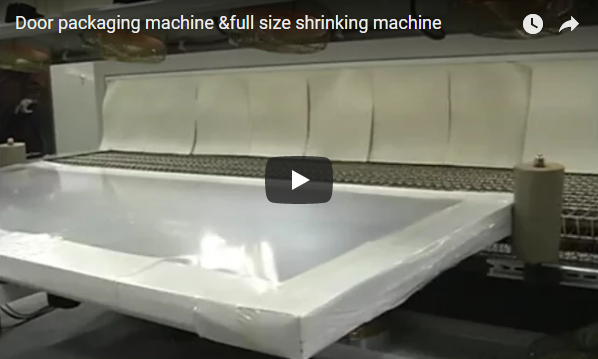
A white door panel transfers on a green in-feed belt into the blue sealing frame, where handwheel-driven guides set the film width to the product. The geared motor and the control buttons sit on top of the sealer. After sealing, the panel rides a long roller conveyor with vertical side rollers into the shrink tunnel, whose fans and heaters are mounted on its roof.
Table of Contents
- Why shrink film for doors
- Machine sequence
- Machine data
- Film choice and film use
- Line speed
- Selection checklist
- Safety
- Engineering FAQ
- Next step
- Related reading
- Sources
Why shrink film for doors
Stretch film around a door leaves the edges loose and the faces wrinkled. Shrink film is sealed all round and then heated, so it closes tight on the faces and edges. Horizontal stretch wrapping works well but needs edge protection on finished doors. Shrinking encloses the door on all sides, and against horizontal stretch it is faster, uses less material and has less size restriction on the product.
Machine sequence
- The door is placed on the in-feed belt.
- Center-folded film opens around the door as it moves forward; the fold closes one long side.
- The motion sealer seals the open long side and the front and back ends, three sides automatically.
- Sensors control where each seal is made, so doors of different lengths need no change.
- The sealed door enters the shrink tunnel on the roller conveyor.
- Hot air shrinks the film tight and the door leaves on the out-feed to cool.
Machine data
| Item | Automatic door shrinking machine |
|---|---|
| Door length | 1,000–4,000 mm |
| Door width | up to 1,200 mm |
| Table height | about 800 mm |
| Speed | 4–9 m/min |
| Film | PE, PVC or POF, 80–150 μm (up to 200 μm) |
| Sealing | three sides automatic, motion sealer with heat sealing knives on both sides |
| Control | PLC and HMI, sensor-controlled sealing |
On one quoted door panel sealing and shrinking line, the sealer took doors up to 1,200–1,300 mm wide, 4,000 mm long, 10–200 mm thick and 10–100 kg. Its hot-air recirculating shrink tunnel measured L 2,500 × W 1,500 × H 300 mm, drew about 30 kW and ran its conveyor at 0–8 m/min. The tunnel is insulated to keep heat inside. Limits for your line are confirmed at quote.
Sealing knife: a permanently heated seal bar with an easy-exchange sealing blade. The PLC controls and monitors its temperature, and the seal is smokeless with no film residue.
Film choice and film use
POF gives a clear, glossy pack. PE is tougher and suits heavy doors and stacked panels. The 80–150 μm range covers most single doors, and thicker film up to 200 μm suits large or stacked goods.
Film per door ≈ (door length + seal gap) × (2 × door width + 2 × door thickness + allowance)
Example only: a 2,100 × 900 × 40 mm door with a 400 mm seal gap and 200 mm allowance uses about 2.5 m × (1.8 + 0.08 + 0.2) m ≈ 5.2 m² of film.
Line speed
Doors per hour = speed × 60 ÷ (door length + gap)
Example only: at 6 m/min with 2.1 m doors and a 0.4 m gap the line packs 6 × 60 ÷ 2.5 = 144 doors per hour. Longer panels lower the count, so the speed is set from your longest regular product.
Selection checklist
- Door or panel length, width and thickness.
- Single pieces or stacks.
- Doors per hour.
- Film type: POF, PE or PVC.
- Floor space for sealer and tunnel.
- Labelling or edge protection before sealing.
Safety
We design to EN ISO 12100:2010 for risk assessment, EN 415-10 for packaging machine safety and EN 60204-1 for the electrical equipment. The motion sealer has guard plates around the heat sealing knives, and the tunnel is insulated to keep heat inside. Hot surfaces are assessed in the risk assessment under EN ISO 12100.
Engineering FAQ
Q: Can it pack stacked panels as well as single doors? A: Yes. For stacks and large goods, thicker film up to 200 μm is used.
Q: Do I need to adjust the machine for every door length? A: No, sensors set the seal positions for each length between 1,000 and 4,000 mm.
Q: Why seal three sides automatically? A: Hand-sealed ends leave gaps. Automatic three-side sealing gives the same tight seam on every door.
Next step
- Send your door sizes, film type and doors per hour to info@fhopepack.com.
- We set the sealer width, tunnel and line layout.
- We reply within 24 hours with a proposal and quotation.
Related reading
- Automatic door shrinking machine (product)
- Door shrinking machine with motion sealer (product)
- Door panel sealing and shrinking machine
- Automatic door 3 sides sealing and shrinking machine
Sources
- FHOPE product pages: automatic door shrinking machine, door shrinking machine with motion sealer
- EN ISO 12100:2010; EN 415-10; EN 60204-1
Last reviewed: 2026-10-20