Executive summary Our horizontal steel wire coiler takes wire from the line, measures it to the centimetre, winds it into a regular coil on a servo-driven coiling head, cuts it at the set length and straps it. A servo holder carries the coil to the strapping station, which ties 2–4 PP straps through the coil eye. The whole cycle runs from one touch screen, so coil length and coil size are settings, not operator judgement.
Table of Contents
- How the coiler works
- Setting coil length for a target weight
- How the PP straps hold the coil
- Strapping data
- Changing coil size while running
- Controls and safety
- Selection checklist
- Engineering FAQ
- Next step
- Related reading
- Sources
How the coiler works
The machine has four working units, controlled by a PLC and servo system:
| Unit | What it does |
|---|---|
| Meter counter | Measures wire length to the centimetre and signals the cutter and the coiling head |
| Coiling head | Moves up and down to take the wire end, then winds a regular coil under servo control |
| Holder | Clamps the finished coil and carries it to the strapping station on a servo drive |
| Automatic cutter | Cuts the wire when the coil reaches the set length |
The counter wheels are aluminium alloy. The upper wheel has a hardened ceramic coating, and the lower wheel has a rubber cover so it cannot mark the wire. A one-way bearing stops the wire running backwards. The cutter blade is special alloy steel, vacuum heat treated for hardness and long life.
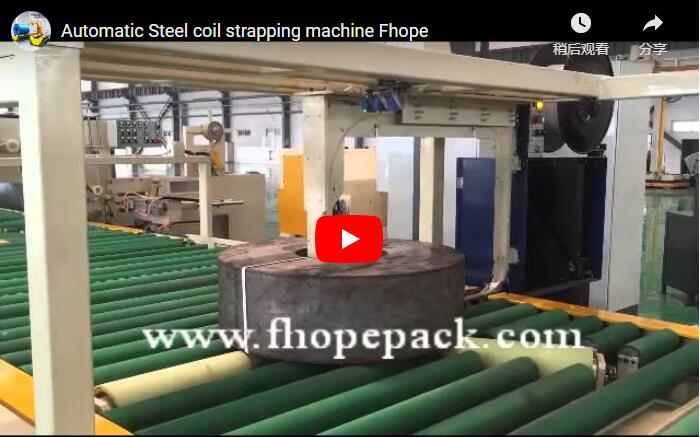
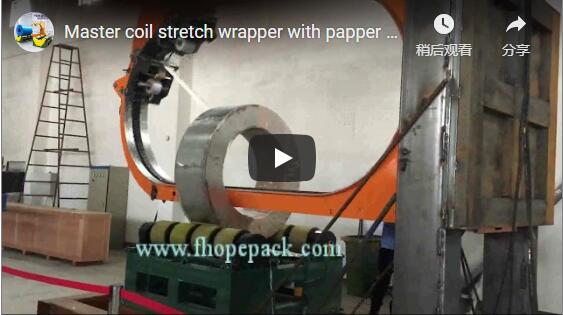
The servo-driven coiling head lays the turns in even, tight layers, as the coil in our video builds up until the cutter ends it. That regular lay is what lets the coil be strapped tightly without loose turns springing out.
Setting coil length for a target weight
Customers usually order wire coils by weight, but the machine cuts by length. Convert one to the other with the wire’s cross-section and the density of steel, about 7.85 g/cm³.
Illustrative example for 2.5 mm wire:
| Item | Value |
|---|---|
| Wire diameter (example) | 2.5 mm |
| Cross-section, π × 2.5² ÷ 4 | 4.91 mm² |
| Weight per metre | about 38.5 g |
| Coil length (example) | 500 m |
| Coil weight | about 19.3 kg |
So a 20 kg coil of 2.5 mm wire needs about 520 m. Set that length on the touch screen, and the meter counter cuts every coil to the same weight.

How the PP straps hold the coil
The strapping unit is eye-through: each strap goes through the centre of the coil and around the outside, so it locks all the layers together. The unit positions the coil automatically, feeds the strap, tensions it and makes a friction-vibration weld. Two to four straps are placed around the coil, and the joint sits on the front of the coil.
The weld holds about 75–80% of the strap’s breaking load. That is why the strap count matters more than the strap size: more straps share the spring force of the coil, so each joint carries less. A heavy or stiff wire coil gets four straps, and a light coil can do with two.
A PP strap pay-off unit with movable wheels stores strap and signals the feed speed, so the strap never jerks or runs short during a cycle.
Strapping data
| Item | Value |
|---|---|
| Strapping type | Eye-through |
| Straps per coil | 2–4 |
| Strap type | PP |
| Strap width | 8–10 mm |
| Strap thickness | 0.8 mm |
| Joint | Friction-vibration weld |
| Joint efficiency | About 75–80% of strap breaking load |
| Joint location | Front of the coil |
Changing coil size while running
On the touch screen, the operator sets winding speed, coil length, alarms and reset. The coil size settings can be changed while the machine runs, by changing the length, the wire diameter setting and the wire speed. The next coil is then wound to the new size, without stopping the wire line for a new program.
The strapping tension is adjustable for each coil type, so a soft annealed wire and a hard spring wire can both be strapped tight without crushing the coil or leaving it loose.
Controls and safety
The coiling and strapping sequence runs under the touch screen, PLC and servo system. The control panel sits on the machine frame, with start, emergency stop and reset within reach of the operator at the coiling head, so the operator can stop the machine without walking round it.
The standards that apply depend on the destination market. For CE markets, ISO 12100 sets the risk-assessment method and EN 415-10 sets general requirements for packaging machines.
Selection checklist for a steel wire coiler
- Wire grade and diameter range.
- Coil weight or coil length ordered.
- Coil ID, OD and height.
- Wire line speed.
- Number of straps per coil.
- Wrapping after strapping, if needed.
- Local power supply.
Engineering FAQ
Q: How accurate is the coil length? A: The meter counter measures to the centimetre and signals the cutter, so every coil is cut to the set length.
Q: How many straps go on a coil? A: Two to four eye-through PP straps, placed automatically. Use more straps for heavier or stiffer wire, because each strap then carries less of the coil’s spring force.
Q: How strong is the strap joint? A: The friction-vibration weld holds about 75–80% of the strap’s breaking load.
Q: Can I change coil size without stopping? A: Yes. Length, wire diameter setting and wire speed can be changed on the touch screen while the machine runs.
Q: How do I set the length for a 20 kg coil? A: Divide the coil weight by the weight per metre. For 2.5 mm wire, at about 38.5 g/m, a 20 kg coil needs about 520 m.
Next step
We plan your wire coiling and strapping machine in three steps:
- Submit your layout drawing with wire sizes, coil weights and line speed to info@fhopepack.com.
- Receive a proposal within 48 hours, with the coiler and strapping layout.
- Book a site survey to check the wire line outfeed and the coil handling area.
Related reading
- Horizontal steel wire winding and strapping machine
- Wire coil wrapping machine FPW-300
- Video: steel wire coil wrapping machine and packing machine
Sources
- Machine units, controls and strapping data: steel wire winding and strapping machine page
- Machine in action: our steel wire coiler video on YouTube
- Coil weight example: our worked example, illustrative values
- Standards scope: ISO 12100:2010, EN 415-10:2014
Last reviewed: 2026-10-04