Executive summary Packing hose coils by hand means one person wraps, one lifts the coil into a box and one tapes the box, and the pace drops through the shift. Our line in this video wraps each black hose coil in clear film, an arm lifts the wrapped coil into an open carton, and the carton is conveyed to a sealer and closed. The pace the line has to hold follows from your hose output per shift and the length per coil.
Table of Contents
- What the video shows
- How a coil goes from wrap to sealed carton
- Coils per hour from your output
- Controls and safety
- Selection checklist for a hose coil wrapping and cartoning line
- Engineering FAQ
- Next step
- Related reading
- Sources
What the video shows
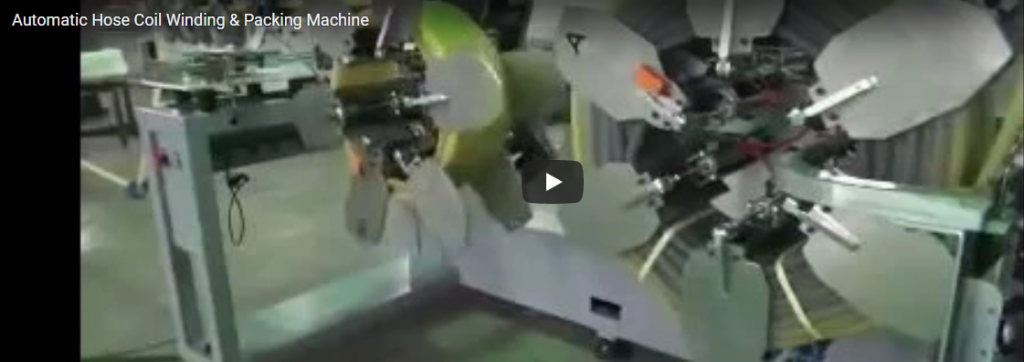
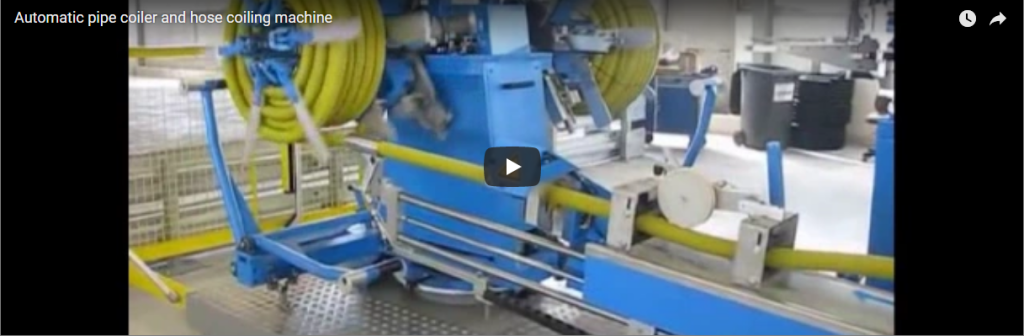
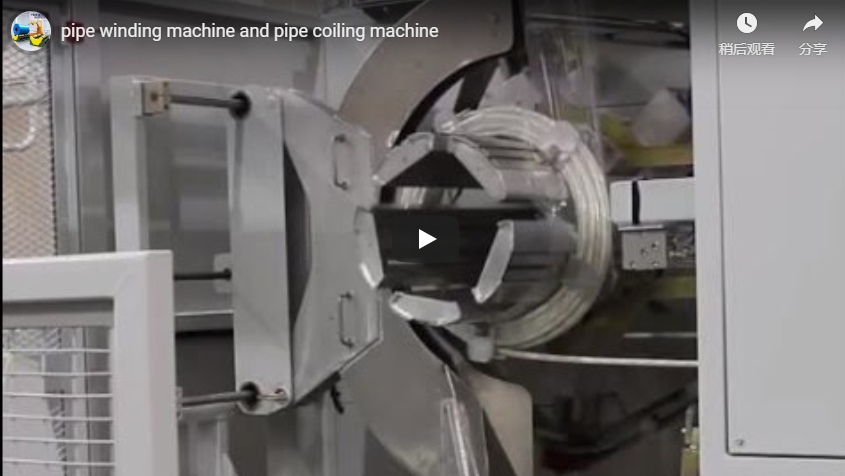
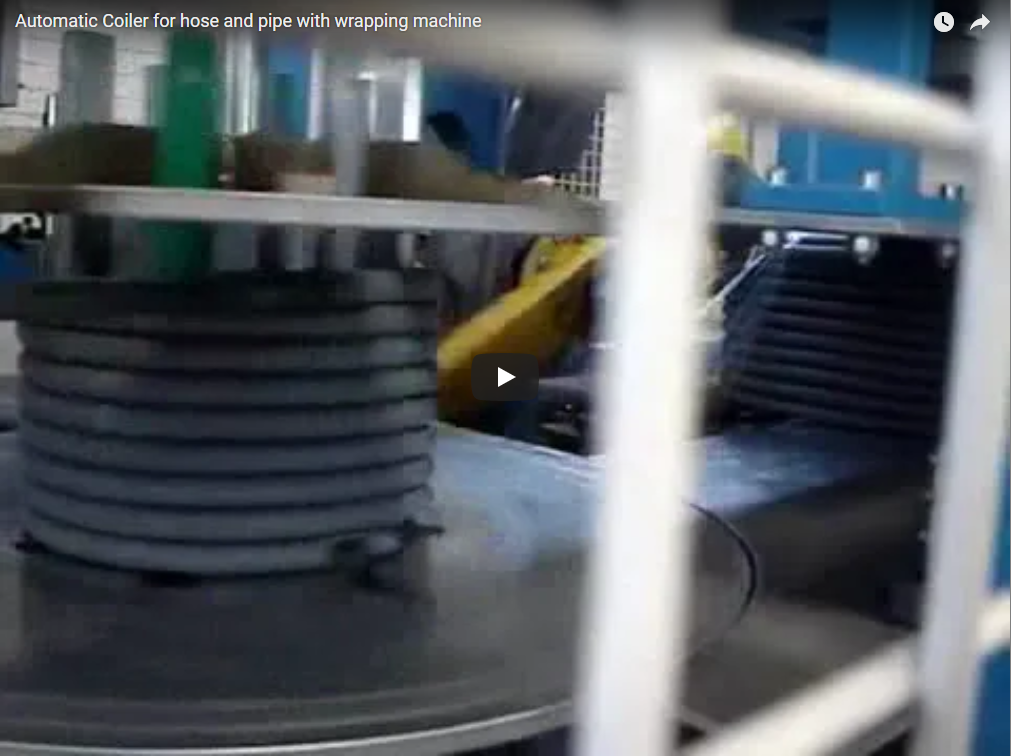
A large black hose coil sits on a turning platform under a metal press plate. An arm moves the coil on to the wrapping station, where rollers turn it while clear film is wrapped round it.
The operator touchscreen shows the length and diameter settings, with start and input buttons below. The wrapped coil travels along the roller conveyor, an arm picks it up, carries it over a row of open cartons and lowers it into one. The filled carton is then conveyed to the carton sealer and closed.
A label applicator with a roll of labels stands by the conveyor, and a yellow electrical warning triangle is on the red control cabinet. Later in the clip the same sequence repeats on the next coils.
How a coil goes from wrap to sealed carton
Times are read from the video timestamps.
| Step | What happens | Video time |
|---|---|---|
| Coil in | The coil sits on the turning platform under the press plate | about 0–4 s |
| To wrapping | An arm moves the coil to the wrapping station | about 4–8 s |
| Settings view | The clip cuts to the touchscreen with length and diameter settings | about 8–12 s |
| Film wrap | Rollers turn the coil while clear film is wrapped round it | about 12–20 s |
| Pick and place | The wrapped coil is conveyed, picked and lowered into a carton | about 24–44 s |
| Seal | The filled carton is conveyed to the sealer and closed | about 44–56 s |
These times show the order of steps in the clip, not a rated cycle time. Settings are made on the touchscreen before a run, not for each coil.
The coil is wrapped before it goes into the carton, so the film keeps the hose clean if the carton is opened at a store and the coil is sold on its own.
Coils per hour from your output
Illustrative example with customer-side inputs:
| Item | Value |
|---|---|
| Hose output per shift (illustrative) | 30,000 m |
| Length per coil (illustrative) | 50 m |
| Coils and cartons per shift, 30,000 ÷ 50 | 600 |
| Shift length (illustrative) | 8 h |
| Coils per hour, 600 ÷ 8 | 75 |
| Time available per coil, 3,600 ÷ 75 | 48 s |
Each station on the line (wrapping, pick and place, and carton sealing) then has to finish its step in less than the time available per coil. We confirm those station times with your coil size during the proposal.
Controls and safety
The turning platform, the wrapping rollers, the pick-and-place arm and the carton sealer all move on their own. Keep hands out of the wrapping station and from under the arm while the line runs, clear jams only with the line stopped, and keep the electrical cabinet closed in operation.
The standards that apply depend on the destination market. For CE markets, ISO 12100 sets the risk-assessment method and EN 415-10 sets general requirements for packaging machines.
Selection checklist for a hose coil wrapping and cartoning line
- Coil outer and inner diameter, height and weight.
- Hose length per coil and output per shift.
- Film type and wrap pattern.
- Carton size and how it is formed and fed.
- Label content and position on the carton.
- Carton sealing method and outfeed to palletizing.
Engineering FAQ
Q: How many coils per hour does the line have to pack? A: Output per shift ÷ length per coil ÷ shift hours: 30,000 m ÷ 50 m ÷ 8 h gives 75 per hour in our example.
Q: How long does each station have per coil? A: 3,600 s ÷ coils per hour: 48 s at 75 coils per hour.
Q: Why wrap the coil before cartoning? A: The film keeps the hose clean if the coil is later sold out of the carton.
Q: What is set on the touchscreen? A: In our line the operator sets the length and diameter on the touchscreen before a run, then starts the line from it.
Q: Can the line take my coil size? A: Send the coil diameters, height, weight and carton size and we size the stations.
Next step
We plan your hose coil wrapping and cartoning line in three steps:
- Submit your layout drawing with coil diameters, heights, weights and carton size to info@fhopepack.com.
- Receive a proposal within 48 hours, with wrap pattern and station layout.
- Book a site survey to check floor space, carton feed and outfeed.
Related reading
- Hose packaging machine
- Video: online cable coil wrapping and boxing machine
- Video: automatic pipe coiling and wrapping machine for hose and plastic tubes
Sources
- Machine content: FHOPE engineering team, 2026-10-04
- Pace example: our worked example, illustrative values
- Machine in action: our video on YouTube
- Standards scope: ISO 12100:2010, EN 415-10:2014
Last reviewed: 2026-10-04