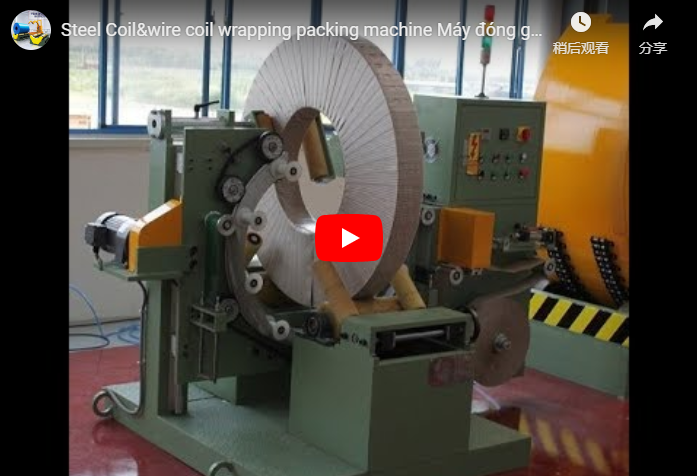
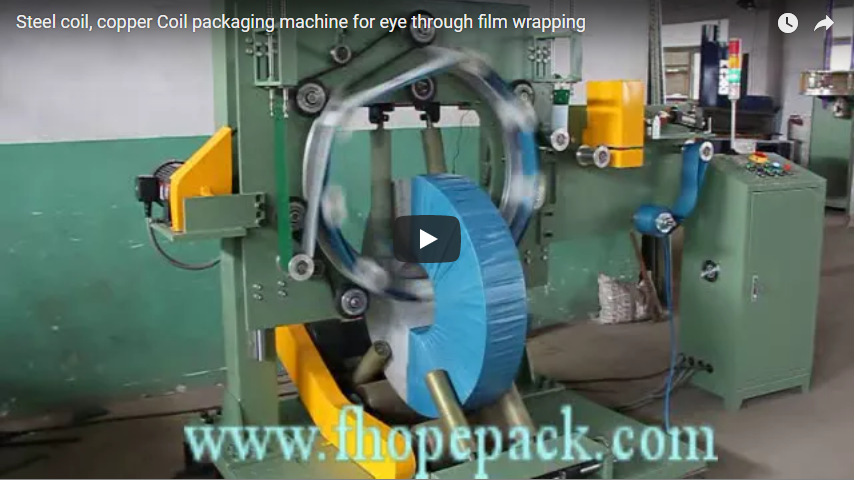
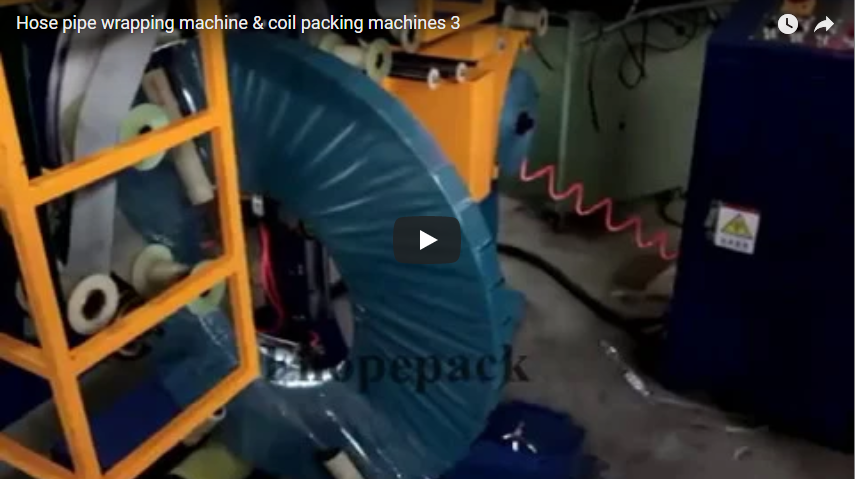
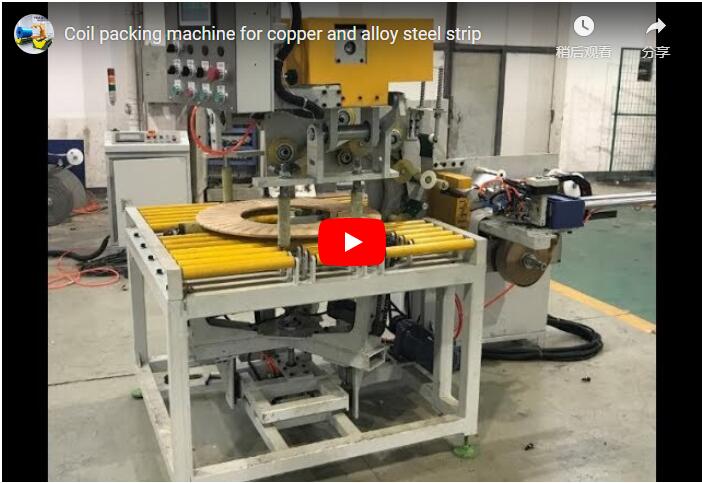
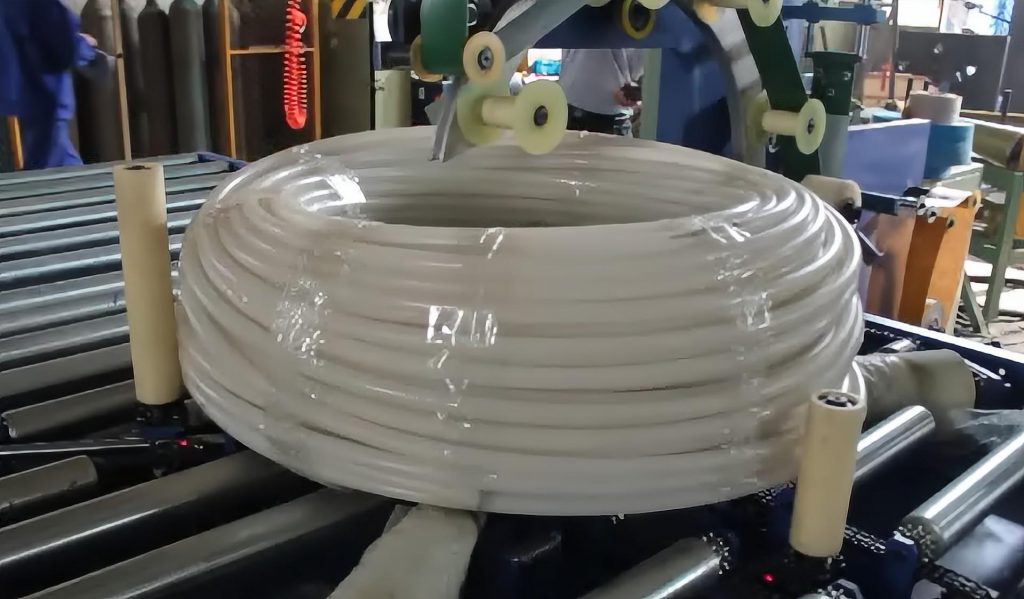
Executive summary Our steel wire coil wrapping machine passes a ring through the coil eye and wraps the coil section with film, paper or woven tape. The FPW-500 takes coils up to 1,500 kg and the FPW-600 up to 4,000 kg, and coil ID, width and weight decide between them. Overlap set at the coil ID is much smaller at the OD, so we size the wrap for full cover at the outside diameter.
Table of Contents
- How the wire coil wrapper works
- FPW-500 or FPW-600
- Wraps per coil and overlap
- Materials
- Loading and unloading
- Utilities and safety
- Selection checklist
- Engineering FAQ
- Next step
- Related reading
- Sources
How the wire coil wrapper works
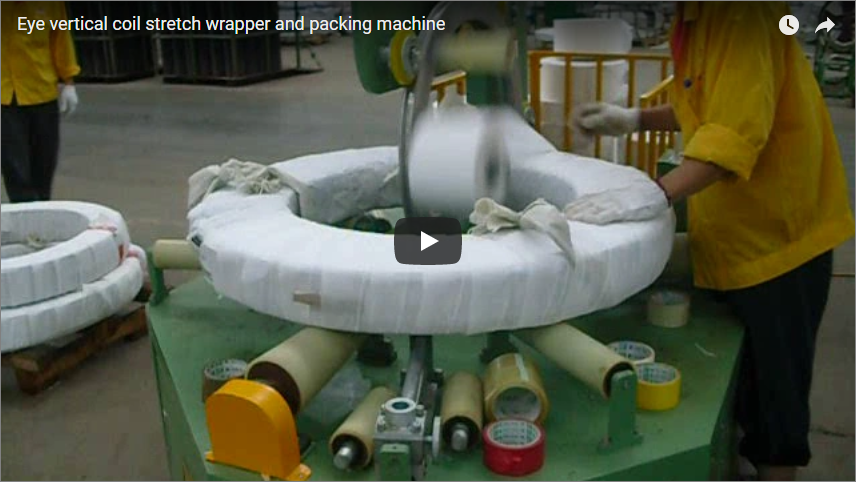
Our wire coil wrapper turns the coil on support rollers while the ring carries the wrapping material through the coil eye, so ring speed and roller speed together set the overlap.
In our video, a black wire rod coil stands on its edge, eye horizontal, and the ring lays white material around it. As the rollers turn the coil, the ring lays the material around the coil section turn by turn, and an orange guard frame surrounds the ring. Finished coils, wrapped in white, are stacked behind the machine.
The wrap gives a 360-degree sealed package that protects the wire against moisture and rust in transport.
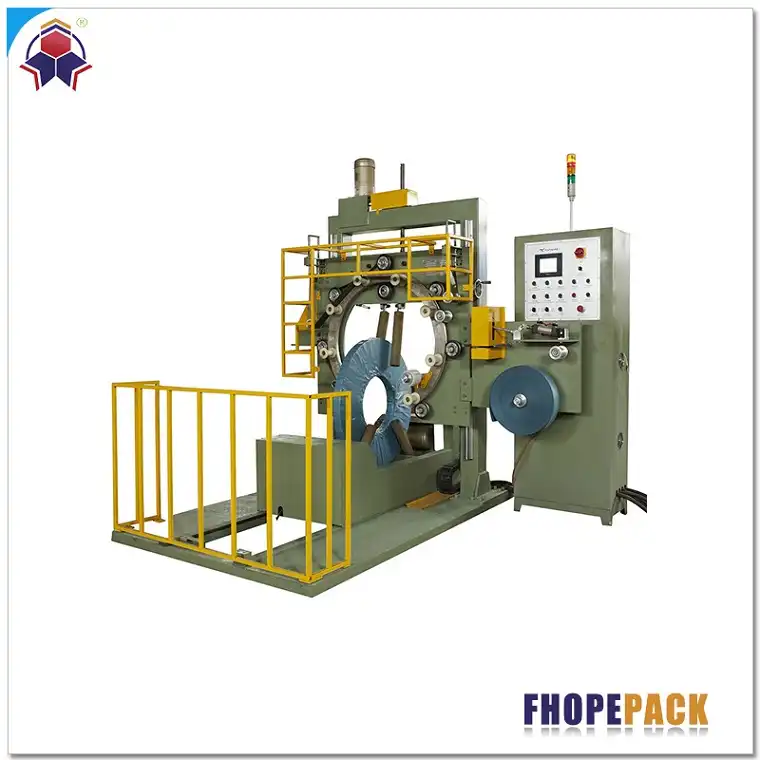
FPW-500 or FPW-600
| Parameter | FPW-500 | FPW-600 |
|---|---|---|
| Coil ID | 300–700 mm | 300–850 mm |
| Coil OD | 700–1,300 mm | 700–1,400 mm |
| Coil width | 50–500 mm | 150–600 mm |
| Coil weight | 40–1,500 kg | 100–4,000 kg |
| Material roll width | 100–120 mm | up to 120 mm |
| Material roll OD | 100–450 mm | 200–450 mm |
| Power | 3.5 kW | 4.5 kW |
Illustrative example: a 1,200 kg coil with 600 mm ID, 1,200 mm OD and 400 mm width fits both models, and the FPW-500 is enough. A 2,500 kg coil, or a coil with 800 mm ID, needs the FPW-600.
The roll travels with the ring through the coil eye, so your smallest coil ID also limits the largest roll OD. We check both together.
Wraps per coil and overlap
Each wrap advances around the coil. The wraps lie closest at the inside diameter and spread out towards the outside. For the 600 mm ID, 1,200 mm OD, 400 mm wide coil with 100 mm tape:
- Inner circumference. π × 600 = about 1,885 mm.
- Wraps for 50% overlap at the ID. Each wrap advances 50 mm, so 1,885 ÷ 50 = about 38 wraps.
- Spacing at the OD. π × 1,200 = about 3,770 mm, and 3,770 ÷ 38 = about 99 mm between wraps. With 100 mm tape, the OD is barely covered.
- Material per coil. The coil section perimeter is 2 × (400 + 300) = 1,400 mm, so 38 wraps use about 38 × 1.4 = 53 m of tape.
So a coil that looks well covered at the eye can be almost open at the outside. Sizing from the OD instead:
- Wraps for 30% overlap at the OD. Each wrap may advance 70 mm, so 3,770 ÷ 70 = about 54 wraps.
- Material per coil. 54 × 1.4 = about 76 m of tape, and the ID gets heavy overlap.
Overlap is adjustable from 10% to 90%. We set it for the cover you need at the OD, then measure the material use on a trial coil.
Materials
| Model | Materials |
|---|---|
| FPW-500 | PVC, LDPE, LLDPE, paper, HDPE |
| FPW-600 | woven belt, compound paper, crepe paper, non-woven fabric, sackcloth tape, stretch film, PE film, LLDPE, HLDPE film |
Both use a 50 mm roll core. The FPW-600 offers OD covering or tape applicators as options for a fully sealed package.
Loading and unloading
The FPW-500 uses an automatic trolley that moves coils in and out with precise positioning, and an automatic feed-and-cut unit (a mechanical hand) handles the material. The main board height adjusts by geared motor for different coil diameters. The FPW-600 has a mechanical arm for automatic feeding and cutting and an adjustable ring centre. For heavy coils, the loading method decides the cell layout, so we agree it with your production team first.
Utilities and safety
| Utility | Requirement |
|---|---|
| Power | 3.5 kW (FPW-500), 4.5 kW (FPW-600) |
| Voltage | 380 V, 50 Hz, 3 phase |
| Compressed air | 4–6 kgf/cm² |
PU-coated contact points protect the wire surface. The standards that apply depend on the destination market. For CE markets, ISO 12100 sets the risk-assessment method and EN 415-10 sets general requirements for packaging machines.
Selection checklist for a wire coil wrapper
- Coil ID, OD, width and weight, smallest and largest.
- Wrapping material and roll size.
- Cover needed at the OD.
- Coils per shift.
- Loading method: trolley, crane or conveyor.
- Compressed air at 4–6 kgf/cm².
Engineering FAQ
Q: Which model fits a 1,200 kg coil? A: The FPW-500, which takes 40–1,500 kg, if the coil ID is 300–700 mm.
Q: When do I need the FPW-600? A: For coils above 1,500 kg up to 4,000 kg, or coil IDs above 700 mm up to 850 mm.
Q: Why does the OD look less covered than the eye? A: The wraps spread out with diameter. On a 600/1,200 mm coil, 38 wraps sit 50 mm apart at the ID but about 99 mm apart at the OD.
Q: How much tape does one coil use? A: For that coil with 100 mm tape, about 76 m for 30% overlap at the OD. Sizing for 50% at the ID uses only about 53 m but leaves the OD barely covered.
Q: Does it feed and cut the material? A: Yes. A mechanical hand on the FPW-500, and a mechanical arm on the FPW-600.
Next step
We size your wire coil wrapper in three steps:
- Submit your layout drawing with coil sizes, weights and coils per shift to info@fhopepack.com.
- Receive a proposal within 48 hours, with the model, material and overlap plan.
- Book a site survey to fit the wrapper to your line.
Related reading
- Wire coil wrapping machine FPW-500
- Wire coil wrapping machine FPW-600
- Wire coil wrapping machine range
- Video: packing machine for wire coil, steel coil and pipe coil
- Video: economic wire wrapping machine for steel
Sources
- FPW-500: FPW-500 page
- FPW-600: FPW-600 page
- Machine in action: our steel wire coil wrapping machine video on YouTube
- Standards scope: ISO 12100:2010, EN 415-10:2014
Last reviewed: 2026-10-04