Executive summary A European welding material manufacturer needed automated coil packaging for coils up to 90 kg, with CE compliance and automatic loading and unloading. Two solutions cover the range: the FPCA-200 wraps coils vertically at 12 to 18 coils per hour under crane loading, and the FPCA-1000 runs 22 to 28 coils per hour on a twin-station conveyor line. This case study covers the coil specifications, both machine lines, the compliance and maintenance points, and how to select between them.
Table of Contents
- What the video shows
- The welding coil packaging challenge
- Coil specifications
- Solution A: FPCA-200 compact vertical wrapping
- Solution B: FPCA-1000 conveyor-based horizontal wrapping
- European compliance and energy
- Maintenance and support
- Quality and performance
- Machine selection checklist
- Engineering FAQ
- Next step
- Related reading
- Sources and standards
What the video shows
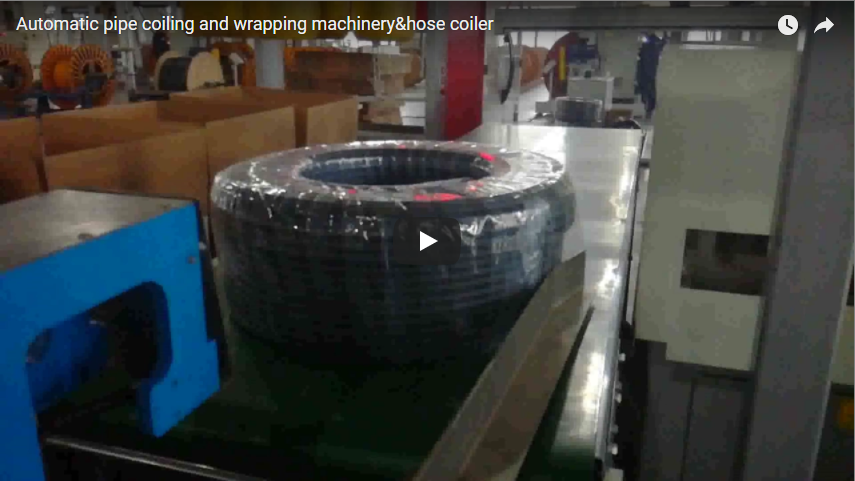
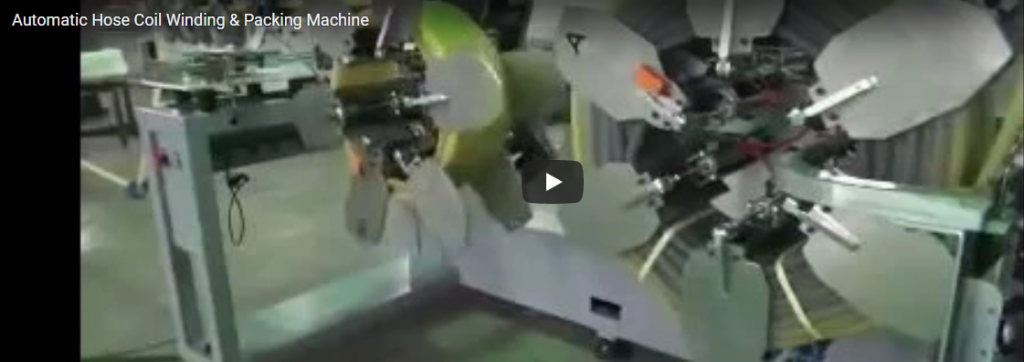
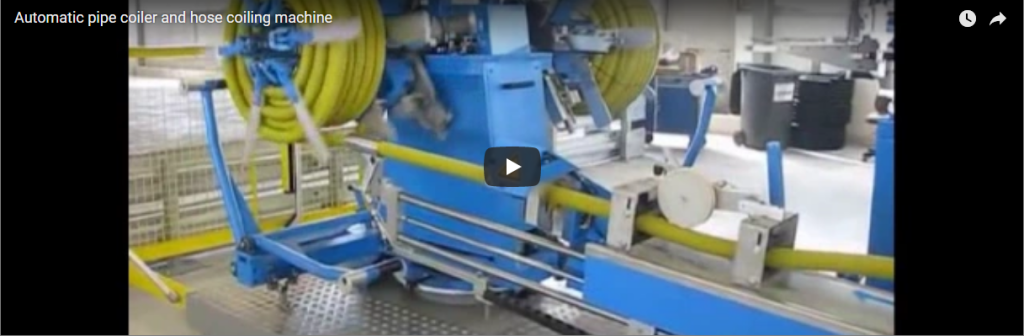
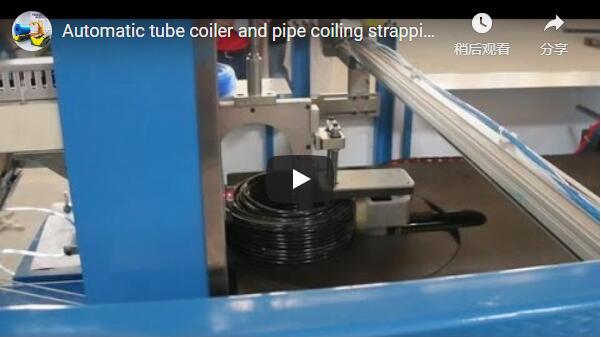
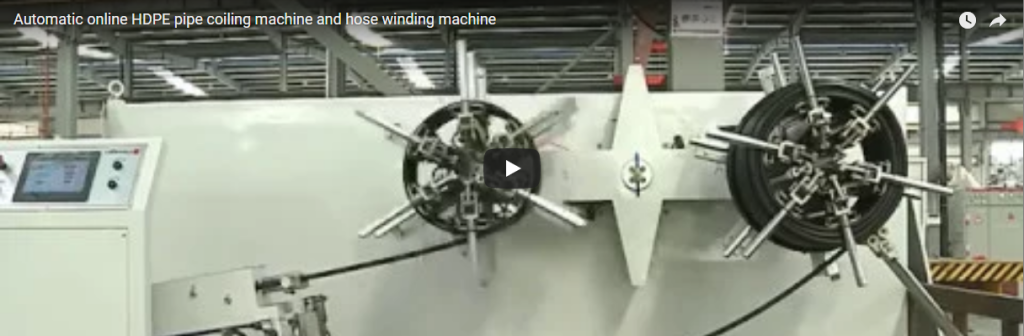
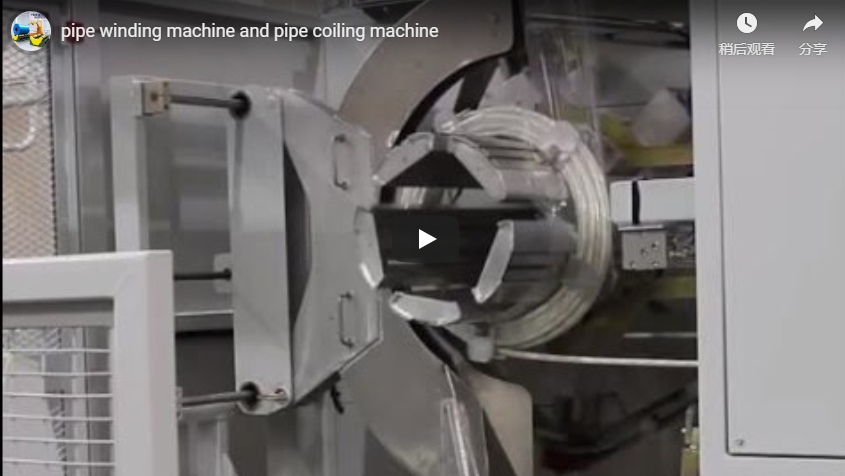
To remove the manual lifting bottleneck and protect moisture-sensitive welding wire, automated through-core wrapping holds film tension and cycle time steady across the shift. The video demonstrates the sequence: film passes through the coil center for complete coverage, automated handling moves large coils with minimal operator intervention, and electronic tension control holds a consistent stretch ratio.
A second sequence covers flexible PVC hose wrapping, with attention to preventing kinks and keeping coil shape. It closes on an automated transfer system that moves wrapped coils to the next generation integrated stretch wrapping and stacking technology line. This clip and the two machine paths below apply the same ideas to welding wire coils.
The welding coil packaging challenge
Welding wire manufacturers run a high-volume, precision-driven operation where packaging quality protects the product during storage and transport. Coils have to be shielded from moisture, dust and mechanical damage from wrapping to installation.
For the European plant in this case, the challenge is threefold. Coils up to 90 kg need lifting equipment, so manual loading and unloading ties up operators. Production floors are tight, so the wrapping cell has to fit a limited footprint. And every machine must carry CE marking with a documented ISO 12100 risk assessment.
Coil specifications
The coils in this case share the same inner diameter across all product lines, while weight, width and outer diameter vary.
| Item | Value |
|---|---|
| Maximum coil weight | 90 kg |
| Coil width | 30 mm, 90 mm or 600 mm across product lines |
| Coil inner diameter | 300 mm |
| Coil outer diameter | up to 800 mm, maximum for the FPCA-200 cell |
All three widths run through adjustable guide systems on both lines, and the range for your product mix is confirmed per project.
Solution A: FPCA-200 compact vertical wrapping
The FPCA-200 is the space-saving path. Coils load vertically by overhead crane, which suits plants that already run cranes over the finishing area. A movable carriage retracts to give the crane access to the wrapping station.
| Parameter | Specification |
|---|---|
| Coil weight capacity | 90 kg maximum |
| Coil dimensions | ID 300 mm, OD 300 to 800 mm |
| Wrapping speed | 12 to 18 coils per hour, depending on loading |
| Film consumption | 0.28 to 0.35 m²/kg, at 220 to 280% stretch |
| Power | 3.8 kW at peak, IE3 efficiency |
| Footprint | 2.8 x 1.9 x 2.4 m |
| Safety | SIL2-rated light curtains and emergency stop |
| Control | PLC with SIL2-rated interlock |
Coils sit on tapered rollers, 120 mm diameter at HRC 52 to 56 surface hardness, that self-center the coil during rotation. The 15-degree taper holds position within 0.3 mm lateral runout at full load. The same self-centering idea appears on lighter cable and wire coils through an economic cable coil packing machine and wire wrapping machine.
Solution B: FPCA-1000 conveyor-based horizontal wrapping
The FPCA-1000 trades floor space for throughput. Conveyors load and unload the machine automatically, removing the crane step and most of the manual handling.
| Parameter | Specification |
|---|---|
| Throughput | 22 to 28 coils per hour, continuous |
| Conveyor speed | 0.15 to 0.25 m/s, adjustable |
| Wrapping stations | 2 independent stations |
| Film pre-stretch | 250 to 320%, electronically controlled |
| Tension consistency | within 5% |
| Control | centralized PLC with HMI |
| Integration | MES or ERP via OPC UA, Industry 4.0 ready |
| Footprint | 6.2 x 3.1 x 2.8 m, including buffer conveyors |
Material flow runs as a three-stage conveyor sequence: an infeed line with weight check, the twin wrapping station where one coil wraps while the next positions, and an outfeed to palletizing or storage. Each station runs independent servo drives at 400 W and 3000 rpm, with absolute encoders positioning to 0.15 degrees.
European compliance and energy
Both solutions go through a full conformity assessment for European operation. The design is verified against Annex I of the Machinery Directive 2006/42/EC, a risk assessment follows ISO 12100, and a declaration of conformity is issued with a unique identification number.
Energy efficiency follows the Ecodesign Directive. Standby power measured under 1.0 W, motors are IE3 class, and power factor reaches 0.95 or better at full load. Annual energy is calculated per the EN 50564 methodology.
Maintenance and support
European plants need fast spares and clear documentation. The case setup offers 48-hour delivery of critical spare parts within the EU, support from a multilingual engineering team, and training and documentation in all EU official languages.
The warranty is 24 months as standard, extendable to 36 months. Preventive maintenance runs every 1,000 operating hours or 6 months, with an annual safety inspection of protective devices and emergency stops.
Quality and performance
The automation changes package consistency, not just speed. Manual wrapping in the case showed 18 to 22 percent variation in film tension, against 3 to 5 percent with the automated line. Coil edge damage dropped from 2.1 percent to 0.3 percent of shipments, and the consistent film overlap, 55 plus or minus 2 percent against a 30 to 70 percent manual range, improves the humidity barrier.
Both lines integrate with existing quality control. In-line scales check weight within 0.5 kg, camera systems verify film integrity, and every coil gets a unique packaging record with time, film usage and operator.
Machine selection checklist
Work through these points before you ask for a quote, and we confirm the rest against your coil output per project.
| Item | What to confirm per project |
|---|---|
| Coil | weight, width, ID and OD range |
| Loading | crane available, or conveyor infeed needed |
| Throughput | coils per hour and shift pattern |
| Film | stretch film, VCI film or barrier film |
| Compliance | CE, risk assessment and target market |
| Integration | MES or ERP connection required |
| Support | spares lead time and language needs |
Engineering FAQ
Q: Can one machine handle coil widths of 30, 90 and 600 mm? A: Both lines accommodate variable widths. The FPCA-200 uses adjustable guides with a changeover of 8 to 12 minutes; the FPCA-1000 adjusts width automatically by servo in 45 to 60 seconds.
Q: Which film types work with welding wire packaging? A: Stretch film at 17 to 23 microns runs at 220 to 280% pre-stretch on the FPCA-200 and 250 to 320% on the FPCA-1000, selection per project. VCI film at 25 to 30 microns suits corrosion-inhibited long-term storage, and multi-layer barrier films protect export humidity.
Q: How does automation connect to existing quality control? A: Automated checkweighers hold weight within 0.5 kg, camera systems verify film integrity, and each coil receives a unique packaging record with time, film usage and operator.
Q: What maintenance does CE compliance require? A: An annual safety inspection of protective devices and emergency stops, preventive maintenance every 1,000 operating hours or 6 months, and a technical file updated when the machine is modified.
Q: How do the two solutions compare on footprint? A: The FPCA-200 fits a 2.8 x 1.9 x 2.4 m cell with crane access overhead, and the FPCA-1000 line needs 6.2 x 3.1 x 2.8 m with its buffer conveyors.
Next step
- Email us at info@fhopepack.com with your coil sizes, line output and loading method.
- We send a layout drawing and a wrapping proposal within 48 hours.
- We arrange a site survey to confirm footprint, crane access and control integration.
Related reading
- Coil and roll stretch wrapping machine
- Automatic horizontal orbital wrapping for one-pass full coverage
- Steel sheet strapping machine
- Preventing telescoping on strapped and wrapped steel coils
- FHOPE packaging machinery product lines
Sources and standards
- ISO 12100:2010 — Safety of machinery. General principles for design, risk assessment and risk reduction
- EN 415-10:2014 — Safety of packaging machines. General requirements
- EN ISO 13849-2:2013 — Safety of machinery. Safety-related parts of control systems
- IEC 61131-3:2013 — Programmable controllers. Part 3: Programming languages
- EN 619:2002+A1:2010 — Continuous handling equipment and systems. Equipment for mechanical handling of unit loads
- FHOPE automated coil wrapping solutions case demonstration video, YouTube.
Last reviewed: 2026-10-09