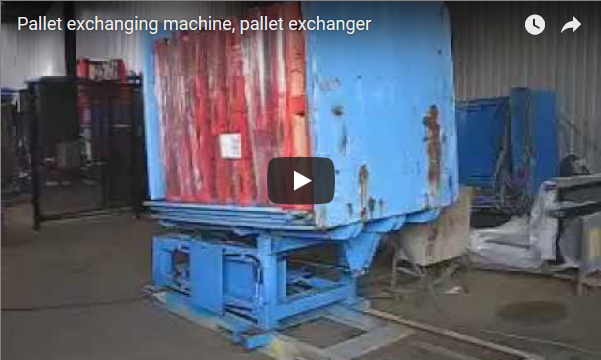
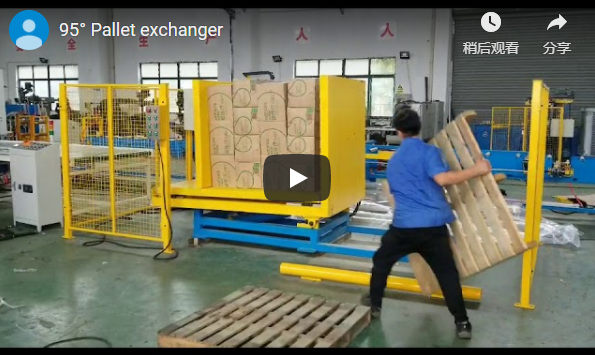
Executive summary This video shows an automatic pallet changing system built from a steel frame, an orange gantry-style arm, a blue lifting pallet platform, and a yellow support rail mechanism. Footage captures a forklift delivering a carton-loaded pallet into the machine and the internal structure opening up ahead of pallet exchange. Cycle time, load capacity, and control details are not shown — confirm with the manufacturer.
Why pallet changing matters in a packaging line
Pallets wear out. They crack, they get rejected by export inspectors, or they simply arrive in the wrong size for a customer. When that happens, someone has to move the entire load from the old pallet to a new one. Done by hand, that means lifting cartons layer by layer — slow, labor-intensive, and a real risk of product damage or back injuries.
An automatic pallet changing system replaces that manual job with machinery. The load stays together; only the pallet underneath is swapped. The video on this page shows the equipment at FHOPE’s facility, and this article walks through what the footage actually shows, what it does not, and what a buyer should verify before committing to an implementation.
The machine in action: what the footage captures
The video runs roughly 24 seconds and follows the start of a pallet exchange sequence:
| Time | What happens |
|---|---|
| 0–8s | Static scene: an automatic pallet changing system stands on the factory floor. A pallet loaded with stacked cartons sits at the left station; a blue pallet platform on the right is at a low standby position. |
| 10–12s | An orange forklift enters from the left, forks under the loaded pallet, and begins moving it toward the machine. |
| 14–16s | The forklift carries the loaded pallet fully into the machine’s internal area, apparently the old-pallet unloading zone. A gray central door panel is closed. |
| 18–24s | The forklift has left the frame. The machine’s interior is exposed: the central door opens, revealing internal rails and lifting mechanisms. A yellow guide rail or support arm extends from the machine body, consistent with new-pallet conveying or waste-pallet stacking functions. Spare cartons are stacked in the lower left of the frame. |
At the end of the clip, the left pallet station is empty and the right blue platform holds an empty pallet — the setup you would expect just before a new-pallet supply or waste-pallet stacking step.
Direct observation notes
The following is a plain factual description kept close to the analyzed footage, with only grammar-level edits:
- The system has a gray painted steel frame with thick upright columns and a top beam spanning left to right, forming an enclosed working space.
- An orange gantry-style arm with vertical lifting cylinders and a horizontal extending arm is mounted on the right column.
- A blue double-layer pallet platform with rollers or slide rails at its base can rise and lower; it stands at a low position early in the video.
- A fixed pallet station with positioning stops sits on the left.
- A gray central door panel can open and close — plausibly a safety guard or a passage for goods entering and leaving.
- Yellow guide rails or support arms extend from inside the machine in the final frames, apparently for pallet conveying or stacking.
- Blue cylinders mounted beside the arm drive gripping or lifting actions.
- Multiple black cylindrical sensors or photoelectric switches are fitted on the columns and the arm, used for positioning or safety interlocks.
- The product handled is carton-packed goods on a pallet of roughly 1200 × 1000 mm proportions, stacked two layers high and two columns wide.
- Readable markings on the machine and wall include “FHOPE GROUP” and “PACKING SOLUTION FOR YOU”, plus wall text reading “叉车 1800”. Cartons in the corner print “UNIVERSAL”.
Machine structure at a glance
| Component | Observed detail | Likely function |
|---|---|---|
| Steel frame | Gray, enclosed structure with top beam | Forms the machine’s working envelope |
| Gantry arm | Orange, vertical cylinder + horizontal extension, right column | Gripping or lifting the load during exchange |
| Pallet platform | Blue, double layer, rollers/slide rails | Carries the new or replacement pallet |
| Left pallet station | Fixed position with stops | Receives the incoming loaded pallet |
| Central door | Gray, hinged with latches | Guard or product passage |
| Yellow rails/support arms | Extend in final frames | Pallet conveying or waste-pallet stacking |
| Sensors | Black cylindrical units on columns and arm | Position detection, safety interlocking |
How implementation typically works
Based on the observed layout, an implementation flows like this:
- Inbound. A forklift delivers the loaded pallet into the left station, exactly as shown at 10–16 seconds.
- Securing. The load is positioned against the station stops; sensors on the columns confirm pallet presence.
- Exchange. Internally, the system transfers the load off the old pallet and onto a fresh one dispensed from the new-pallet supply, while the emptied pallet is moved to a stacking position.
- Outbound. The re-palletized load and the waste pallet stack exit via their respective positions.
Important caveat: the video does not show steps 3 and 4 actually executing. The final frames show the machine opening up and rails extending, which is consistent with these stages starting — but the full exchange, dispensing, and stacking actions are not captured. Treat the sequence above as the typical operating concept, and ask the manufacturer to demonstrate a complete cycle.
What the video shows (with time references)
- Around t≈0–8s a static scene shows an automatic pallet-changing system (orange arm, grey frame, blue pallet platform) on the shop floor: the left pallet carries stacked cartons (some with green/red print) while the right empty pallet platform waits at low idle.
- Around t≈10–12s an orange forklift enters from the left with its forks already under the carton-loaded pallet, preparing to move or exchange it; the mechanical arm stays still.
- Around t≈14–16s the forklift moves right, feeding the loaded pallet fully into the machine interior (the old-pallet unloading zone) while the right platform remains empty and the central grey door is closed.
- Around t≈18–24s the forklift exits the frame; the interior is now exposed — the left pallet position is emptied, the right blue empty pallet remains, the central grey door is open revealing internal rails and a lifting mechanism, and yellow guide/mover elements extend as part of the new-pallet feed / used-pallet stacking system; cartons at lower-left carry partial “UNI…” printing.
What the video does not show
Buyers should be aware of the significant gaps in the footage:
- Rated load capacity (maximum pallet weight, arm capacity)
- Total cycle time per pallet exchange
- Machine model designation
- Power source details (motor rating, hydraulic pressure/flow)
- PLC brand, HMI type, and control architecture
- Safety certifications (CE, ISO 13849, or equivalent)
- Internal structure of the new-pallet dispensing mechanism (magazine capacity, conveyor length)
- Waste-pallet stacking height or count limits
- HMI screens, button panels, or operator interfaces — none are visible in any frame
- Emergency stop buttons and safety light curtains were not observed on camera
None of these are criticisms — they simply are not in this short clip. Every one of them belongs on your pre-purchase checklist.
Fit criteria: is this system right for your line?
| Fit well if… | Think twice if… |
|---|---|
| You regularly re-palletize carton-loaded pallets for export or customer compliance | Your loads are unstable or shrink-wrapped loosely — check load-retention handling |
| You want to cut forklift trips in and out of the work zone | You need a fully demonstrated automated cycle — request a live test with your goods |
| Floor space can accommodate an enclosed steel-frame machine | Your pallet sizes vary widely — confirm adaptability first |
| You want waste pallets collected in one stack rather than hauled out one by one | You require remote monitoring/diagnostics — verify available interfaces |
What to verify with the manufacturer
Before purchase, put these questions in writing:
- Pallet size adaptability (e.g., 1200 × 1000 mm vs 1100 × 1100 mm)
- Rated load per cycle and arm capacity
- Measured cycle time with a load similar to yours
- Whether the new-pallet dispensing module is fully automatic or requires manual refill, and its magazine capacity
- Whether the waste-pallet stacker includes counting or full-stack alarm functions
- Control interface options (e.g., integration with existing line PLCs) and remote monitoring availability
- Safety compliance for your jurisdiction, plus guarding and interlock design
- After-sales training and spare-parts commitments
Safety and operating notes
The machine’s semi-enclosed steel frame and central door form a physical barrier, which is a sensible baseline. Sensor units visible on the columns suggest automated position checking. However, the footage does not confirm light curtains, e-stops, or interlock logic, so during your site assessment:
- Confirm the arm’s operating zone is fully fenced with interlocked access.
- Verify the lifting platform cannot cycle with personnel inside the enclosure.
- If a hydraulic system is used, ask about leak-inspection intervals as part of the maintenance plan.
- Request the full safety circuit diagram before signing off the layout.
FAQ
Does the video show a complete pallet change cycle? No. It shows a forklift delivering a loaded pallet, then the machine opening up with rails extending. The actual load transfer, new pallet dispensing, and waste pallet stacking are not shown executing.
What kind of goods was the machine demonstrated with? Stacked cartons — roughly two layers and two columns wide, filling a pallet of about 1200 × 1000 mm proportions.
Is there a control panel visible? No screen, buttons, or indicator lights appear clearly in any frame. Panel layout and HMI details should be confirmed with the manufacturer.
How are waste pallets handled? Yellow rails or support arms extending in the final frames are consistent with a stacking function, but the stacking process itself is not shown. Ask for a demonstration of that stage.
What is the cycle time? Not shown or stated in the footage. Request a measured cycle time under a comparable load — check with the manufacturer.
Related reading
- Automatic pallet wrapping machine — for the stretch-wrapping stage that often follows pallet changing
- Semi-auto pallet wrapping machine — a lower-volume alternative
- Automatic packing line — how individual machines integrate into a full line
- Pallet inverter — the related option for load rotation rather than pallet replacement
Next step
If this system matches your re-palletizing requirement, the practical next step is a cycle demonstration with your actual product. Visit our contact page to request a video test, a quotation, or an implementation discussion.
Source and method
This article is based on the embedded video as its sole factual source. Analysis was performed by a vision model on sampled frames; the video contains background music only, with no narration or speech. Claims not observable in the footage are explicitly marked as items to verify with the manufacturer.