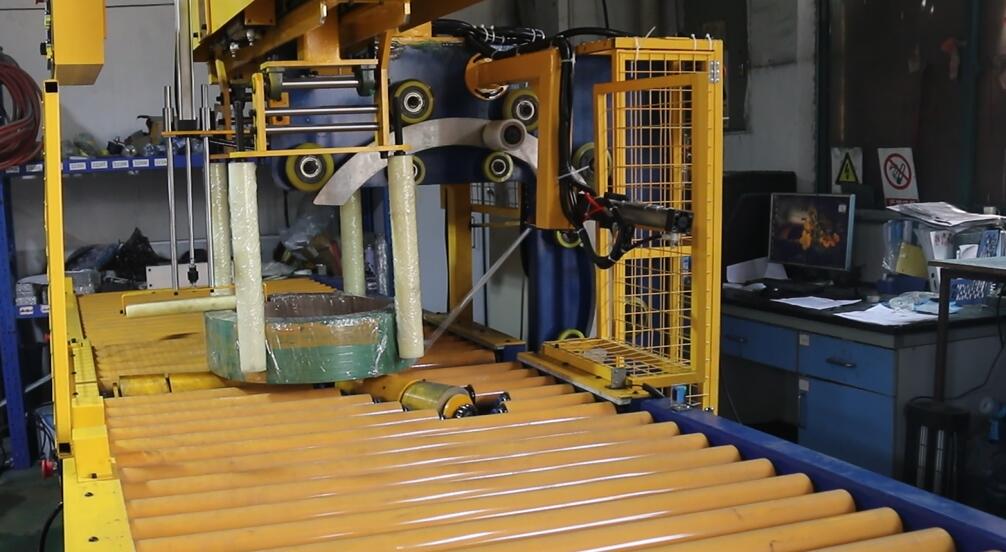
Executive summary The FPCA series wraps stretch film, PE, or PVC through the eye of a cable coil supported by driven conical rollers, enabling a single operator to complete a protective orbital wrap in 18–30 seconds per coil on our standard FPCA-100. Sized for coils from 2 kg to 200 kg with inner diameters (ID) from 90 mm to 510 mm, the equipment enforces stable film tension and precise outer diameter (OD) overlap. Because coil geometry dictates that inner circumference is significantly shorter than outer circumference, overlap is calibrated strictly to the OD—the eye naturally accumulates higher layer density. This technical manual details mechanical specifications, kinematic cycle breakdowns, overlap mathematics, and integration parameters required for proposal validation.
Table of Contents
- How the coil-wrapping cycle works
- FPCA model ranges
- Overlap at OD and ID — why setting at the OD matters
- Wrap time per coil
- Film and material choices
- Controls and automation
- Safety and standards
- Selection checklist
- Engineering FAQ
- Next step
- Related reading
- Sources
How the coil-wrapping cycle works
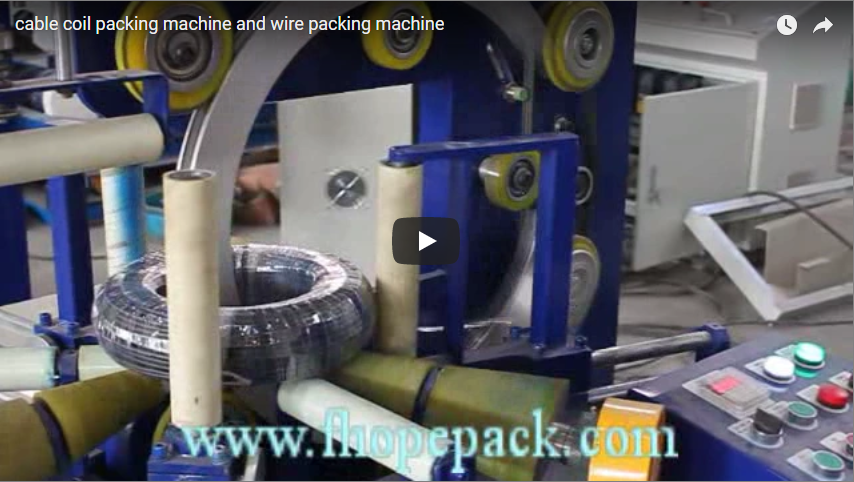
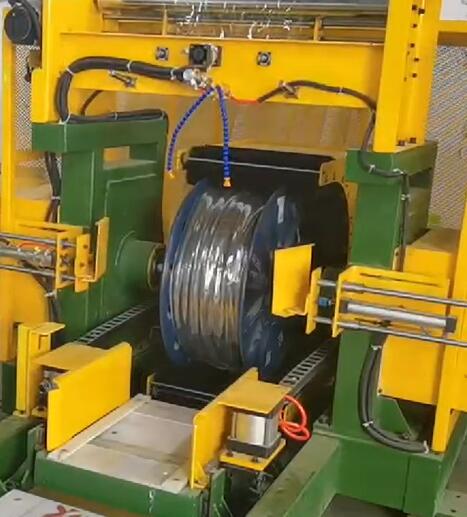
The FPCA cable coil packing machine uses an orbital wrapping ring rotating on a vertical plane while the cable coil rests horizontally (“eye-to-sky”) on a cradle of driven conical rollers. The rotating ring drives a low-inertia film shuttle through the central eye, applying material radially around the cross-section while the driven rollers rotate the coil around its vertical axis.
          [ Pneumatic Press-Down Roller ]
                     │  (Stabilizes coil)
                     ▼
             ┌──────────────┐
  ===========│  Cable Coil  │===========   <-- Orbital Ring Path
             └──────────────┘                  (Travels through eye)
              ▲            ▲
              │            │
      [ Conical Roller ]  [ Conical Roller ]
(Polyurethane-coated, driven)- Load and Centering (0–4 s). The operator places the unstrapped or strapped coil flat onto the polyurethane-coated conical driving rollers. Adjustable vertical guide posts establish physical alignment, keeping coils of varying widths centered beneath the ring plane.
- Clamping and Wrapping (4–28 s). A pneumatic press-down roller descends onto the upper face of the coil section (regulated at 0.4–0.6 MPa, providing 50–150 N clamping force to prevent coil hop or telescoping). The orbital ring accelerates smoothly via inverter control, threading stretch film through the eye. Simultaneously, the bottom conical rollers turn the coil at a synchronized surface velocity, advancing the outer circumference by an exact pitch on every revolution.
- Cut and Wipe. On standard semi-automatic FPCA-100 configurations, the operator performs a quick manual cut using an integrated safety blade holder. On FPCA-200 and FPCA-300 lines equipped with optional pneumatic cut-and-clamp units, a mechanical gripper catches the trailing film, cuts it cleanly, and smooths the tail against the coil body.
- Unload (28–32 s). The press-down cylinder retracts. The operator removes the fully bound coil.
Shuttle film capacity depends on coil eye constraints. Standard shuttles accept coreless or small-core rolls (50–100 mm width, 100–150 mm roll OD, 1.5–3 kg weight, yielding roughly 150–300 m of linear stretch film). Under a standard 50% OD overlap, a single shuttle roll covers approximately 20–40 small coils before requiring a rapid 30-second reload.
FPCA model ranges
The structural sizing of each FPCA wrapper is dictated by ring pass-through clearance and roller payload capacity.
| Engineering Parameter | FPCA-100 | FPCA-200 | FPCA-300 |
|---|---|---|---|
| Coil Inner Diameter (ID) | 90–250 mm | 150–400 mm | 250–510 mm |
| Coil Outer Diameter (OD) | 150–400 mm | 250–500 mm | 400–900 mm |
| Coil Width / Height | 50–180 mm | 80–200 mm | 60–300 mm |
| Maximum Load Capacity | 30 kg | 50 kg | 200 kg |
| Ring Rotation Speed | 10–120 RPM | 10–120 RPM | 10–90 RPM |
| Average Wrapping Cycle | 18–30 s/coil | 20–30 s/coil | 20–38 s/coil |
| Installed Drive Power | 1.8 kW | 2.0 kW | 2.4 kW |
| Pneumatic Supply Pressure | 0.5–0.7 MPa | 0.5–0.7 MPa | 0.5–0.7 MPa |
Power configuration ships standard as AC 380 V, 3-Phase, 50/60 Hz, with single-phase 220 V or alternative industrial voltages configurable upon engineering review.
Overlap at OD and ID — why setting at the OD matters
Orbital wrapping around a toroidal profile enforces unequal surface speeds across the coil geometry:
- Outer circumference:
C_OD = π × OD - Inner eye circumference:
C_ID = π × ID
Because the orbital ring travels through the eye once per cycle, the linear pitch advanced at the inner diameter is compressed relative to the outer diameter by an exact geometric ratio:
Accumulation Ratio = C_OD / C_ID = OD / IDWorked Engineering Example
Consider a standard commercial wire coil running on an FPCA-100:
- ID = 100 mm (
C_ID = π × 100 ≈ 314 mm) - OD = 400 mm (
C_OD = π × 400 ≈ 1,257 mm) - Ratio:
1,257 / 314 = 4.0
If the machine inverter is tuned for a 50% overlap at the OD using a 100 mm film roll:
- Forward pitch at OD =
100 mm × (1 - 0.50) = 50 mm - Number of layers deposited at the OD = 2 layers
- Layers accumulated at the ID =
2 layers × 4.0 =8 layers
   Film Overlap Geometry:

          OD (1,257 mm Circumference): 50% Overlap  ==>  [ Layer 1 ][ Layer 2 ]
          ──────────────────────────────────────────────────────────────────
          ID (314 mm Circumference):   87.5% Overlap ==>  [L1][L2][L3][L4][L5][L6][L7][L8]
Setting overlap targets at the inner eye would leave the outer circumference starved of coverage, causing edge fraying and moisture exposure during transit. Consequently, the PLC recipe always calculates indexing speeds from the OD target (adjustable from 20% to 90%).
Wrap time per coil
Cycle time consists of dynamic ring acceleration, continuous wrapping revolutions, and ramp-down deceleration. The steady-state wrapping time is calculated as follows:
- Advance Pitch at OD:
Pitch_OD = W_film × (1 - Overlap_rate)(Example: 100 mm film at 50% overlap = 50 mm advance per ring revolution) - Total Orbital Revolutions Required:
N_turns = (π × OD) / Pitch_OD(Example: (π × 400 mm) / 50 mm ≈ 25.13 → 26 turns) - Pure Orbital Run Time:
T_run = (N_turns / RPM_ring) × 60 s(At an inverter setting of 75 RPM: (26 / 75) × 60 ≈ 20.8 s) - Total Floor-to-Floor Cycle:
T_total = T_load + T_accel + T_run + T_decel + T_unload(Typically 4 s load + 1 s ramp + 21 s wrap + 1 s stop + 3 s unload ≈ 30 s)
For smaller building-wire coils (200 mm OD), ring run times drop below 12 seconds, resulting in overall throughput rates of 100–140 coils per operating hour.
Film and material choices
The mechanical tensioner inside the FPCA orbital shuttle accommodates varied web substrates to meet shipping and storage demands:
- LLDPE Stretch Film (15–35 µm): The industry baseline. High puncture resistance and elasticity provide tight, moisture-resistant sealing while retaining high barcode readability through transparent layers.
- Polyvinyl Chloride (PVC) Film: Offers structural firmness and tear resistance against sharp-ended stranded cable coils. Its glossy exterior improves package presentation for consumer hardware distribution.
- Crepe Paper & Woven Polypropylene (PP) Tape: Available primarily on FPCA-200 and FPCA-300 units for specialized heavy-gauge magnet wire or subsea umbilical cables requiring breathable packaging or heavy-duty abrasion shields.
Operating Note: Coils wound on modern semi-rigid winders do not require prior tape or strap binding; the mechanical tension of the cross-wrapped film maintains hoop integrity.
Controls and automation
All FPCA systems are controlled by an onboard industrial PLC paired with an intuitive touch-screen HMI:
- Independent Variable Frequency Drives (VFDs): The orbital ring motor and the conical roller motor are driven by separate inverters. Modulating the ratio between ring RPM and roller line speed allows operators to fine-tune the OD overlap from 20% to 90% without physical mechanical gear adjustments.
- S-Curve Acceleration / Deceleration: Soft-start and soft-stop motor profiles prevent high-inertia shock loading on the friction drive wheels and eliminate coil skidding at the start of the wrapping cycle.
- Automatic Home Positioning: Proximity sensors confirm ring index alignment, bringing the shuttle to an exact rest position at cycle completion for rapid access and manual cutting.
- Memory Recipe Storage: The HMI stores parameters for up to 16 common coil part numbers (ID, OD, speed ratio, overlap percentage), reducing changeover intervals to under 15 seconds.
Safety and standards
Rotating orbital packaging rings pose high-inertia pinch hazards that require active and passive engineering controls:
- Guard Enclosures: Heavy-gauge tubular steel guards prevent operator contact with the ring shear zone during operation.
- Safety Interlocks: Access doors are equipped with dual-channel safety limit switches that disable ring power via Category 0 emergency stop relays.
- Ergonomic Enabling Devices: Standard machines incorporate shielded foot-switch activation, ensuring the operator remains positioned away from the rotating ring envelope during initial film tucking.
- Design Compliance: Structural risk mitigation follows ISO 12100:2010 (Safety of Machinery — Risk Assessment and Reduction) and EN 415-10:2014 (Safety Requirements for Packaging Machines).
Selection checklist
To determine the correct machine frame and tooling, verify the following six physical constraints before ordering:
- Dimensional Envelope: Smallest coil ID, largest coil OD, and maximum coil height/stack width.
- Coreless Eye Passage Check: Confirm that
Coil_ID_min ≥ Shuttle_Thickness + Ring_Cross_Section + 30 mm Clearance. - Weight Extremes: Minimum and maximum mass (to confirm driving roller motor torque and brake ratings).
- Target Throughput: Coils required per hour (determines if automatic cut-and-clamp automation is justified).
- Wrapping Media: Width, roll OD, core ID, and film material (stretch PE, PVC, or paper).
- Facility Power: Plant supply voltage, frequency, and compressed air availability at the wrapping station.
Engineering FAQ
Q: Which FPCA model handles a coil with 180 mm ID, 450 mm OD, and 120 mm width? A: The FPCA-200. While the 450 mm OD exceeds the 400 mm limit of the FPCA-100, it falls squarely within the FPCA-200 envelope (150–400 mm ID, 250–500 mm OD, up to 50 kg).
Q: Why does the wrapped film look significantly thicker at the inner hole?
A: This is an inherent physical outcome of orbital geometry. Because the eye circumference is much smaller than the outer circumference, the orbital ring applies the same number of film passes across a significantly smaller surface area, multiplying layer density at the ID by the ratio OD / ID.
Q: How does the operator adjust the film overlap percentage? A: Overlap is managed electronically via the HMI touchscreen by altering the speed ratio between the roller inverter and the ring inverter. Increasing roller forward speed stretches out the pitch, reducing overlap; decreasing roller speed increases overlap density.
Q: Can the FPCA-100 wrap coils without pre-applied tape or strapping? A: Yes. The pneumatic top press roller clamps the coil turns firmly against the polyurethane conical rollers during orbital cycling, preventing unwinding or telescoping while the initial film layers lock the bundle together.
Q: What maintenance is required on the ring friction drive? A: Inspect the high-friction polyurethane drive wheels for wear every 1,000 operating hours. Check drive belt tension monthly, and clean debris from the internal ring bearing track to prevent rotational vibration.
Next step
- Submit Coil Dimensions: Send your complete product range (minimum/maximum ID, OD, coil height, and weight) along with required output to info@fhopepack.com.
- Review Layout Drawing & Proposal (within 48 Hours): Our engineering department will return an equipment recommendation, shuttle clearance confirmation, and calculated cycle times.
- Factory Acceptance & Integration: Ship coil samples to our testing facility for real-world film overlap validation, roll yield analysis, and factory sign-off.
Related reading
- Cable Packing Machine Solutions Overview
- FPCA-100 Cable Coil Packing Machine Technical Overview
- FPCA-200 Semi-Automatic Cable Coil Wrapping Machine
- FPCA-300 Heavy-Duty Coil Packaging System
- Automatic Coiling and Wrapping Production Line
- Hose and Plastic Pipe Orbital Wrapping Equipment
Sources
- ISO Standards Authority: ISO 12100:2010 Safety of Machinery
- European Standards: EN 415-10:2014 Packaging Machines Safety
- FHOPEPACK Engineering Technical Documentation: FPCA Series Operation and Safety Manual