Executive summary
A cylindrical pipe that leaves production bare needs a protective film wrap before storage or transport, and doing that by hand is slow and uneven. This pipe winding machine clamps the workpiece, rotates it and winds clear film over the full surface, then cuts the film and places the wrapped piece on a roller conveyor — one automatic cycle from clamp to outfeed. We build pipe winding and coiling machines. Pipe range and film setup are confirmed per project.
Table of Contents
- Why pipes need a machine wrap
- What the machine does
- The working cycle
- Film winding and finish
- What the footage shows
- Typical configuration
- Selection checklist
- Operation and safety
- Engineering FAQ
- Next step
- Related reading
- Sources and standards
Why pipes need a machine wrap
A bare pipe picks up dust and moisture, and the surface can be damaged when it moves between stations or ships to the next site. A film wrap keeps the pipe clean and protects the finish through transport. Hand wrapping a cylindrical pipe is slow and uneven, and the coverage varies from pipe to pipe.
A machine that holds the pipe horizontally and winds the film around the full surface gives every pipe the same even, tight layer. The pipe stays protected from the moment it leaves the machine. The wrap standard and film setup are confirmed per project.
What the machine does
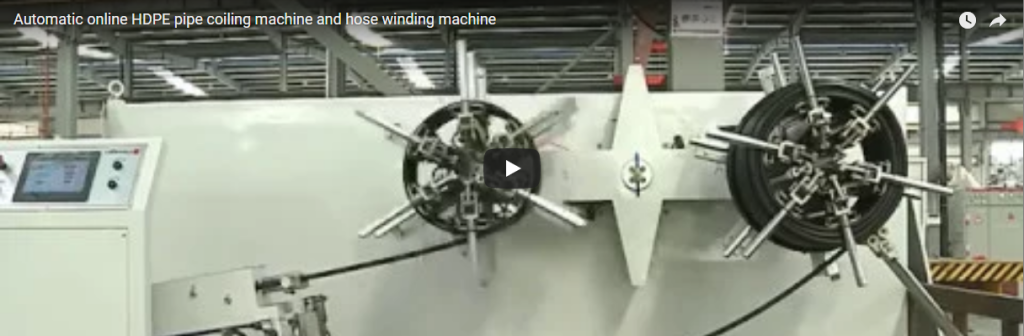
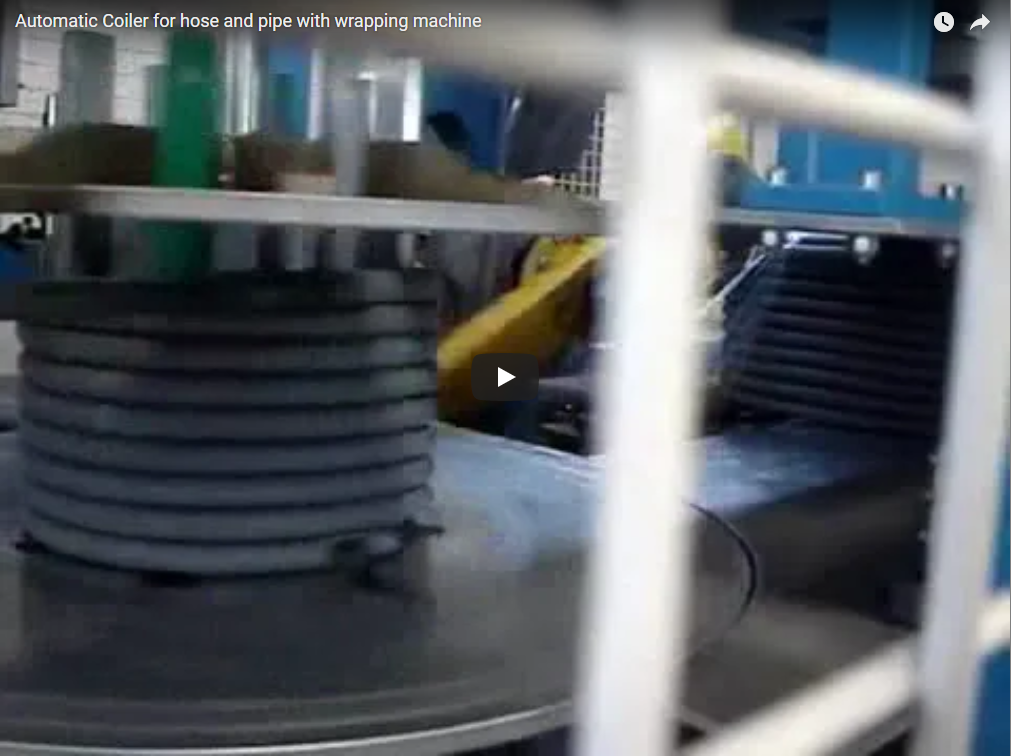
The machine is a pipe winding machine for cylindrical workpieces. The pipe sits horizontally in a central clamping fixture, the fixture closes and rotates the workpiece, and film feeds from above and to the side, winding continuously over the surface. When the wrap completes, the film is cut and a mechanical arm places the wrapped pipe onto a roller conveyor.
The whole sequence runs in one automatic cycle. A metal mesh safety fence lines the work zone, and a white control cabinet carries the operator interface. Pipe range and automation level are confirmed per project.
The working cycle
The footage follows one full cycle. The machine opens with the workpiece in the clamp, the fixture closes and secures the pipe, and the rotation starts the film winding across the surface. When the surface is covered, rotation stops, the clamp opens and the mechanical arm lifts the wrapped pipe onto the conveyor.
The cycle is continuous and automatic, built for repeated production rather than one-off hand wrapping. The conveyor carries the wrapped pipe away and the machine returns to its start ready for the next piece. Cycle steps are confirmed per project.
Film winding and finish
Film feeds from a roll above and to the side of the machine, drawn tight over the rotating pipe so the surface is covered in an even layer. Once the surface is covered, the film tail is handled by the mechanical arm, finishing the wrap cleanly before the pipe is moved out.
Because the pipe rotates under the film, every pass lays the next layer over the previous one, so the coverage is even along the full length. Film width, tension and wrap pattern are selected for the pipe. Film setup is confirmed per project.
What the footage shows
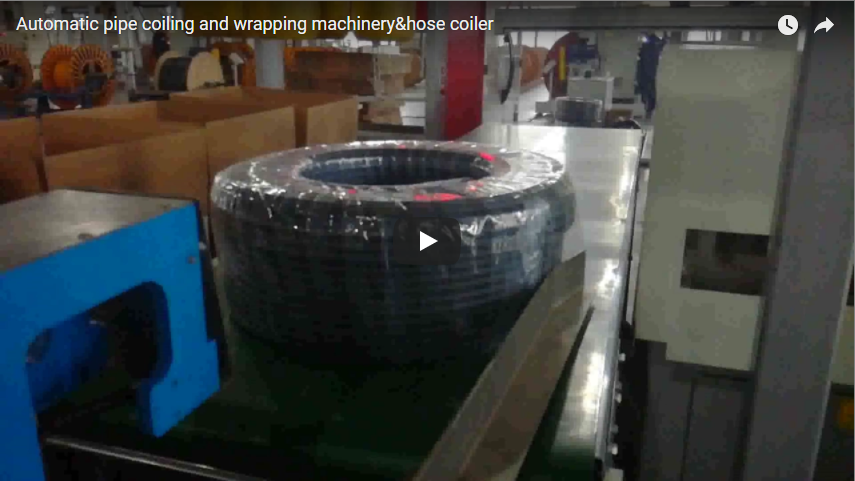
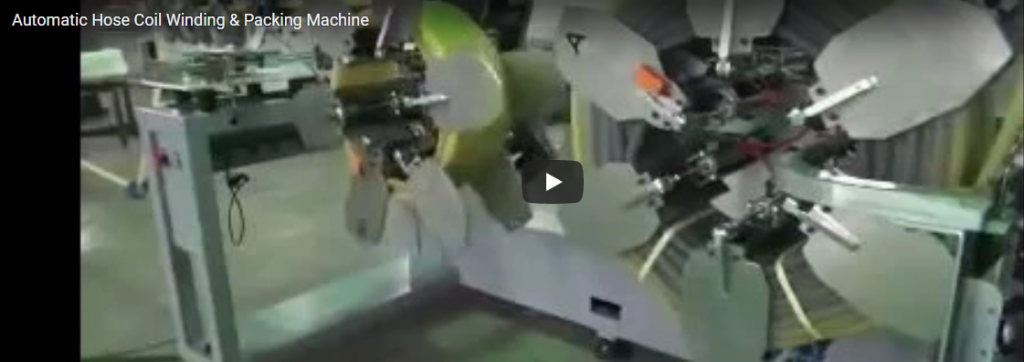
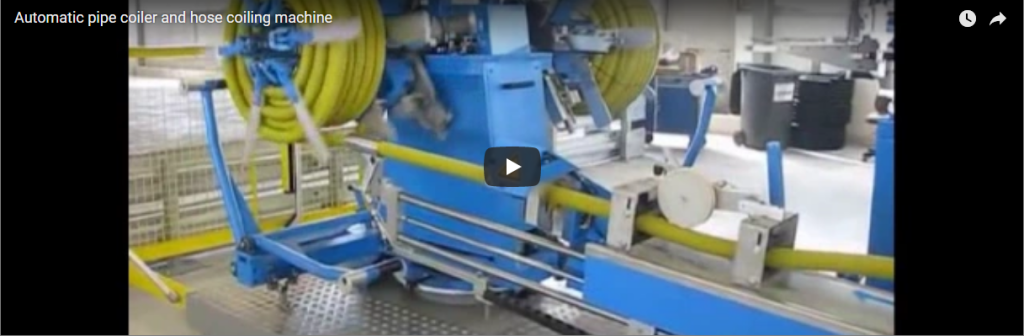
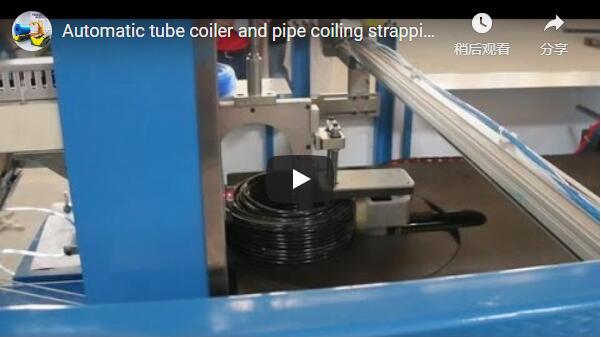
Our footage shows a pipe winding machine wrapping a cylindrical workpiece and placing it on a roller conveyor. It is a general demonstration, so your pipe range and film requirements are confirmed with us per project.
Typical configuration
Figures below list functional design boundaries rather than numeric values, and are confirmed per project.
| Parameter | Typical range, confirmed per project |
|---|---|
| Product | cylindrical pipes |
| Clamp | horizontal fixture |
| Wrap | rotating pipe, film feed |
| Finish | film cutting, arm placement |
| Outfeed | roller conveyor |
| Control | PLC and HMI |
| Electrical supply | 380 V three phase 50 Hz, or 220 V single phase for light machines, selected per project |
Selection checklist
| Question | Confirm per project |
|---|---|
| Pipe range | diameters, lengths, weights |
| Clamp | holding range |
| Wrap | film width, layers, cycle |
| Finish | cut and placement |
| Outfeed | conveyor length, height |
| Control | PLC and HMI options |
| Electrical supply | voltage, phase and frequency on site |
Operation and safety
Run the cycle from the panel and the machine clamps, wraps and places the pipe automatically. Keep clear of the clamping fixture, rotating pipe, film feed and mechanical arm while the machine runs, with guarding and emergency stops at the operator position. The mesh safety fence keeps the moving parts out of reach.
Routine checks cover the clamp drive, rotation, film unit, cutting mechanism, sensors and control, per the machine manual. Confirm the wrap settings against the pipe before each run so pipes wrap evenly.
Engineering FAQ
Q: What does the machine wrap? A: Cylindrical pipes, held horizontally and wound with a protective film layer.
Q: How is the film applied? A: The clamp rotates the pipe while film feeds over the surface in an even layer.
Q: Is the cycle automatic? A: Clamping, wrapping, film cutting and conveyor placement run in one automatic sequence.
Q: What finishes the wrap? A: The film tail is handled by the mechanical arm before the pipe leaves the machine.
Q: What does the footage prove? A: A full automatic wrap and outfeed cycle on a cylindrical workpiece.
Next step
- Email us at info@fhopepack.com with your pipe diameters and lengths.
- We send a winding proposal and a layout drawing within 48 hours.
- We arrange a site survey to confirm pipe range and film requirements.
Related reading
- Automatic pipe coiler and hose coiling machine
- Pipe coiling and strapping machine | hose winding and strapping machine
- Automatic pipe coiler and strapping machine
- FHOPE packing machinery product lines
Sources and standards
- ISO 12100:2010 Safety of machinery, general principles for design and risk assessment
- EN 415-10:2014 Safety of packaging machines, general requirements
- EN ISO 13849-1:2023 Safety of machinery, safety-related parts of control systems
FHOPE pipe winding and coiling machine demonstration video. Reviewed as a general demonstration; pipe range and film confirmed per project.
Last reviewed: 2026-10-11