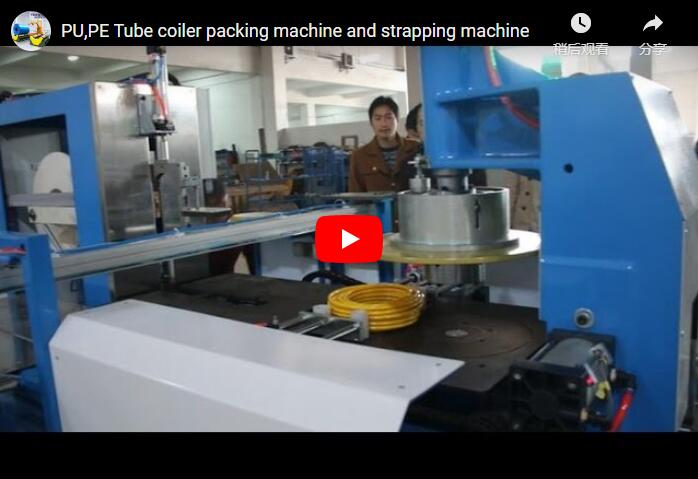
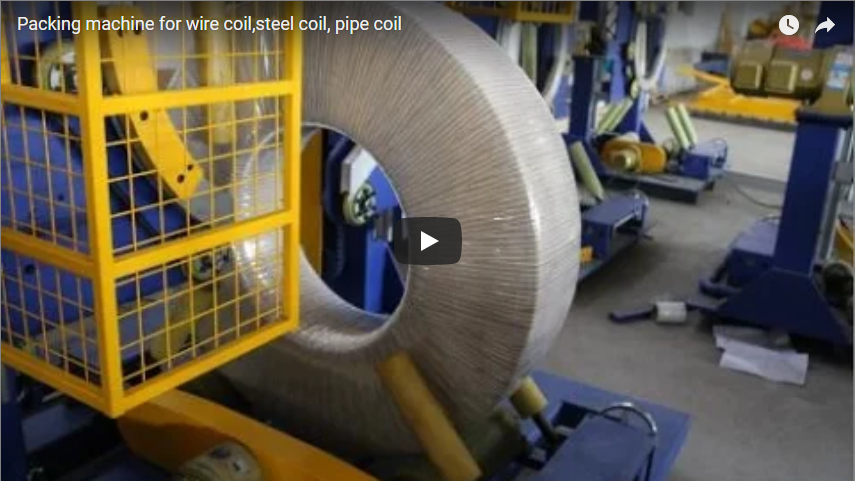
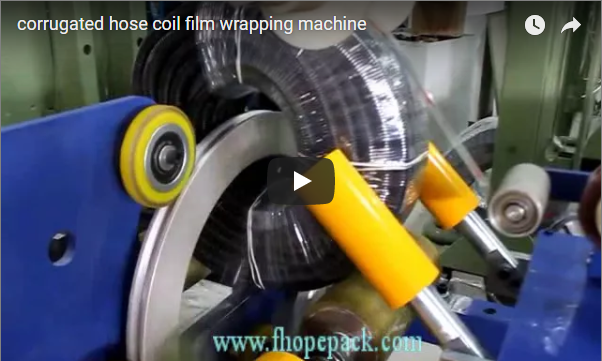
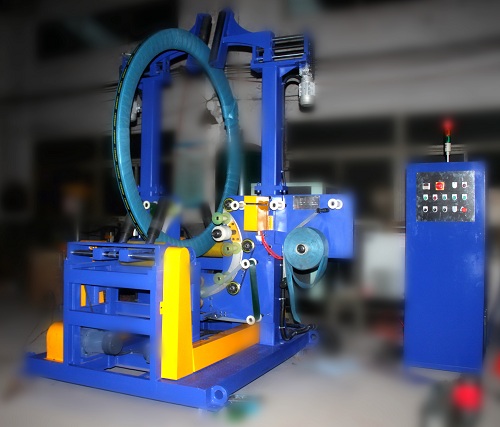
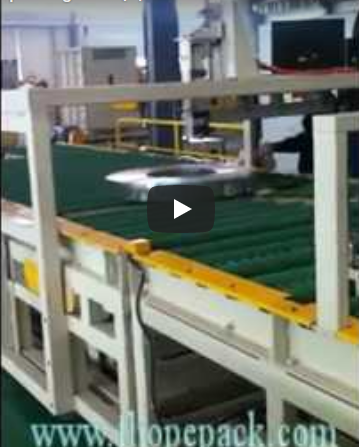
Executive summary This video shows a complete wrap cycle for a large roll of material: inclined infeed, positioning on a rotating platform, vertical-arm wrapping with stretch film, and discharge on a powered roller conveyor. The visible sequence runs from infeed at about 0–4 seconds to a fully wrapped roll exiting the machine around 40–48 seconds. Use this page to understand the workflow, the structure you can see, and the questions to confirm with the manufacturer before purchase.
Why this video matters
Rolls of film, paper, nonwoven, or similar materials are awkward products. They are heavy, round, and they tend to unwind if the outer layers are not secured. A dedicated roll stretch wrapper solves this by rotating the roll against a stationary film carriage, so the load never has to be lifted or spun by hand. The footage on this page records one full cycle of exactly that process, filmed on a working machine.
The video runs about seven minutes, but the informative portion is concentrated in the first minute. After roughly 48 seconds the footage continues to show the wrapped roll traveling away on the outfeed conveyor, which confirms stable, continuous discharge rather than a staged demo.
What the video shows: the full automatic cycle, step by step
Based on the footage, the cycle breaks down into five clear stages:
| Stage | Time in video | What happens |
|---|---|---|
| 1. Infeed | 0–8 s | A large, white, plastic-wrapped roll rests on a flat stainless steel conveyor. The conveyor section tilts upward, lifting the roll onto an inclined roller conveyor. A worker in a blue shirt is briefly visible at the base, guiding the roll. |
| 2. Transfer | 8–16 s | The roll moves up the inclined rollers and levels out onto a horizontal roller conveyor inside the machine envelope. |
| 3. Positioning | 16–20 s | The roll sits on a rotating platform. A vertical support arm begins to move down toward the roll. |
| 4. Wrapping | 20–40 s | The platform rotates the roll while stretch film is applied. The vertical arm stays in position during the wrap; at about 32 seconds the arm begins to lift, and by 36–40 seconds it is fully raised and the wrap is complete. |
| 5. Discharge | 40–48 s | The wrapped roll sits briefly on the platform, then transfers onto a horizontal roller conveyor and moves away from the machine. |
A few observations worth noting for anyone evaluating this class of machine:
- The load rotates, not the film carriage. The vertical arm and film delivery remain fixed in position while the platform spins. This is a common and simple architecture for roll wrapping.
- An operator touch point exists at infeed. The worker visible near the base during the tilt stage suggests manual guiding or loading assistance at the entry point. Whether loading can be fully automated depends on the upstream configuration — check with the manufacturer.
- Discharge is by roller conveyor. The wrapped roll rolls away under its own momentum or conveyor drive, which means the line can continue to a staging area, a palletizing zone, or a downline wrapper without re-handling.
Direct observation notes
The following block keeps the visual report’s factual statements close to their original wording, with only grammar-level edits. It is the evidentiary core of this article.
- The video opens with a large, white, plastic-wrapped roll of material resting on a flat, stainless steel conveyor; the machine’s vertical support frame is visible on the right, and the roll is stationary.
- At 4–8 seconds, the conveyor tilts upwards, lifting the roll; a worker in a blue shirt is briefly visible at the base of the machine, seemingly guiding the roll; the roll is then positioned on an inclined roller conveyor.
- From 8 to 16 seconds, the roll moves along the inclined roller conveyor and then onto a horizontal roller conveyor; the machine’s base is visible.
- At 16–20 seconds, the roll is on a rotating platform and the machine’s vertical arm begins to move down, preparing to wrap the roll.
- From 20 to 32 seconds, the arm is fully lowered and the roll rotates on the platform while the machine wraps it with plastic film; the arm remains in place.
- At 32–40 seconds, the vertical arm begins to lift and is fully raised; the wrapping process is complete and the roll continues rotating briefly.
- From 44 seconds onward, the roll is on a horizontal roller conveyor moving away from the machine; for the remainder of the video, the roll continues to move further away, with the machine’s base visible.
What the video does not show
Honest evaluation requires knowing the limits of the footage. The following points are not visible or verifiable in this video:
- Machine model, dimensions, and load capacity — no nameplate or spec display appears.
- Film specification — gauge, width, and pre-stretch ratio of the stretch film cannot be determined from the footage.
- Cycle time as a rated figure — the visible wrap phase spans roughly 20 seconds of footage, but rated throughput depends on film overlap settings, rotation speed, and conveyor speeds. Verify rated capacity with the manufacturer.
- Control panel and HMI — no screen, buttons, or parameter settings are shown.
- Safety guarding detail — light curtains, e-stops, and guarding layouts are not identifiable.
- Film cut-and-clamp mechanism — the film tail handling at the end of the wrap is not shown in close-up.
- Power requirements and film consumption per roll — request these figures directly.
Technical parameters to confirm before you buy
Because the video shows function but not specification, use this checklist when requesting a quotation. Each item maps to a real decision you will need to make.
| Parameter | Why it matters | Where to get it |
|---|---|---|
| Max roll weight and diameter | Determines frame strength and platform size | Manufacturer datasheet |
| Roll width range | Sets ring/arm clearance and conveyor width | Manufacturer datasheet |
| Cycle time (rated) | Sets line throughput | Manufacturer datasheet or FAT test |
| Film width and pre-stretch % | Drives film cost per roll | Manufacturer datasheet |
| Infeed/outfeed conveyor type and height | Must match upstream and downstream equipment | Layout drawing |
| Loading method (manual vs. auto) | The video shows operator assistance at infeed | Confirm with the manufacturer |
| Control features (recipe storage, counters) | Reduces changeover time | Confirm with the manufacturer |
| Safety package | Compliance with your local standards | Confirm with the manufacturer |
Field optimization guide
Once a roll wrapper like this is installed, most performance gains come from four areas. None of the specific values below are taken from the video — they are standard field practices, and exact settings should be validated with the manufacturer.
1. Film overlap and wrap force. More overlap means better containment but higher film cost. For rolls that tend to telescope or unwind, consistent tension matters more than heavy overlap. Test with your actual product, not a dummy roll.
2. Rotation speed vs. stability. Faster platform rotation shortens the cycle, but light or non-rigid rolls can deform or shift at high speed. Find the speed at which the roll stays round and concentric through the full wrap.
3. Infeed staging. The video shows an operator near the infeed. If rolls arrive consistently, a powered infeed with positioning stops can reduce that labor touch point. If rolls vary in size, keeping a human at infeed may be the safer choice.
4. Outfeed handling. The long outfeed conveyor shown in the footage does two jobs: it buffers wrapped rolls and lets the wrapper start the next cycle sooner. Size the outfeed conveyor to your removal rhythm, not just the machine.
Fit criteria: is this type of machine right for your product?
- ✅ Good fit: cylindrical rolls that are reasonably rigid, produced in repeatable volumes, and already conveyed or palletized before wrapping.
- ✅ Good fit: products where hand wrapping is slow, inconsistent, or causes strain injuries.
- ⚠️ Check first: very light rolls that may shift on a rotating platform; very heavy rolls that exceed platform capacity.
- ❌ Likely poor fit: square or irregular loads — a pallet wrapper or horizontal wrapper is usually better suited.
FAQ
How long does one wrap cycle take? The visible sequence runs from infeed at roughly 0–4 seconds to the wrapped roll leaving the platform around 40–48 seconds. Rated cycle time depends on settings and roll size — check with the manufacturer for a guaranteed figure.
Does the roll rotate or does the machine rotate around it? The roll rotates on a platform while the vertical arm and film delivery stay in position, as shown between 20 and 40 seconds.
Is loading automatic? A worker is briefly visible guiding the roll at infeed, so some manual involvement is shown. Whether fully automatic loading is available — check with the manufacturer.
What film is used? Stretch film is clearly visible being applied, but gauge, width, and pre-stretch cannot be judged from the video — check with the manufacturer.
Can it integrate with existing conveyors? The machine shown feeds and discharges via roller conveyors, which is the standard integration method. Conveyor heights and widths must be matched to your line — request a layout drawing.
What maintenance does it need? Not covered in the video. Typical roll wrapper upkeep involves film carriage components, drive chains, and platform bearings — confirm the maintenance schedule with the manufacturer.
Related reading
- Automatic horizontal stretch wrapper — a different wrapping architecture where the load travels through a rotating ring or arm.
- Stretch wrapping machine overview — the broader product family.
- Automatic pallet wrapping machine — for square or palletized loads.
- Rotary ring stretch wrapping machine — high-speed alternative for stable loads.
Next step
If your product is a roll, coil, or similar cylindrical load, send FHOPE your roll dimensions, weight range, and target cycle time. The team can confirm specifications not shown in this video, recommend the right machine configuration, and provide a layout proposal. Start at the contact page to request drawings and a quotation.
Source and method
The sole factual source for this article is the embedded video. Footage was analyzed frame-by-frame using a local vision model; the video contains background music only, with no narration, so no speech-to-text was performed. All timing references come from the sampled-frame timeline. Specifications, capacities, and settings not visible in the footage are explicitly marked as items to verify with the manufacturer.
Published: 2026-09-03