Executive summary In this 73 s clip, narrow steel coils lie flat on a roller conveyor. A vertical ring wraps each one through the eye in clear stretch film. Downstream, a gantry stacker grips each wrapped coil from the sides and sets it down on the stack. We explain why stacking comes after wrapping, how the stack is built, and which coil sizes the conveyor-fed models cover.
Table of Contents
- What the clip shows
- Station timeline
- Why the coil is wrapped before it is stacked
- How the gantry stacker builds the stack
- Coil range for conveyor-fed wrapping
- Selection checklist for a wrap-and-stack line
- Controls and safety
- Engineering FAQ
- Next step
- Related reading
- Sources
What the clip shows
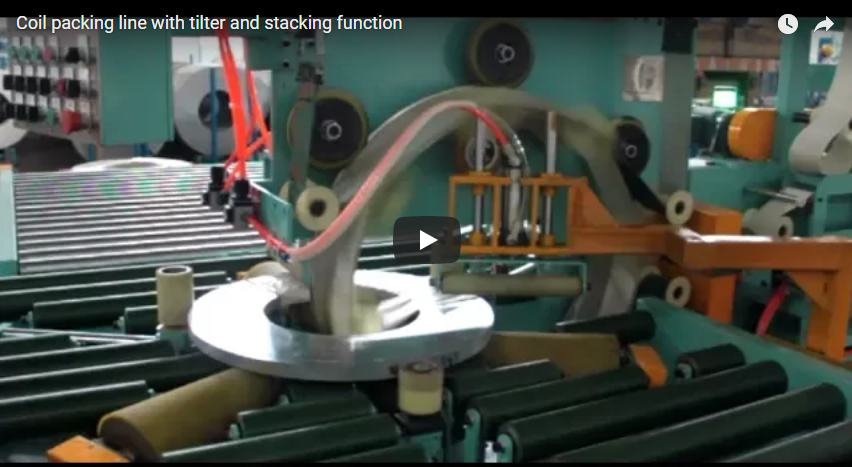
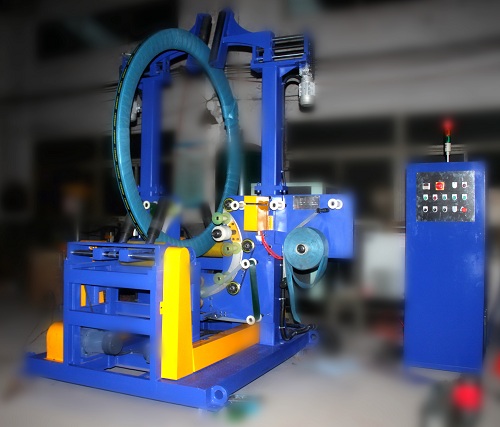
The line consists of a powered roller conveyor, a vertical eye-through wrapping ring and an overhead gantry stacker.
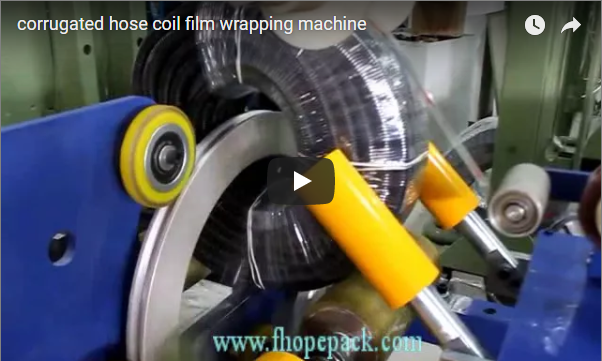
- Wrapping ring: a narrow coil lies flat, eye vertical, on the rollers inside a vertical ring. The ring turns through the eye and lays clear film over the section while the coil rotates.
- Gantry stacker: further down the line, a blue gantry spans the conveyor. Its carriage lowers vertical gripper arms, which hold a wrapped coil by its outer edge and set it down.
- Stack at the end: a second camera angle shows a stack of film-wrapped coils, white in this view, on the rollers between guide arms, ready to leave the line.
Small picture-in-picture windows in the corners show other parts of the same plant at work.
Station timeline
| Station | What happens | Clip time |
|---|---|---|
| Vertical wrapping ring | coil wrapped through the eye in clear film | 0–20 s |
| Gantry stacker | gripper arms lower a wrapped coil onto the stack | about 24–40 s |
| Stack outfeed | finished stack on the rollers, guide arms at the side | about 45–73 s |
Times come from frames taken every 3 s, so each boundary is approximate.
Why the coil is wrapped before it is stacked
Slit coils are narrow and their edges are easy to damage. Wrapping each coil on its own, before stacking, has clear benefits:
- Every coil is sealed through the eye, so it can later be split from the stack without opening the package.
- The ring only needs to fit one coil width, not the full stack height.
- Film protects the faces where one coil sits on the next in the stack.
Our coil packing line programs adjust centring, tension and overlap per coil type, so a thin coil and a wide coil get the same film coverage.
How the gantry stacker builds the stack
The stacker in the clip is a gantry over the conveyor with a carriage that moves up and down.
- A wrapped coil stops under the gantry.
- The gripper arms close on the outer edge of the coil.
- The carriage lifts, and the coil is set down on the stack being built.
- When the stack is complete, the rollers carry it to the outfeed.
On our automatic coil packing line, the quote form allows up to 6 coils per stack. In the clip the coils are stacked eye to sky. Eye-to-wall packing is also offered, with a different handling station from this gantry; see stretch wrapping and downender stacking. Stack height is chosen with your handling: a forklift, a C-hook or a pallet.
Coil range for conveyor-fed wrapping
From our steel coil wrapper model table, the conveyor-loaded models:
| Model | Coil ID | Coil OD | Coil width | Max coil weight |
|---|---|---|---|---|
| FPCA-1000 | 508 / 610 mm | 700–1600 mm | 20–400 mm | 2000 kg |
| FPCA-1200 | 508–610 mm | 800–1400 mm | 20–500 mm | 2500 kg |
These widths match narrow slit coils like those in the clip. The model table is a starting point, not a full list; each line is built to the coil range of the project, so the figures can change.
Selection checklist for a wrap-and-stack line
- Coil ID, OD, width and weight, smallest and largest.
- Coils per hour from the slitter.
- Film, paper or woven wrap, and the overlap needed.
- Stack height, eye to sky or eye to wall, and stack weight.
- Strapping of the stack (PET or steel strap) and labelling for ERP/MES.
- How stacks leave the line: forklift, crane or conveyor to the warehouse.
Controls and safety
The standards that apply depend on the destination market. For CE markets, ISO 12100 sets the risk-assessment method and EN 415-10 covers general requirements for packaging machines, which fixes guarding and the emergency-stop arrangement.
The line runs on a PLC with HMI. Guarding around the ring and under the gantry stacker is set in the risk assessment for each layout.
Engineering FAQ
Q: How does the gantry stacker move a coil onto the stack? A: Vertical gripper arms close on the outer edge of the coil, the carriage lifts, and the coil is set down on the stack on the conveyor.
Q: How many coils can go in one stack? A: Our automatic coil packing line quote form allows up to 6 coils per stack, depending on coil weight and handling.
Q: Which coil widths suit conveyor-fed wrapping? A: Our FPCA-1000 covers 20–400 mm and the FPCA-1200 covers 20–500 mm.
Q: Can the stack be strapped after stacking? A: Yes. PET or steel strapping is an option on our coil packing lines, added as a station after the stacker.
Q: Is film the only wrap option? A: No. Film, paper and woven wrap are all options, set by the program for each coil type.
Next step
We size a wrap-and-stack line in three steps:
- Submit your layout drawing with the coil range, coils per hour and stack pattern, to info@fhopepack.com.
- Receive a proposal within 48 hours, with the wrapper, stacker and conveyor layout.
- Book a site survey so we confirm the slitter exit, floor space and the stack outfeed.
Related reading
- Slit Coil Packing Line for Service Centers: Strapping, Eye-Through Wrapping and Stacking
- Steel Coil Packaging Line from Strapping to Stacking: Five ROI Metrics and a Payback Formula
- Master Coil Eye-Through Wrapper in a Fenced Cell
- Automatic coil packing line
Sources
- Machine in action: the video on YouTube (73 s)
- Stack of up to 6 coils, eye to sky / eye to wall, PET or steel strap, film/paper/woven wrap, ERP/MES labelling, PLC/HMI centring, tension and overlap: Automatic coil packing line
- FPCA-1000 and FPCA-1200 values: Steel coil wrapping machine
- Standards scope: ISO 12100:2010; EN 415-10:2014
- Proposal timing: approved house CTA (proposal within 48 hours)
Last reviewed: 2026-10-06