> **Executive summary**
> A wire rod coil upender turns a coil 90° between lying flat (eye vertical) and standing on its rim (eye horizontal). In this clip the 90° tilt takes about 48 s and the return about 28 s, so a two-way cycle uses most of a 90 s takt.
> Our FZ-H05 hydraulic tilter is specified for 1,000 to 1,800 mm OD and 1,000 to 5,000 kg, configured per project.
Table of Contents
- What the clip shows, in order
- What a wire rod coil upender does
- 90° tilt, hold and return stroke timing
- Hydraulic drive, hold and slow stop
- Takt and the handling envelope
- Selection checklist for a wire rod coil upender
- Controls and safety
- Engineering FAQ
- Next step
- Related reading
- Sources
What the clip shows, in order
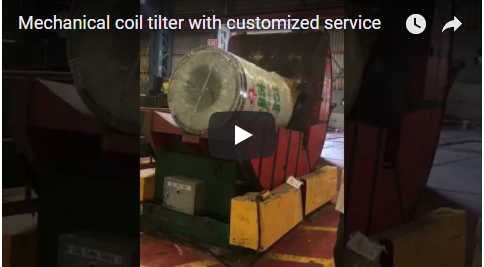
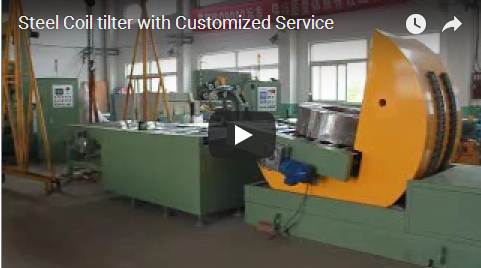
The clip shows one machine from one fixed camera position: a red base, a yellow rotating platform with a clamp arm, and a red power unit with hoses. The coil starts flat, held between platform and clamp. The platform tilts it onto its rim, holds it, and in the last third of the clip returns it flat. No operator enters the rotating area.
What a wire rod coil upender does
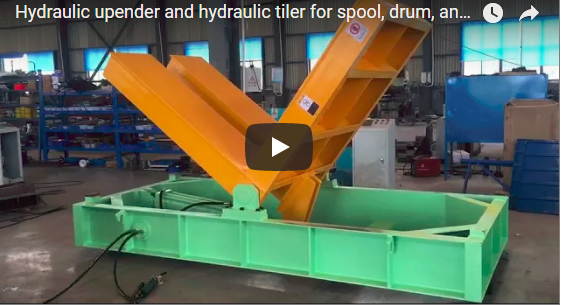
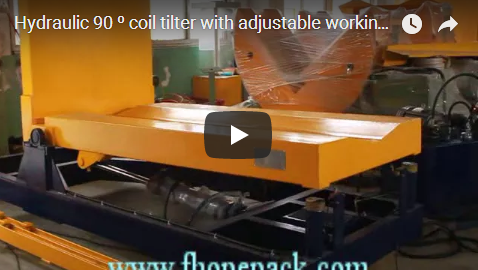
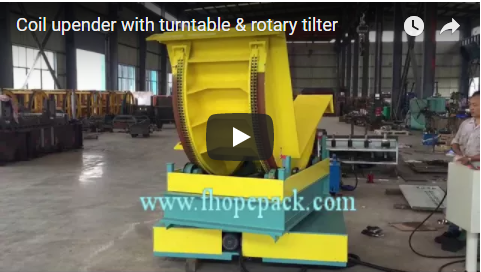
A wire rod coil upender is a hydraulic handling machine that turns a coil 90° between eye-vertical and eye-horizontal so the next station receives it in the attitude it needs.
Eye-vertical vs eye-horizontal coil handling
A wire rod coil arrives from the rolling mill or from storage in one of two attitudes. Eye-vertical means the coil lies flat on its face with the eye axis vertical, as at the start of the clip. Eye-horizontal means it stands on its rim with the eye axis horizontal, as in the middle of the clip.
A wrapping or strapping station may need the coil on its rim, while stacking and fork-lift pickup usually need it flat on its face. The upender makes that 90° change between two conveyors, or between a conveyor and a floor station, for example ahead of [automatic steel wire coil compacting and strapping](https://www.fhopepack.com/videos/how-to-do-steel-wire-compacting-and-strapping-automatically/). For tilting slit coils without edge damage, see our [coil handling, wrapping and strapping line](https://www.fhopepack.com/videos/eliminating-edge-damage-and-telescoping-defects-an-engineering-deep-dive-into-tilting-mechanisms-for-slit-coils/).
A round coil rolls on a flat plate once it stands on its rim, so our upender platforms carry a V bracket that stops it rolling sideways. The clamp holds the coil against the platform through the turn. Platform, cradle and clamp are configured per project.
| Coil upender element | Sized by |
|---|---|
| V bracket on the platform | Coil OD and width |
| Platform deck | Handling method: fork-lift, crane or conveyor |
| Clamp or face plate | Coil weight and face condition |
| Hydraulic cylinders | Load moment |
90° tilt, hold and return stroke timing
A complete cycle of a two-way unit has three parts, and all three take time out of your takt:
1. **Tilt.** The platform turns the coil from flat to on its rim. On the clip this runs from the first frame to about 48 s.
2. **Hold.** The coil stays on its rim for the next handling step, such as strapping or fork-lift pickup. On the clip this lasts from about 48 s to about 72 s.
3. **Return stroke.** The platform brings the coil back to flat. On the clip this runs from about 76 s to 104 s, roughly 28 s of motion.
The full cycle on the clip, including the hold and the short pause before the return, runs to about 104 s, longer than the 90 s example below. A one-way unit that never returns has a shorter cycle than the same frame used two ways:
| Operating mode | Tilt stroke | Return stroke | Machine travel | Left in a 90 s takt |
|---|---|---|---|---|
| One-way upender | about 48 s | none | about 48 s | about 42 s |
| Two-way upender | about 48 s | about 28 s | about 76 s | about 14 s |
Add grip, release and conveyor index time before comparing with your takt.
Hydraulic drive, hold and slow stop
Our tilter is driven by hydraulic cylinders, and the speed and pressure are adjustable on the hydraulic system. A two-way back-pressure circuit keeps the platform from creeping while the coil is held, and soft start and stop limit shock when a heavy coil changes direction. An independent electrical panel puts the control position outside the rotating envelope. We set speed and hold time at commissioning.
Takt and the handling envelope
Takt comes from your output target, not from the machine. For an illustrative target of 40 coils per hour, one coil must leave the upender every 90 s:
| Item | Value |
|---|---|
| Output target (illustrative) | 40 coils per hour |
| Takt, 3,600 ÷ 40 | 90 s per coil |
| Tilt stroke (observed on the clip) | about 48 s |
| Return stroke (observed on the clip) | about 28 s |
| Hold and transfer, left in the budget | 14 s |
| Condition | Sum of the three steps within 90 s |
The two observed strokes take about 76 s, leaving 14 s. Where that is too tight, we shorten the hold with a powered conveyor or run the upender one way only.
Coil envelope is the other half of the check:
| FZ-H05 hydraulic tilter | Specification |
|---|---|
| Load outer diameter | 1,000 to 1,800 mm |
| Load weight | 1,000 to 5,000 kg |
| Worktable length | up to 2,000 mm |
| Turning angle | 90° |
Selection checklist for a wire rod coil upender
- [ ] Coil outer diameter, inner diameter, width and weight range.
- [ ] Arriving attitude and the attitude the next station needs.
- [ ] Turn angle, and whether the unit works one way or returns.
- [ ] Handling method in and out: fork-lift, crane or conveyor.
- [ ] Floor space, foundation and clearance for the rotating envelope.
- [ ] Takt, including the hold and the return stroke.
Controls and safety
The rotating envelope of the platform and coil is the danger zone; keep everyone outside it while the unit runs. Stop, isolate and lock out the power unit before any work on the coil, cradle or clamp, and never leave a coil clamped with the power unit isolated unless it is mechanically supported.
The standards that apply depend on the destination market. For CE markets, EN 415-10 covers general requirements for packaging machines and ISO 12100 sets the risk-assessment method, which fixes guarding and the emergency-stop arrangement.
Engineering FAQ
Q: Why does a wire rod coil need a V cradle on the upender?
A: A round coil rolls once it stands on its rim. Our upender platforms are supplied with a V bracket, so the circular cross-section nests in the V and cannot roll sideways during the 90° turn.
Q: What coil sizes does the FZ-H05 upender take?
A: Loads of 1,000 to 1,800 mm OD and 1,000 to 5,000 kg, on a worktable up to 2,000 mm long, turned 90°.
Q: What coil data do you need before you quote an upender?
A: Send the coil outer diameter, width, weight and arriving attitude, plus the turn angle and takt; we check them against the FZ-H05 envelope above.
Next step
We size a wire rod coil upender in three steps:
1. **Submit your layout drawing** with the coil outer diameter, width, weight, turn angle and takt, to **info@fhopepack.com**.
2. **Receive a proposal within 48 hours**, including the platform and cradle arrangement and the cycle check against your takt.
3. **Book a site survey** so we confirm the handling method, the foundation and the clearance around the rotating envelope.
Related reading
- [Hydraulic tilter FZ-H05](https://www.fhopepack.com/Hydraulic/hydraulic-tilter.html)
- [Customised coil upenders and tilters](https://www.fhopepack.com/Show-Room/Upender/Coil-upenders.html)
- [Large and long coil upenders in real-world operation](https://www.fhopepack.com/videos/large-and-long-coil-upenders-in-real-world-operation/)
- [Multipurpose automatic coil tilter with slide table](https://www.fhopepack.com/videos/multipurpose-automatic-coil-tilter-with-slide-table/)
- [Steel wire coil wrapping and packing machine](https://www.fhopepack.com/videos/steel-wire-coil-wrapping-machine-and-packing-machine-2/)
Sources
- Upender specifications and features: [Hydraulic tilter FZ-H05 product page](https://www.fhopepack.com/Hydraulic/hydraulic-tilter.html)
- V bracket and platform description: [Customised coil upenders and tilters](https://www.fhopepack.com/Show-Room/Upender/Coil-upenders.html)
- Cycle timing: frame timings taken from the clip, 4 s between frames
- Machine in action: [our video on YouTube](https://www.youtube.com/watch?v=xlSbfMziKzk)
- Standards scope: [ISO 12100:2010](https://www.iso.org/standard/51528.html), [EN 415-10:2014](https://www.nen.nl/en/nen-en-415-10-2014-en-191845)
Last reviewed: 2026-10-04