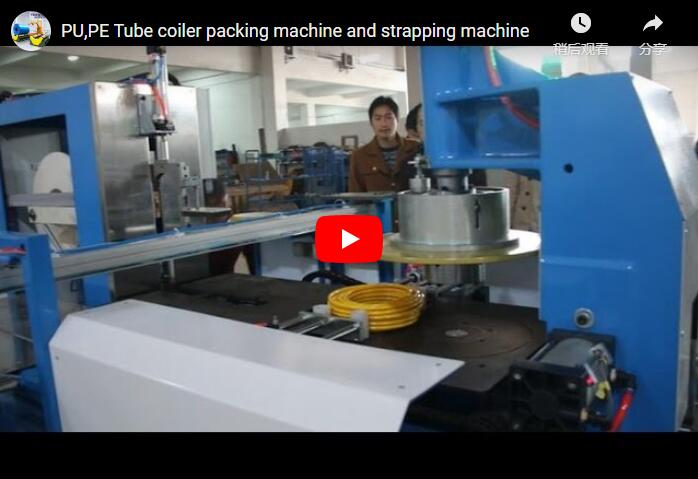
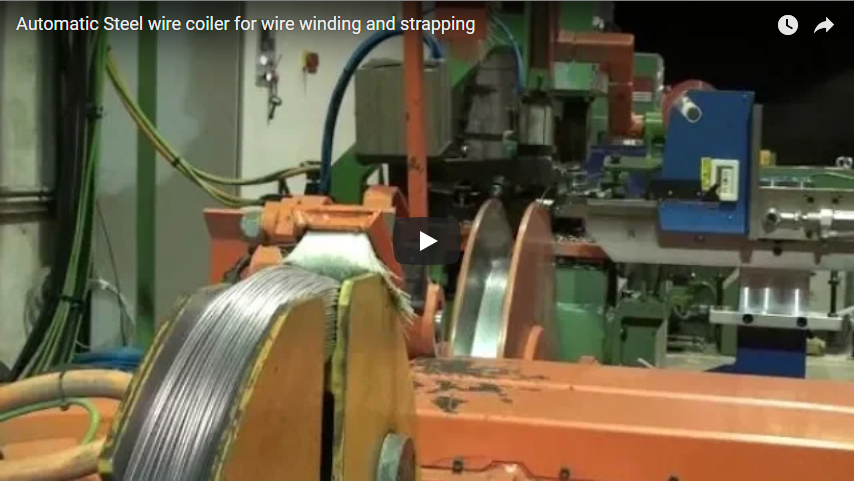
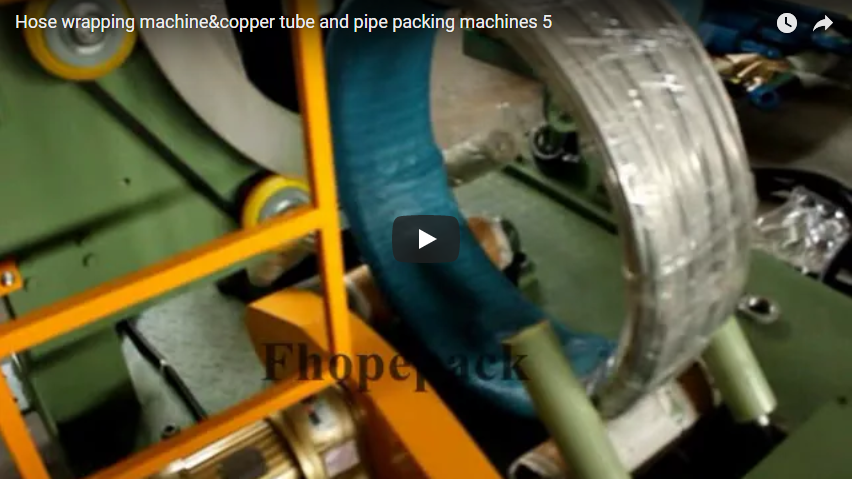
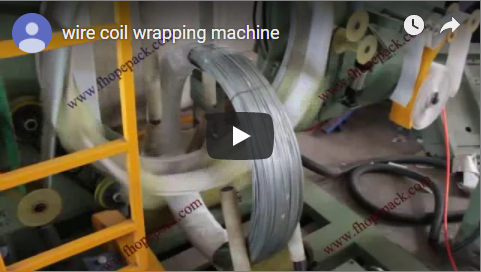
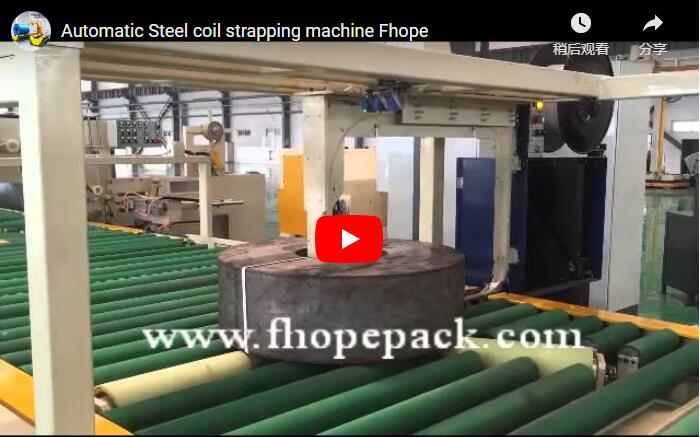
Executive summary Edge damage and telescoping start when a coil is handled loosely or left without cover and bands. Our steel coil packaging line in this video handles the coil at a vertical-coil station with V-shaped rollers, wraps it in white film and bands it with metal strap. The film cover at the edge follows from the film overlap. We set it per project.
Table of Contents
- What the video shows
- Where the line protects the edges
- Film layers at the edge
- Defects and the step that prevents them
- Controls and safety
- Selection checklist for an edge-protecting coil packaging line
- Engineering FAQ
- Next step
- Related reading
- Sources
What the video shows
The video opens on a long steel coil packaging line in a customer plant. At a vertical-coil handling station with V-shaped rollers and control panels, a coil is presented upright.
Further on, coils lying on roller conveyors move under overhead arms and rotating platforms. Film is dispensed at the wrapping station and coils leave covered in white film. The last shots show coils with thin metal strapping bands. FHOPE “PACKING SOLUTION FOR YOU” lettering appears at the line ends.
Where the line protects the edges
| Station | How it protects the coil |
|---|---|
| Vertical-coil handling | V-shaped rollers support the coil instead of a hook |
| Roller conveyors | Coils roll between stations instead of being dragged |
| Film wrapping | Film covers the edges against knocks, dust and moisture |
| Metal strapping | Bands hold the turns so the coil does not telescope |
Each station removes one moment when the coil edge could be knocked or the turns could slip. For a roller station used with heavy coils, see our roller station for big coil packing; for the strapping step on its own, see our automatic steel coil strapping machine.
Film layers at the edge
The film layers over any point follow from the overlap between passes:
Layers ≈ 1 ÷ (1 − overlap)
| Overlap (illustrative) | Layers over each point |
|---|---|
| 50% | 2 |
| 66% | about 3 |
| 75% | 4 |
We set the overlap at the coil OD, where it is lowest, so the edges get at least the layers you specify.
Defects and the step that prevents them
| Defect | Prevented by |
|---|---|
| Edge dents from hooks | V-roller handling and conveyors |
| Scratches from dragging | Rolling on conveyors |
| Rust spots in transit | Full film cover |
| Telescoped turns | Metal bands round the wall |
Tell us which defects your customers reject coils for, and we plan the line around them.
Controls and safety
Coils move on conveyors and under overhead arms, and the wrapper and strapping heads run automatically. Keep people out of the line while it runs, and enter a station only when it is stopped and isolated.
The standards that apply depend on the destination market. For CE markets, ISO 12100 sets the risk-assessment method and EN 415-10 sets general requirements for packaging machines.
Selection checklist for an edge-protecting coil packaging line
- Coil OD, ID, width and weight range.
- Defects your customers reject coils for.
- Film type and overlap.
- Strap material and bands per coil.
- Coils per hour.
- Building space and crane access.
Engineering FAQ
Q: How does the line prevent edge damage? A: By supporting the coil on V-shaped rollers and conveyors, covering the edges in film and banding the turns.
Q: How many film layers cover the edge? A: Layers ≈ 1 ÷ (1 − overlap); 50% overlap gives 2 layers and 75% gives 4.
Q: Where is overlap set? A: At the coil OD, where it is lowest.
Q: What stops telescoping? A: Metal bands round the wall hold the turns together.
Q: Which defects can the line be planned around? A: Edge dents, scratches, rust spots and telescoping; each maps to a station in our defects table.
Next step
We plan your coil packaging line in three steps:
- Submit your layout drawing with coil sizes, output and reject reasons to info@fhopepack.com.
- Receive a proposal within 48 hours, with the station plan and film overlap.
- Book a site survey to check the building and crane access.
Related reading
Sources
- Line content: FHOPE engineering team, 2026-10-04
- Film layer example: our worked example, illustrative values
- Machine in action: our video on YouTube
- Standards scope: ISO 12100:2010, EN 415-10:2014
Last reviewed: 2026-10-04