Precision Orbital Wrapping for Extra-Long Panels: The Ultimate Dust-Proof Solution

Executive summary

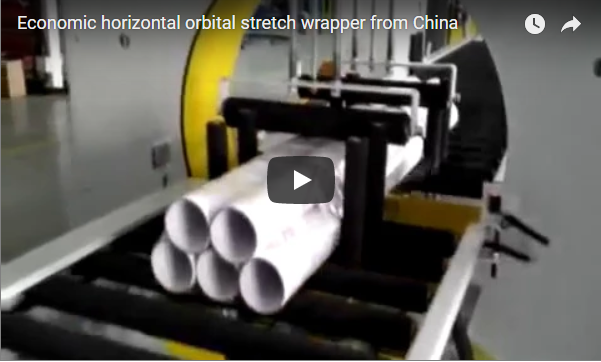
This article reviews the embedded footage of a horizontal orbital stretch wrapper designed for extra-long panels. As sampled, the video shows the line’s handling and feeding side: an overhead vacuum gantry lifts and stacks panels, then a film-wrapped stack of extra-long panels feeds into the blue-framed wrapping station. The orbital wrap action itself is not visible in the sampled frames. Use this page to see what the footage actually proves, and use the checklist at the end to confirm the missing specifications with the manufacturer before you buy.

What the video shows

The video is a factory demonstration with background music and no narration. Twenty frames were sampled at three-second intervals, covering roughly the first minute of footage. The sampled sequence falls into two segments.

Segment 1 — Vacuum handling and stacking (about 0–45 s)

Time What you see
0–6 s A long white panel rests on a roller conveyor. An orange overhead gantry with vacuum cups stands above it, ready.
9–12 s The gantry lifts the panel and moves forward along a blue overhead beam, carrying it over the line.
15–24 s The panel is lowered onto a stack on the right-side output conveyor. A worker is visible at a remote control station in the background.
27–30 s The gantry retracts back toward the loading zone.
33–45 s The gantry extends again, preparing to pick up the next panel.

Segment 2 — Feeding the wrapping station (about 45–60 s)

  • A film-wrapped stack of extra-long panels (light-cyan plastic film over the side and end faces) moves along the roller line into the machine’s working area.
  • The machine — a large blue-framed station with a control cabinet and a film-application mechanism held high — stays idle in these frames; only a small green indicator lamp is lit on the cabinet.
  • Panels are handled as a stack, with no operator in frame during feeding.

What the video does not show

Be honest about the boundary of this footage before drawing conclusions:

  • The orbital wrapping action. No ring rotation, film payoff, or spiral wrap is visible in the sampled frames. The clip captures handling and infeed only.
  • Rated specifications. Maximum panel length, width and height; film width and type; overlap rate; cycle time per panel; ring rotation speed; and conveyor speed are not shown.
  • Machine data. Model number, PLC / HMI details, power rating, air requirement, and certifications (CE, ISO) are not legible.
  • The “dust-proof” envelope. No dust-seal detail, enclosure, or filtration is shown; film overlap can resist dust and light moisture, but the achieved seal must be confirmed.
  • Maintenance and changeover. Nothing in the footage covers setup between panel sizes or service access.

Direct observation notes (from the frame analysis)

  • Machine frame: blue-painted steel frame and support structure; silver cylindrical conveyor rollers mounted on blue supports.
  • Handling unit: orange overhead gantry with rows of vacuum suction cups, travelling along a blue overhead beam.
  • Wrapping station: large blue-framed machine with a control cabinet (small LCD screen, red/green/yellow buttons, and a red mushroom-type emergency stop under a guard) and a film press / application mechanism held high and idle; blue mesh safety fencing surrounds the working area; in Segment 1 a yellow safety railing appears behind the conveyor.
  • Product: long, flat, white/off-white panels with a laminated edge structure (ribbed core); an estimated 12–15 panels per stack with an overall length beyond about 3 metres; the stack is partially covered by light-cyan plastic film.
  • Process observed: panel placed on the input conveyor → lifted and transported by the vacuum gantry → deposited onto the output stack → gantry returns; later a film-wrapped stack feeds into the wrapping station.
  • Readable text: brand watermark printed on the wrapping film reads FNHOPEGROUP and FNHOPEGROUP PACKAGING SOLUTION FOR YOU. No model numbers, warning signs or certification marks are legible in any frame.

The machine in view

The footage shows the two elements of one panel-packaging line: a vacuum handling gantry upstream and a horizontal orbital wrapper downstream.

Component What is visible Role
Vacuum gantry Orange carriage, blue beam, rows of suction cups Lifts heavy panels without contact, avoiding scratches and fingerprints
Roller conveyor Silver rollers, blue supports Carries panels and stacks between stations
Wrapping station Blue frame, film mechanism, control cabinet Applies film around the panels (action not captured in the sampled frames)
Safety package Blue mesh fencing, yellow railing, red emergency stop Guards the moving and wrapping zones

Handling a long, heavy panel by hand risks flexing, edge damage and surface marks. The vacuum lift seen here removes most of that risk before the panels ever reach the wrapper.

Which panels this line suits

Your situation Fit What to check
Long flat panels several metres long Good The orbit ring travels the full length, so the wrap is even along the panel
Coated, printed or high-value surfaces Good Vacuum handling keeps surfaces contact-free
Dust-sensitive panels in storage or transit Good Film overlap plus end coverage resists dust; confirm the seal level
Very thick or oddly shaped sections Check Ring opening and conveyor width set the envelope
Very high throughput Check Cycle time per stack must be confirmed for your rate

Orbital (eye-through) wrapping passes the product through a ring while the film carriage travels around it, applying film in a continuous spiral along the length. That geometry is a good match for long, straight products such as panels and boards.

What to verify with the manufacturer

  1. Panel envelope — maximum length, width and height the line accepts.
  2. Film package — film width, material and achievable overlap percentage.
  3. Cycle time — panels per hour at your panel size and wrap count.
  4. Controls — PLC/HMI, Automatic/Manual/Semi-Auto modes, fault messages.
  5. Utilities and footprint — power, compressed air, and installation space.
  6. Safety package — fencing, light curtains, infeed guards, and certifications.
  7. Integration — whether the vacuum gantry is supplied as one line with the wrapper, and how changeover between panel sizes works.

The product page for this machine lists figures such as a product width up to 1,500 mm, conveyor speeds of 2–4 m/min, ring speeds of 20–100 rpm, a cycle time of 20–60 seconds per unit, and overlap of 10%–60%, with PU-coated rollers and a Siemens-class PLC controller. None of these values is visible in the footage, so treat them as manufacturer claims to confirm, not as video facts.

Frequently asked questions

Does the video show the orbital wrapping actually happening? No. The sampled frames show the vacuum handling and the feeding of a film-wrapped panel stack into the station; the ring rotation and spiral wrap are not visible in this clip. Ask the supplier for a run video of the wrap cycle.

What is the maximum panel size this machine handles? It is not visible in the footage. The page states widths up to 1,500 mm and heights up to 600 mm, but those are manufacturer claims — confirm the envelope for your longest panel.

Can it really keep panels dust-proof? A continuous film wrap with overlapping laps resists dust and light moisture during storage and transport. How far that goes depends on the overlap rate, film choice and how the ends are sealed, so confirm the achieved protection for your dust standard.

Is manual labour still needed? In the footage, the gantry handles the panels automatically and no operator appears during feeding. Confirm the remaining manual steps — film loading, first-panel setup, and changeover between panel sizes.

Does the line also suit aluminium panels, boards, or profiles? The page targets wooden boards, aluminium panels and construction materials. The orbit-ring design suits long, straight products; confirm the fixtures and sizes for the specific panels you produce.

Do I need the vacuum gantry and the wrapper together? The footage shows both as one production flow. You can confirm whether each module is available separately and whether they can be retrofitted to an existing line.

Why orbital wrapping matters for extra-long panels

Hand-wrapping a three-metre panel by hand is slow and uneven: the film wrinkles, gaps appear, and dust enters at the loose ends. An orbital wrapper applies film with even tension and controlled overlap along the whole length in one pass, which is why it is the practical path to a dust-proof, moisture-resistant protective layer for long panels.

Two benefits are directly visible in this footage:

  • Non-contact handling. The vacuum gantry moves panels without touching their surfaces, protecting coated and printed finishes.
  • Batch feeding. Panels are handled as a stack and moved into the station as one unit, which suits continuous-flow packing lines.

Source and method

This article is based on a frame-by-frame visual analysis of the YouTube video embedded above (video ID _dkOIV0rZrQ). Twenty frames were sampled every three seconds (roughly the first 60 seconds of footage) and processed by a vision-language model (qwen3-vl-flash, DashScope cloud endpoint). The raw analysis is archived in vlm_reports/12610-precision-orbital-wrapping-for-extra-long-panels-the-ultimate-dust-proof-solution-cloud.md, and the film watermark text was confirmed in a focused verification pass. The video contains background music and no narration, so no speech transcription was performed. All observations are limited to what is visible in the sampled frames; specifications that are not shown must be confirmed with the manufacturer.

Related reading

Next step

Decide whether orbital wrapping fits your panel line by matching your panel sizes and finish requirements against the checklist above, then ask the supplier to confirm the envelope, film package and cycle time for your actual panels.

Contact the FHOPE sales team for a line assessment and a wrapper sized to your extra-long panels. Use the contact page to start the conversation.

Last updated: 2026-09-02.