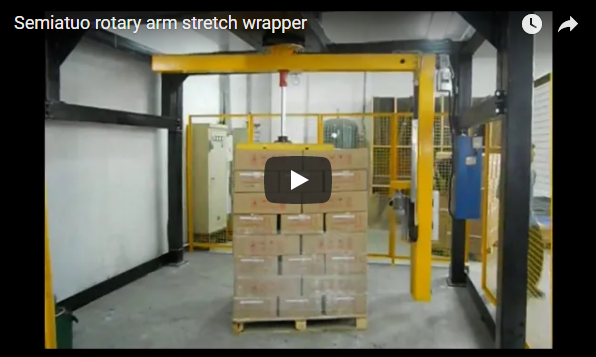
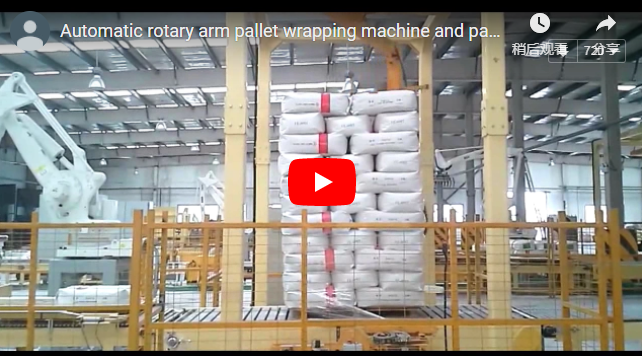
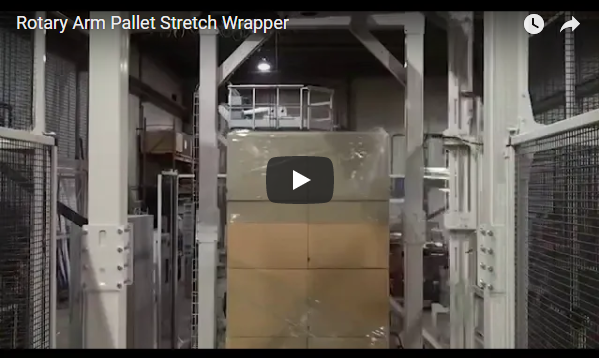
If you are specifying a stretch wrapper for pallets that cannot be spun — stacked pallet boxes, tall or unstable loads, drums of liquid — a semi-automatic rotary arm machine is the configuration to look at first. The load stays standing on the floor while an arm mounted on a column orbits around it, so the wrapper never subjects the load to rotation. Published data for this machine class covers loads up to 1400 × 1400 × 1800 mm (L × W × H), an arm speed of 10–14 rpm, and a rated output of up to 35 pallets per hour. The key decision condition for a purchasing manager or plant engineer is whether that 35 pallets/hour figure holds up for your actual load height and wrap program — the worked cycle-time check below shows where it does and where it does not.
Overview
Why the load must stay still: the rotary arm principle
A turntable wrapper rotates the pallet. That is fine for compact, stable loads, but it becomes a problem when the load is a stack of pallet boxes held together only by their own weight, a tall load with a high centre of gravity, or containers of liquid that should not be spun. In those cases the sensible arrangement is the reverse: keep the load stationary and let the film-carrying mechanism move.
That is exactly what a rotary arm wrapper does. The pallet is set down on the floor — no turntable, no conveyor required in the base configuration. A rotating arm on a vertical column sweeps around the load, paying film from a carriage that travels up and down the load profile. The arm does the turning; the load does nothing. Because the arm orbits rather than carries, the machine’s capacity is not limited by load weight — the floor under the load sets that limit. Confirm the floor condition per project.
How the operator works with the machine
The semi-automatic cycle keeps the operator in the loop for film handling only:
- Tie the film tail to a pallet corner, or slip it under the load.
- Press start. A photo eye detects the load top and the PLC runs the programmed winds — bottom, middle and top zones, each adjustable from 0 to 99 turns.
- When the arm stops, cut the film and press the tail onto the wrap.
- Remove the pallet; the next one can be brought in.
With the optional film clamper and cutter, steps 1 and 3 are handled automatically and the operator’s role reduces to loading and unloading.
Machine data at a glance
| Parameter | Value |
|---|---|
| Working mode | Semi-automatic |
| Output | Up to 35 pallets/hour |
| Arm rotation | 10–14 rpm, variable via inverter |
| Max load (L × W × H) | 1400 × 1400 × 1800 mm |
| Wrap program | Bottom / middle / top, 0–99 winds each |
| Film | LLDPE, 500 mm wide, 76 mm core, roll OD 250 mm |
| Film force | Variable, by separate motor |
| Carriage speed | 2.9 m/min |
| Controls | PLC, photo eye load-height sensor, re-wrap, overwrap and overlap adjustment |
| Counters | Independent top and bottom wrap counters; total and resettable cycle counters |
| Power | 380 V, 3 phase, 60 Hz, adjustable |
| Compressed air | Quoted with 6–8 kgf/cm² clean, dry air |
| Pre-stretch | Powered, up to 250% (semi-automatic R200); other ratios made to order |
| Machine weight | Approx. 650 kg |
| Options | Film clamper and cutter; conveyor of customised length; open-type pre-stretch carriage |
Does 35 pallets/hour hold up? A cycle-time check
Treat the following as an engineering estimation, not a measured claim. At 35 pallets per hour, the entire budget per pallet is about 103 seconds — wrapping plus operator handling.
Take a demanding case: an 1800 mm tall load, arm at 12 rpm (one turn every 5 s), 3 bottom winds plus 3 top winds. The carriage moves at 2900 mm/min ≈ 48 mm/s, so one full up-and-down pass over the load takes 2 × 1800 / 48 ≈ 75 s. The extra bottom and top winds add 6 × 5 = 30 s. Total wrap time ≈ 105 s — already at or slightly over the 103 s budget before any handling time. The work-step budget for this case cross-checks as follows:
| Work step | Calculation | Time |
|---|---|---|
| Carriage up and down the load | 2 × 1800 mm ÷ 48 mm/s | ≈ 75 s |
| Extra bottom and top winds | 6 × 5 s | 30 s |
| Total wrap time | 75 s + 30 s | ≈ 105 s |
| Available budget at 35 pallets/hour | 3600 s ÷ 35 | ≈ 103 s |
The conclusion is practical: 35 pallets/hour is realistic on lower loads or with fewer winds. A 1200 mm load wraps in roughly 80 s under the same settings, leaving about 20 s for the operator to tie, cut and swap the pallet. If your product mix is dominated by full-height loads, either reduce the wrap counts or plan a lower hourly rate — and confirm the achievable rate per project with your load profile.
Film overlap: derived from arm speed and carriage speed
Overlap is not a dial setting someone guesses; it follows directly from how far the carriage climbs during one arm revolution.
At 12 rpm, the arm turns once every 5 s. In those 5 s the carriage climbs 48 mm/s × 5 s ≈ 240 mm. A 500 mm film band laid over that climb overlaps the previous band by 500 − 240 = 260 mm — roughly 50%. At 10 rpm the climb per turn is longer, and the overlap drops to about 42%. Note also that film narrows slightly under tension, so the effective overlap is a little less than the geometric value. This is why the PLC includes a per-program overlap adjustment: set the target overlap for each recipe and let the control reconcile arm speed and carriage speed.
Film consumption at 250% pre-stretch
Another estimation, for a stacked load 1200 × 1000 mm and 1600 mm high, wrapped at 12 rpm with 3 bottom and 3 top winds:
- The carriage covers 2 × 1600 / 240 ≈ 13 turns plus the 6 extra winds = 19 turns.
- Film path per turn: 2 × (1.2 + 1.0) = 4.4 m.
- Film on the load: 19 × 4.4 ≈ 84 m.
- With powered pre-stretch at 250%, film drawn from the roll: 84 / 3.5 ≈ 24 m, per the published worked example.
- Without powered pre-stretch, the same wrap consumes the full 84 m of roll film.
That comparison is the business case for the powered pre-stretch carriage: the same wrap needs only about 24 m of roll film instead of 84 m. Confirm the pre-stretch ratio and film specification per project.
Stacked and tall loads: where this configuration earns its keep
Stacked pallet boxes are held together by weight alone; spinning them on a turntable invites slippage. On a rotary arm machine the stack never moves, which is the whole point. Two practical adjustments improve containment: add extra winds at the joint between boxes and at the base of the load, using the 0–99 wind counters per zone. Near the 1800 mm height limit, check the arm’s clearance under any roof beam or sprinkler line at the intended wrapping spot before you site the machine — this is a layout item, not a machine limitation, and should be confirmed per project.
What to confirm before ordering
- Largest load dimensions: length, width and height against the 1400 × 1400 × 1800 mm envelope.
- Pallets per hour required, by load height and wrap program — use the cycle-time check above.
- Manual film tying, or the clamper and cutter option.
- Floor-standing loads, or a conveyor of customised length.
- Ceiling height at the wrapping position, including arm sweep clearance.
- Power and compressed air available on site: 380 V 3 phase 60 Hz (adjustable) and 6–8 kgf/cm² clean, dry air in the quoted configuration.
Safety and compliance
The applicable design references for this machine family — EN 415-10, EN ISO 12100 and EN 60204-1 — are design methods and risk-assessment frameworks only; they are not a unit certificate. Guarding (perimeter mesh with an interlocked gate, or optoelectronic presence sensing), emergency stop provisions, the electrical disconnect arrangement, and CE documentation and protective documents are agreed per project in the order agreement. Plan the perimeter early: the arm sweeps a full circle around the load position, and that envelope must be kept clear of personnel during the cycle.
Engineering FAQ
Is there a load weight limit? The arm orbits the load and never carries it, so the machine itself imposes no weight limit — the floor bearing capacity at the installation point does. Confirm per project.
What is the maximum load height? 1800 mm, per the published specification.
Can the machine run without an operator tying the film? Yes, with the film clamper and cutter option; the tail is clamped and cut automatically.
Is compressed air mandatory? The quoted configuration includes 6–8 kgf/cm² clean, dry air. Confirm your supply at quotation stage.
Can a conveyor be added later? A conveyor of customised length is available as an option.
Next step
Send us your load sizes and heights and your required pallets per hour. We will select the wrap program and options to match, then send a proposal and quotation.
Related reading
- Rotary stretch wrapper RAS100 (product)
- Semi-automatic rotary arm pallet stretch wrapper
- Rotary arm pallet wrapping machine
- FHOPE R100 rotary arm pallet wrapper with film cutter
- Double rotary arm stretch wrapping machine
- Pallet wrapping machine with auto film cutting
Sources
- Machine specifications, operator sequence, cycle-time, overlap and film-consumption worked examples: FHOPE published data for the semi-automatic rotary arm stretch wrapper (R200 series), fhopepack.com.
- Compliance references cited as design and risk-assessment methods only: EN 415-10, EN ISO 12100, EN 60204-1.