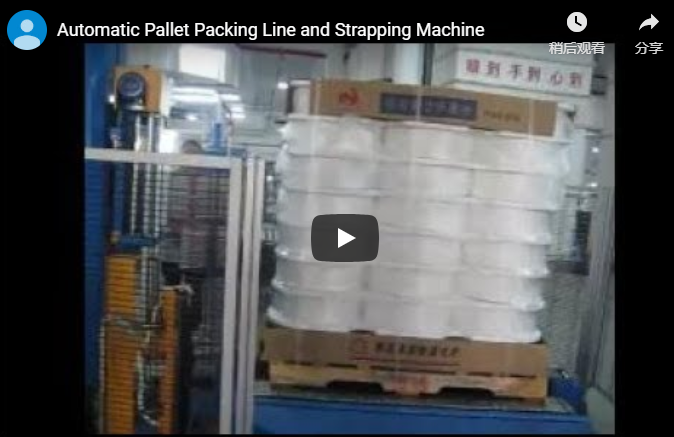
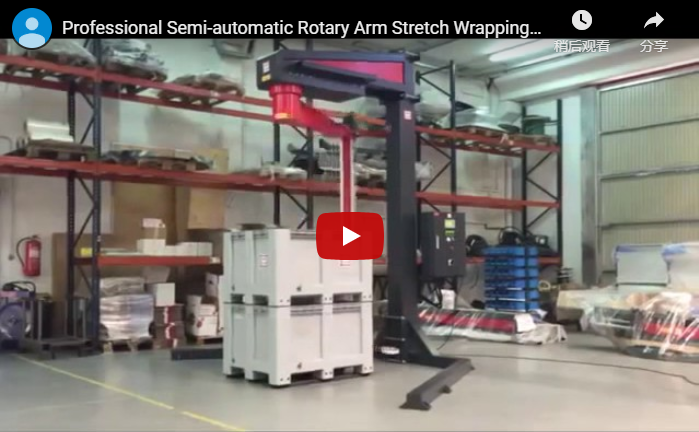
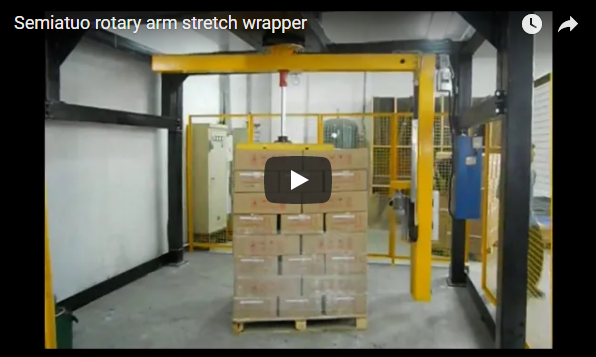
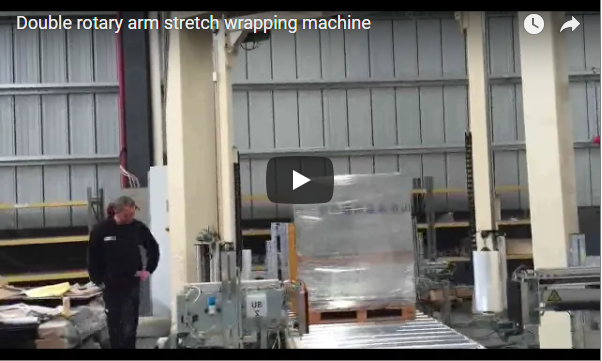
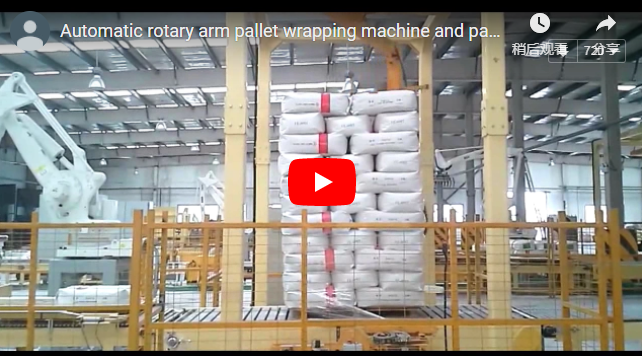
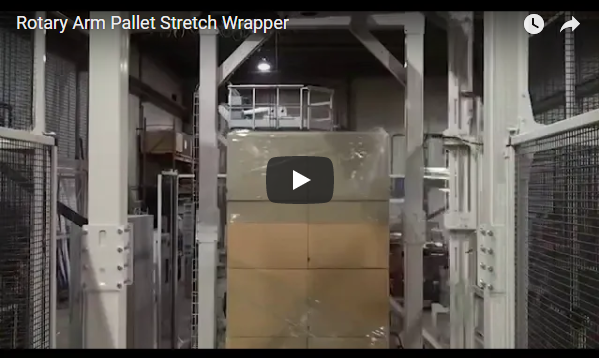
Executive summary The RAS200 automatic rotary arm pallet stretch wrapping machine secures unit loads up to 2,000 kg directly on powered roller conveyors while the pallet remains completely stationary. Equipped with an integrated pneumatic pallet lifter, the system raises the pallet block above conveyor line height, allowing the powered film carriage to apply continuous tension bands through the bottom deck boards and skid blocks—locking cargo and wooden pallet into a single, monolithic unit. This technical document details kinematic motion cycles, film pre-stretch consumption math, EN 415-6 industrial safety compliance, and actual cycle budgets required to sustain 40 to 50 loads per hour.
Table of Contents
- Why bind the film to the pallet
- How the pneumatic pallet lifter works
- RAS200 automated wrapping sequence
- Technical specifications: RAS200 data sheet
- Worked engineering example: cycle budget and arm dynamics
- Application engineering checklist
- Safety design standards: EN 415-6 and ISO 12100
- Frequently asked engineering questions
- Next project steps
- Related systems and documentation
- Reference standards and sources
Why bind the film to the pallet
A stretch-wrap cycle that terminates at the pallet top deck binds the stacked goods to one another, but fails to secure the load to the pallet base. During emergency deceleration inside a transport trailer—where dynamic longitudinal forces exceed 0.8 g under European standard EN 12195-1—friction alone between timber boards and corrugated cardboard or shrink plastic is insufficient. The entire cargo stack can shear cleanly off the wood base.
By driving the film carriage below the roller line, the stretch film grips both the lower container tiers and the bottom bearer boards. This mechanical interlock transforms the cargo and pallet into a unified freight body, preventing load shifting, transit abrasion, and catastrophic rack collapses inside automated high-bay warehouses.
How the pneumatic pallet lifter works
Standard rotary arm machines wrap pallets positioned flush upon conveyor rollers, leaving the structural pallet base inaccessible. The RAS200 overcomes this constraint via an integrated four-point pneumatic scissor lifter mounted directly inside the central conveyor segment.
+---------------------------------------------------------+
|                  Stacked Cargo Block                    |
+---------------------------------------------------------+
| [Pallet Top Deck]                                       |
| [Pneumatic Lifter Raises Load Clear of Conveyor Roller] | <--- Film wraps both
| [Pallet Bottom Skids]                                   |      pallet and cargo
+---------------------------------------------------------+
O O O O [Conveyor Rollers] O O O O- Conveyor Elevation: Heavy-duty pneumatic bellows or twin cylinders lift the pallet 80 mm to 120 mm above roller plane height.
- Full Clearance Wrapping: The rotating arm drives the film carriage down to the exposed stringers and bottom deck, applying high-tension containment layers.
- Optional Top Press Stabilizer: For high-aspect-ratio, lightweight, or unstable layers, an electromechanical overhead scissor plate descends with 300 N to 1,500 N of programmable downforce.
- Top Sheet Cover (TS Dispenser): For IP54/dust-tight or weather-resistant transport, an inline overhead carriage dispenses a polyethylene top film before final wrapping cycles.
RAS200 automated wrapping sequence
[Infeed Conveyor] ---> [Index & Center] ---> [Pneumatic Lift & Clamp]
                             |
                             v
[Outfeed Conveyor] <--- [Cut & Wipe Seal] <--- [Rotary Arm Wrap Up/Down]- Infeed & Positioning: Optical sensors detect load entry; variable frequency drive (VFD) rollers decelerate the pallet into positive mechanical alignment.
- Pneumatic Lift & Stabilization: The sub-conveyor lifter elevates the load; optional overhead top press secures loose layers.
- Rotary Wrapping Cycle: The cantilever arm accelerates along a smooth S-curve ramp. The motorized power pre-stretch carriage applies programmable base wraps, traverses upward to pallet top height via ultrasonic sensor detection, overlaps the crown, and wraps downward.
- Film Clamp, Cut & Weld: At the cycle base, an air-actuated clamp catches the web, a hot-wire/impulse blade executes a clean sever, and an active pneumatic brush wipes the film tail firmly against the pallet face.
- De-elevation & Discharge: The lifter drops flush into the conveyor bed; motorized outfeed rollers advance the wrapped unit to downstream transport lines.
Technical specifications: RAS200 data sheet
| Machine Parameter | RAS200 Engineering Specification |
|---|---|
| Control Architecture | Siemens S7-1200 PLC with 7-inch color HMI touchscreen |
| Maximum Load Dimensions | 1,200 × 1,200 × 2,000 mm (L × W × H) |
| Maximum Load Capacity | 2,000 kg (pallet stationary during complete wrapping cycle) |
| Line Throughput | 40–50 pallets/hour (conveyor-speed and layer dependent) |
| Film Pre-stretch System | Motorized power pre-stretch (standard 200%, options 250%–300%) |
| Film Tension Regulation | Constant torque load-cell dynamic compensation |
| Rotary Arm Rotation Speed | 6–22 RPM (inverter-controlled with programmable S-curves) |
| Pneumatic Operating Pressure | 0.4–0.6 MPa (4.0–6.0 bar clean, dry compressed air) |
| Electrical Supply | 3-phase 380 V / 400 V, 50/60 Hz, 4.5 kW total installed load |
| Machine Dead Weight | 1,500 kg (structural carbon steel frame) |
| Modular Station Options | Scissor-type pallet lifter, top press plate, TS top sheet dispenser |
Worked engineering example: cycle budget and arm dynamics
Consider a customer unit load: 1,200 mm × 1,000 mm footprint, 1,400 mm stack height, weighing 1,500 kg.
1. Line Time Budget vs. Throughput
- At 50 pallets/hour: T_total = 3,600 s ÷ 50 = 72.0 s per pallet
- At 40 pallets/hour: T_total = 3,600 s ÷ 40 = 90.0 s per pallet
Fixed transfer and auxiliary times consume a substantial portion of this budget:
- Infeed conveyor entry and soft deceleration: 12.0 s
- Lifter elevation + top press down: 3.5 s
- Film clamping, cutting, and pneumatic wiping: 4.5 s
- Lifter lowering + outfeed conveyor transfer: 12.0 s
- Total auxiliary cycle time (T_aux): 32.0 s
Net time window available for rotary arm rotation (T_wrap):
- For 50 loads/h: T_wrap = 72.0 s – 32.0 s = 40.0 s
- For 40 loads/h: T_wrap = 90.0 s – 32.0 s = 58.0 s
2. Film Turns & Overlap Geometry
Using 500 mm film roll width with 50% vertical overlap, the carriage vertical advance per arm rotation is:
Pitch = 500 mm × (1 - 0.50) = 250 mm/revolution
- Ascending traversal turns:
1,400 mm ÷ 250 mm = 5.6 turns - Descending traversal turns:
1,400 mm ÷ 250 mm = 5.6 turns - Bottom containment wraps (binding pallet skids): 3.0 turns
- Top stabilization reinforcement wraps: 2.0 turns
- Total required rotations (N_turns): 5.6 + 5.6 + 3.0 + 2.0 = 16.2 turns
3. Dynamic Rotary Arm Speed Matrix
Because the arm mass requires 2.0 s acceleration and 2.0 s deceleration (4.0 s total non-steady-state time), effective steady-state RPM must be calculated accurately:
| Allowed Net Wrap Window | Kinematic Profile | Arm Steady Speed Required | Feasibility & Structural Status |
|---|---|---|---|
| 40 s (Target: 50 p/h) | 4 s ramp + 36 s steady | 25.2 RPM | Requires high-speed drive & dynamic balancing |
| 48 s (Target: 45 p/h) | 4 s ramp + 44 s steady | 21.1 RPM | Standard RAS200 high-throughput zone |
| 58 s (Target: 40 p/h) | 4 s ramp + 54 s steady | 17.4 RPM | Standard operational speed; low mechanical fatigue |
4. Stretch Film Material Consumption
- Pallet cross-sectional perimeter:
2 × (1,200 mm + 1,000 mm) = 4,400 mm = 4.4 m - Applied film perimeter for 16.2 turns:
16.2 × 4.4 m = 71.28 m applied - At a fixed 200% power pre-stretch ratio (stretch factor = 1 + 2.00 = 3.0):
Roll film unwound = 71.28 m ÷ 3.0 = 23.76 m per pallet
Application engineering checklist
To receive an engineered footprint and firm commercial quotation within 24 hours, specify the following parameters:
- Load Dimensions: Minimum and maximum footprint (L × W) and vertical stack height (H).
- Weight Boundaries: Minimum load stability threshold and maximum gross weight (kg).
- Pallet Integration: Pallet types (Euro, CHEP, GMA) and confirmation if film must bind the wooden skids.
- Throughput Target: Sustained pallets per hour (pph) and conveyor roller pass-line elevation.
- Load Stability: Presence of loose cartons, top-heavy barrels, or requirement for scissor top press.
- Environmental Protection: Need for inline automatic polyethylene top sheet (TS module).
- Site Utilities: Available factory line voltage (V / Hz) and compressed air supply capacity.
Safety design standards: EN 415-6 and ISO 12100
The RAS200 complies with safety engineering directives for packaging machinery:
- EN 415-6 Harmonized Compliance: Evaluates all crushing, shearing, and drawing-in hazards generated by the rotary arm sweep and pallet lifting equipment.
- ISO 12100:2010 Risk Mitigation: Incorporates intrinsic fail-safe engineering controls throughout rotating and pneumatic assemblies.
- Perimeter Fencing & Access Interlocks: Heavy-duty RAL 1021 perimeter guarding (minimum 2,000 mm height) equipped with Cat.4 / PLd dual-channel interlock switches on maintenance access doors.
- Optical Safety Curtains: Category 4 optical mute light curtains at conveyor infeed and outfeed openings distinguish moving pallets from personnel intrusion.
- Pneumatic Safety Dump: In the event of an Emergency Stop (E-stop), mechanical check valves lock the pallet lifter and top plate in position to prevent gravity-induced dropping.
Frequently asked engineering questions
Q: Why is pallet lifting superior to standard turntable wrapping on conveyors? A: On powered roller lines, roller tubes shield the bottom 100–150 mm of the pallet, preventing film from anchoring the base. The pneumatic lifter raises the pallet clear of the rollers, enabling full perimeter banding. Furthermore, heavy loads (up to 2,000 kg) remain completely stationary, eliminating centrifugal tipping forces inherent in turntable systems.
Q: How does the power pre-stretch carriage maintain constant tension without crushing carton corners? A: The carriage utilizes twin geared rollers operating at differential speeds to stretch film 200% prior to leaving the carriage. A sensitive load-cell dancer roller dynamically adjusts the carriage feed motor via closed-loop PID control, maintaining wrap tension within ±2 N regardless of pallet diagonal variations.
Q: Can the RAS200 handle irregular, non-rectangular cargo? A: Yes. Because the pallet does not rotate, odd-shaped, off-center, or hanging machinery parts can be secured without dynamic unbalance or wobble.
Next project steps
- Send Technical Parameters: Transmit your pallet matrix, line elevation, and throughput goals to info@fhopepack.com.
- Engineering Review: Our systems engineering team delivers a 2D layout drawing, kinematic cycle breakdown, and detailed quotation within 24 hours.
- FAT Validation: Full Factory Acceptance Testing with customer pallets before line dispatch.
Related systems and documentation
- Rotary arm stretch wrapper RAS200 technical details
- Automatic rotary arm pallet wrapping machine with top sheet covering
- Rotary arm pallet wrapper with top film dispenser
- Semi-auto rotary arm stretch wrapper
- Automatic rotary arm wrapper with top sheet and corner applicator
- Fully automatic pallet wrapping machinery line
Reference standards and sources
- Machinery Safety Standards: EN 415-6 (Safety of packaging machines – Pallet wrapping machines); EN ISO 12100:2010 (Safety of machinery – General principles for design).
- Load Securing Regulations: European Standard EN 12195-1 (Load restraining on road vehicles).
- Machine Demonstration: FHOPE Packaging Rotary Arm Pallet Wrapping Machine Demonstration
- Technical Data: FHOPE Packaging RAS200 engineering manual and conveyor integration archives.
Last technical review: 2026-10-17 | Authored by OEM Principal Packaging Engineer