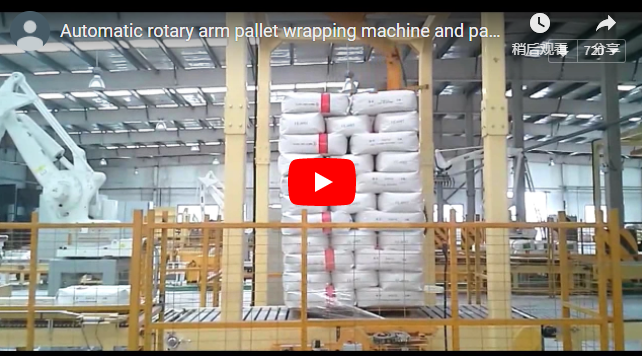
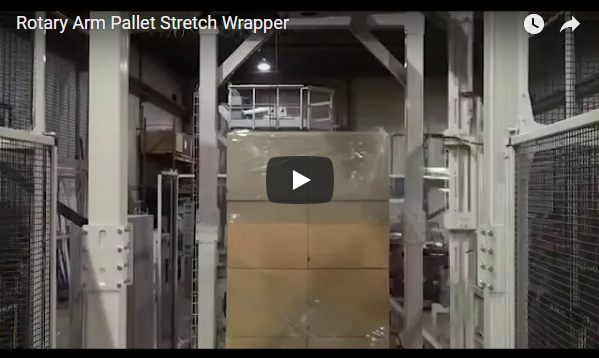
Executive summary Our R200 semi-auto rotary arm stretch wrapper keeps the pallet still on the floor while a gantry-mounted arm wraps it. Its powered carriage pre-stretches the film up to 250% before it reaches the load, which cuts the film drawn off the roll. Surround fencing, a pneumatic top plate and an automatic film grab and cut are available. A worked example shows how much film a carton pallet uses at two pre-stretch levels.
Table of Contents
- Where a semi-auto rotary arm fits
- What powered pre-stretch does to film use
- Gantry, ring bearing and carriage
- R200 features and options
- Worked example: film for one carton pallet
- Selection checklist: what to send us
- Safety and EN 415-6
- Engineering FAQ
- Next step
- Related reading
- Sources
Where a semi-auto rotary arm fits
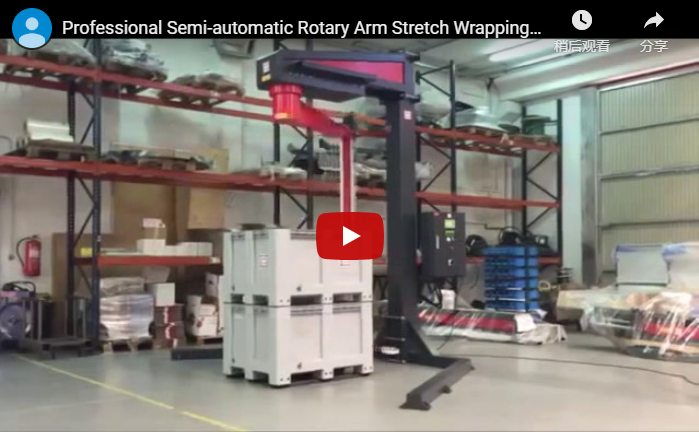
A semi-auto wrapper suits warehouses and lines with moderate volumes. A pallet truck or forklift sets the load in the station, the operator attaches the film and starts the cycle, and then cuts the film at the end.
Because the arm turns and the pallet does not, the R200 handles loads that are very tall, too heavy for a turntable, or so light they would shift if spun. It is used in chemicals, electronics, building materials, appliances, paper, food and beverage.
What powered pre-stretch does to film use
In a powered pre-stretch carriage, the film passes between two rollers driven at different speeds. The second roller runs faster, so the film is stretched before it touches the load. At 250% pre-stretch, each metre drawn off the roll becomes 3.5 m on the pallet.
Stretched film is thinner and stronger in holding force per gram. The load is held by tension, not by layers of slack film. A dancer bar and a separate DC motor feed the film at a variable speed, so tension stays even as the arm passes the corners.
Gantry, ring bearing and carriage
The arm hangs from a standing gantry reinforced with a steel cross member. It turns on a heavy ring bearing with soft start and soft stop. A heavy-duty double chain lifts the carriage, and the carriage door opens for an easy roll change and film threading.
The OMRON PLC sets separate counts for top, bottom and up-down wraps. A photo-eye finds the top of the load, and reinforced wrapping adds turns at chosen heights.
R200 features and options
| Item | R200 |
|---|---|
| Working mode | semi-automatic |
| Control | OMRON PLC, separate start, reset and emergency stop buttons |
| Pre-stretch | powered, up to 250%; other ratios to order |
| Film feed | variable speed by separate DC motor, with dancer bar |
| Arm and carriage speed | each variable, arm speed by inverter |
| Height sensing | photo-eye |
| Safety | blocker detection with automatic stop |
| Packing height | up to 2,500 mm option |
| Options | surround fencing; pneumatic top plate; pneumatic film grab and cut; remote control |
Arm speed and output are confirmed for your loads when we quote.
Worked example: film for one carton pallet
Take a pallet of cartons 1,200 × 1,000 mm and 1,050 mm high, wrapped with 500 mm film 23 µm thick. These are illustrative customer figures.
Turns. At 50% overlap the carriage climbs 250 mm per turn. Up and down is 1,050 ÷ 250 × 2 = 8.4 turns. With 2 extra turns at the bottom and 2 at the top, that is 12.4 turns.
Film on the load. The perimeter is 2 × (1,200 + 1,000) = 4,400 mm, so the pallet carries 12.4 × 4.4 = 54.6 m of stretched film.
Film off the roll. At 250% pre-stretch, 54.6 ÷ 3.5 = 15.6 m leaves the roll. At 100% it would be 54.6 ÷ 2 = 27.3 m.
Weight. One metre of film 500 mm wide and 23 µm thick weighs 0.000023 m × 0.5 m × 1 m × 920 kg/m³ = 0.0106 kg, or 10.6 g. So one pallet uses 15.6 × 10.6 = 165 g at 250%, against 27.3 × 10.6 = 289 g at 100%. Over 100 pallets, that is about 16.5 kg against 28.9 kg.
Cycle time. Wrap time is 12.4 ÷ n minutes at an arm speed of n r/min. Add the time to place the load, tie on and cut the film.
Selection checklist: what to send us
- Pallet size and maximum load height.
- Load weight and how stable the stack is.
- The film you use now: width and thickness.
- Pallets per shift.
- Whether you need fencing, a top plate or automatic cutting.
- Power supply at site.
Safety and EN 415-6
We design the R200 to EN 415-6 for pallet wrapping machines and assess risks to ISO 12100. The turning arm and the carriage are the main hazards. Blocker detection on the carriage stops the arm if it meets an obstacle. With the surround fencing option, a yellow mesh fence with doors closes off the station, and an emergency stop sits beside it.
Engineering FAQ
Q: Does higher pre-stretch weaken the wrap? A: Not when the film suits it. Stretched film is held at tension, and the number of turns sets the holding force.
Q: Can I add automatic cutting later? A: The pneumatic film grab and cut system is an option on the R200. Tell us at the quote stage so the carriage is prepared.
Q: How tall can the load be? A: Packing height up to 2,500 mm is available.
Q: Which safety standards apply? A: In CE markets, EN 415-6 covers pallet wrapping machines and ISO 12100 the risk assessment.
Next step
- Email your pallet sizes, film type and pallets per shift to info@fhopepack.com.
- We reply within 24 hours with a proposal, including the pre-stretch ratio for your film.
- We send a layout drawing showing the gantry, fencing and loading side.
Related reading
- Semi-auto rotary arm stretch wrapper R200
- Stretch film and packing material
- R100 rotary arm pallet wrapping machine
- Rotate arm stretch wrapping machine, pallet wrapping machine
- FHOPE-R100 rotary arm pallet wrapper with film cutter
- Height pallet packing machine with top press device
Sources
- Specifications: FHOPE semi-auto rotary arm stretch wrapper R200 product page
- Machine video: semi-auto rotary arm stretch wrapper on YouTube
- Film use and weight: our worked example, illustrative film and load figures
- Standards: EN 415-6 (pallet wrapping machines); ISO 12100:2010
Last reviewed: 2026-10-17