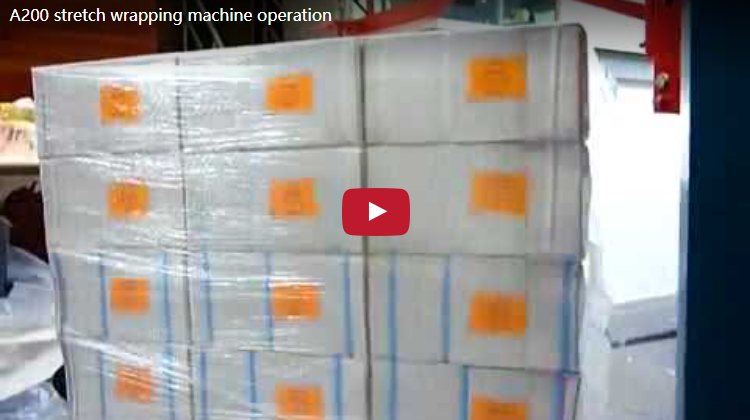
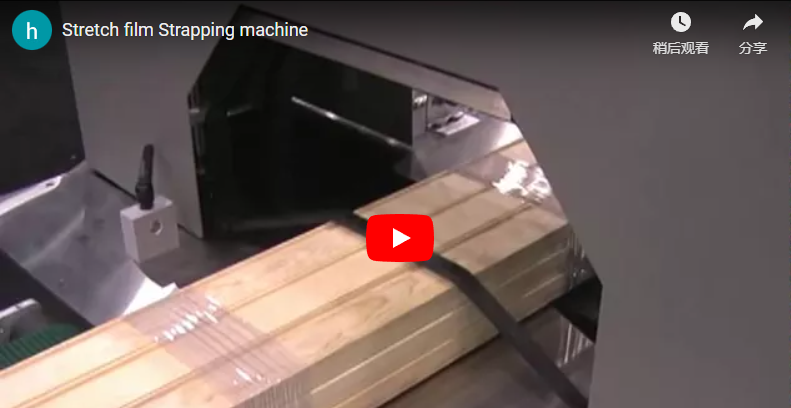
Executive summary The R100 is our rotary arm pallet wrapper: the pallet stays still on the floor while an arm carries the film roll around it. Our R100 is specified for loads up to 1,300 × 1,300 × 2,300 mm and about 35 pallets an hour, configured per project. The machine here carries our optional automatic film cutter, which cuts the film at the end of each cycle; the standard R100 is cut by hand.
Table of Contents
- When a rotary arm beats a turntable
- R100 specifications
- One cycle, step by step
- Manual vs automatic film cut
- Worked example: wrap time for one pallet
- Selection checklist: what to send us
- Safety and EN 415-6
- Engineering FAQ
- Next step
- Related reading
- Sources
When a rotary arm beats a turntable
In general, a turntable wrapper spins the pallet. That is fine for a stable, light stack, but a tall or top-heavy load can lean or shed cartons as it turns. On the R100 we turn the arm instead, so the load stays still for the whole wrap. It also helps when the load is too heavy for a turntable, or when a forklift has to drop the pallet straight into the wrap area without lining it up on a disc.
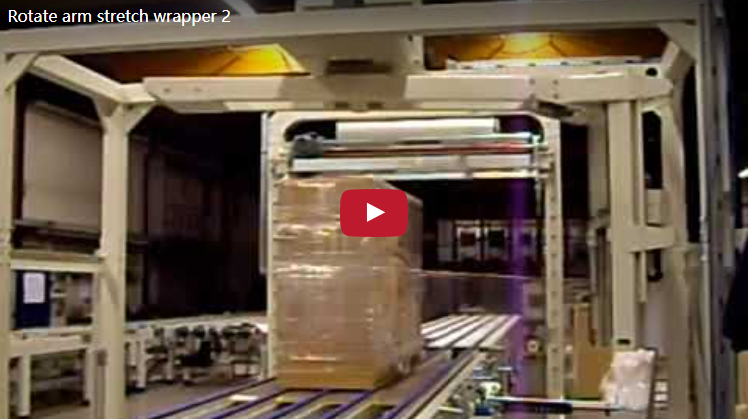
Our semi-automatic rotary arm stretch wrapper cycle shows the same principle.
R100 specifications
These are the specifications of our R100 range; the final values are configured per project.
| Item | Our R100 range |
|---|---|
| Working mode | Semi-automatic |
| Output | About 35 pallets per hour |
| Arm speed | 10 to 14 rpm, set by inverter |
| Maximum load | L 1,300 × W 1,300 × H 2,300 mm |
| Film | LLDPE, roll OD 250 mm, core ID 76 mm, width 500 mm |
| Carriage speed | 2.9 m/min |
| Wrap layers | Bottom, middle and top, 0 to 99 winds each |
| Air supply | 6 to 8 kgf/cm², clean and dry |
| Machine weight | About 650 kg |
Our R100 range also includes film tension set by a separate motor, a photo-eye for the load height, PLC re-wrap, overlap and reinforcement settings, and automatic arm position reset.
One cycle, step by step
On our R100 range, as described on its product page, a cycle runs like this:
- The load is set in place and the start button is pressed; the R100 is semi-automatic.
- The arm soft-starts, and its speed is variable by inverter.
- The photo-eye senses the load height, and the PLC applies the set bottom, middle and top winds.
- At the end of the cycle the arm resets to its position on its own.
- The arm pulls film from its roll holder on every turn and finishes back at its start position.
- The film is cut: by hand on the standard R100, or by the automatic cutter where it is fitted, as on this machine.
Manual vs automatic film cut
The standard R100 is a manual-cut machine: after packing, the operator cuts the film by hand. The automatic film cutter is an option, and this machine is fitted with it. Both run the same wrap; the difference is what happens in the last few seconds of the cycle.
| Manual cut (standard R100) | Automatic cut (option) | |
|---|---|---|
| How it works | The arm stops at its start position; the operator walks to the load, cuts the film and presses the tail onto the wrap | At the end of the cycle the arm carries the film tail to the cutting position and the cutter cuts it, with no one at the load |
| Cycle time | The cut is an extra manual step after the arm resets, so the pallet waits for the operator | The cut is part of the machine cycle, so the pallet is ready when the arm stops |
| Labour | Needs a person at the load for every pallet | The forklift driver can load, start and remove the pallet without leaving the area |
| Film tail | Length and finish depend on the operator; a loose tail can catch or peel in transport | The cut is made at the same point every cycle, so the tail is more consistent |
| Choose it when | Pallet counts are low, budget matters most, or an operator is at the machine anyway | You run many pallets per shift, one driver handles the whole job, or tail quality matters to your customers |
The specified output of about 35 pallets an hour is a range value; with a manual cut, add the operator’s walk and cut time to each pallet when you plan a shift. Tell us your pallets per shift and we will say whether the cutter pays for itself on your line.
Worked example: wrap time for one pallet
| Step | Value |
|---|---|
| Load height (illustrative) | 2,000 mm |
| Carriage speed, our R100 range | 2.9 m/min = 2,900 mm/min |
| Climb time, 2,000 ÷ 2,900 | about 0.69 min (41 s) |
| Rise per arm turn at 14 rpm, 2,900 ÷ 14 | about 207 mm |
| Bottom and top winds (illustrative) | 6 |
| Time for those winds at 14 rpm, 6 ÷ 14 | about 0.43 min (26 s) |
| Wrap time, 0.69 + 0.43 | about 1.1 min |
With 500 mm film and about 207 mm of rise per turn, each turn overlaps the one below by about 290 mm.
This is a single up-pass wrap at the top arm speed; a down pass with film adds roughly another 41 s. Slower arm speeds, more reinforcement winds or a taller load lengthen the cycle; add forklift loading and unloading for the full time per pallet.
Selection checklist: what to send us
- Pallet footprint and the tallest load height.
- Load weight and whether the stack is stable.
- Film you use now, or want to use, and its width.
- Pallets per shift.
- Floor space around the mast and forklift access.
- Site voltage and phase.
Safety and EN 415-6
The standards that apply depend on the destination market. For CE markets, ISO 12100 sets the risk-assessment method and EN 415-6 covers pallet wrapping machines, including the hazards of rotating arms, rising carriages and film cutting. Our R100 range includes a red mushroom-head emergency stop, a lockable electrical disconnect and an anti-collision protective device.
For each installation, the site risk assessment should determine the guarding needed around the arm travel area, such as perimeter fencing, interlocked access gates or light curtains.
Operators should stay out of the arm circle while it runs, and lock out the machine before clearing a film jam or changing the roll.
Engineering FAQ
Q: Does the pallet move during wrapping? A: No. The arm turns around the load, and the pallet stays where the forklift put it.
Q: Is the automatic film cutter standard on the R100? A: No. The standard R100 is cut by hand after packing; the automatic cutter is an option, fitted to this machine.
Q: How large a load can the R100 take? A: Our R100 range is specified up to a 1,300 × 1,300 mm footprint and 2,300 mm load height, configured per project.
Q: Which film does the R100 run? A: LLDPE stretch film on a 76 mm core, in rolls of up to 250 mm outside diameter and 500 mm wide.
Q: Which safety standard applies? A: EN 415-6 for pallet wrapping machines, together with ISO 12100 for the general risk assessment.
Q: Does the machine need compressed air? A: Yes, clean and dry air at the pressure given in the specification table.
Next step
- Email your pallet size, load height and weight to info@fhopepack.com.
- We reply within 24 hours with a proposal that states the R100 configuration, with or without the cutter.
- We send a layout drawing showing the mast position and forklift access.
Related reading
- Semi-auto rotary arm wrapper R100
- Automatic pallet stretch wrapper with film cutter
- Rotary arm pallet wrapper with top sheet covering
- Turntable pallet wrapper with auto film cutting
- Rotary wrapping machine R300
- Automatic packing line
Sources
- Specifications: FHOPE R100 product page
- Automatic film cutter option: FHOPE (confirmed for this machine)
- Machine video: FHOPE R100 with automatic film cutter on YouTube
- Wrap time: our worked example, illustrative values
- Standards: EN 415-6 (pallet wrapping machines); ISO 12100:2010
Last reviewed: 2026-10-17