Executive summary A single rotary arm lays one film web per turn, while a double arm lays two, so each turn covers twice the height. Our double rotary arm wrapper stands over a roller conveyor in a tall gantry, and pallets run in, are wrapped standing still, and run out. Turns per pallet follow from the load height, the film width and the overlap. All are set per project.
Table of Contents
- What the video shows
- How the inline double rotary arm wrapper works
- Single arm vs double rotary arm: turns and cycle
- Film use and turns per pallet
- Controls and safety
- Selection checklist for a double rotary arm wrapper
- Engineering FAQ
- Next step
- Related reading
- Sources
What the video shows
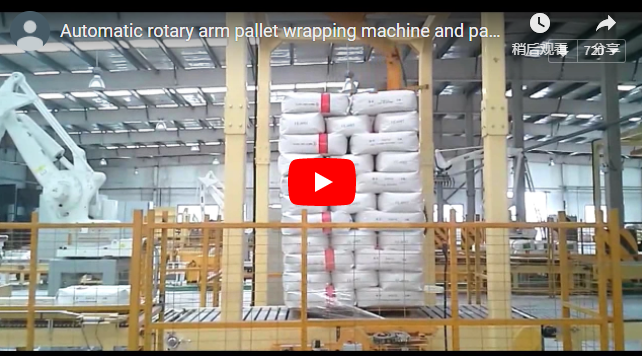
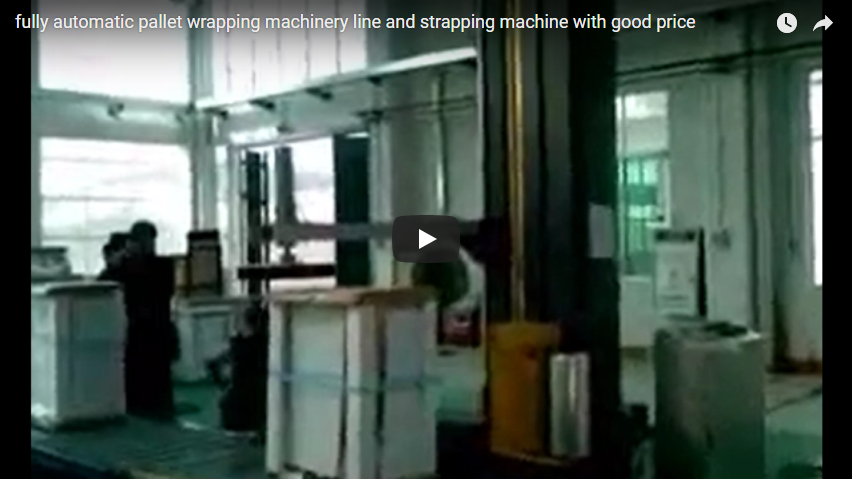
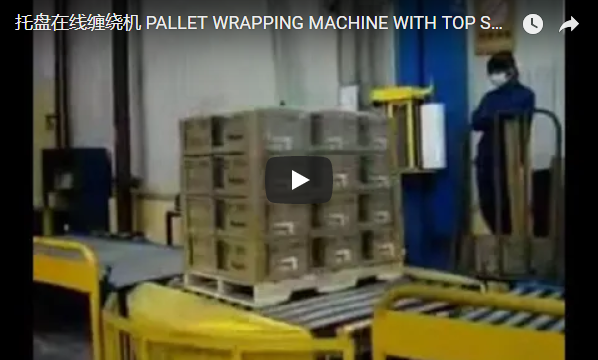
A pallet load stands on the roller conveyor under the tall cream gantry of our rotary arm wrapper, with control cabinets beside the line. The load is wrapped standing still while the arms circle it. It works like the conveyor-fed wrapper in our fully automatic pallet wrapping line.
The wrapped pallet, clear film tight around its sides, runs out along the conveyor. A second wrapped pallet waits further down the line.
How the inline double rotary arm wrapper works
| Step | What happens |
|---|---|
| Infeed | The pallet runs in on the roller conveyor |
| Stop | It stops centred under the gantry |
| Wrap | Two arms circle the pallet, each laying film |
| Cut and seal | Both film ends are cut and held on the load |
| Outfeed | The wrapped pallet runs out |
Two carriages share the work, so the pallet is covered in fewer turns. The arms are set opposite each other, which keeps the gantry balanced at speed. Unlike a turntable wrapper such as our B200 inline roller turntable, the pallet never turns.
Single arm vs double rotary arm: turns and cycle
Illustrative example for a load 1,800 mm high wrapped with 500 mm film at half overlap:
| Item | Single arm | Double arm |
|---|---|---|
| Film webs per turn | 1 | 2 |
| Height covered per turn | 250 mm | 500 mm |
| Spiral turns, 1,800 ÷ height per turn | about 7 | about 4 |
| Top and bottom turns (illustrative) | 4 | 2 |
| Total turns | about 11 | about 6 |
Fewer turns means a shorter cycle at the same arm speed. That is the main reason to choose a double arm on a fast line.
Film use and turns per pallet
Film laid is about the same with one arm or two, because the cover is the same. Illustrative example for a 1,200 × 1,000 mm pallet:
| Item | Value |
|---|---|
| Pallet perimeter, 2 × (1,200 + 1,000) | 4,400 mm |
| Single-arm turns | about 11 |
| Film laid, single arm, 11 × 4.4 m | about 48 m |
| Film laid, double arm, 6 turns × 2 webs × 4.4 m | about 53 m |
This is one carriage pass, or one layer. Film use depends on the carriage program: an up and down program lays two layers and up, down, up, down lays four, with the spiral turns rising to match. We set the program per load.
The small difference comes from the top and bottom turns, which a double arm lays with two webs. The double arm saves time, not film.
Controls and safety
The arms circle at speed over the conveyor. Keep people outside the wrapping area while the machine runs, and stop it before anyone goes near the gantry. For pallet wrapping machines, EN 415-6 adds the specific safety requirements.
The standards that apply depend on the destination market. For CE markets, ISO 12100 sets the risk-assessment method and EN 415-10 sets general requirements for packaging machines.
Selection checklist for a double rotary arm wrapper
- Pallet size and load height.
- Pallets per hour.
- Load type and stability.
- Turns, overlap and top sheet needs.
- Conveyor layout in and out.
- Guarding and floor space.
Engineering FAQ
Q: Why two arms? A: Two arms lay two film webs per turn, so a pallet is covered in fewer turns.
Q: Does it save film? A: No. The cover is the same; the double arm saves cycle time.
Q: How many turns per pallet? A: Our 1,800 mm example needs about 6 with two arms, against about 11 with one.
Q: Does the pallet turn? A: No. It stands still on the conveyor while the arms circle it.
Q: What conveyor does it work with? A: An in-line roller conveyor: pallets run in, stop centred under the gantry, are wrapped and run out.
Q: Which safety standard applies? A: EN 415-6 sets the specific requirements for pallet wrapping machines; the full set depends on the destination market.
Q: What lines suit it? A: Fast end-of-line pallet flows where a single arm would be the bottleneck.
Next step
We plan your rotary arm wrapper in three steps:
- Submit your layout drawing with pallet sizes and output to info@fhopepack.com.
- Receive a proposal within 48 hours, with the arm and film plan.
- Book a site survey to check the conveyor layout.
Related reading
- Automatic pallet wrapping machines
- Video: automatic rotary arm pallet wrapping machine and packing machine
- Semi-automatic pallet wrapping machines
- Video: automatic pallet stretch wrapping machine with film cutter
Sources
- Machine content: FHOPE engineering team, 2026-10-04
- Pallet wrapper safety: EN 415-6
- Turns and film examples: our worked examples, illustrative values
- Machine in action: our video on YouTube
- Standards scope: ISO 12100:2010, EN 415-10:2014
Last reviewed: 2026-10-04