🛠️ Client Background
Industrial packaging operations frequently encounter severe load instability when conventional turntable machinery exceeds its rated capacity, leading to product damage and throughput bottlenecks. Facilities managing heavy or tall palletized goods require stationary wrapping architectures to maintain structural integrity during film application.
Modern distribution centers and manufacturing plants routinely process high-volume outbound shipments where palletized inventory exceeds standard weight thresholds. When loads surpass 1,200 kg or feature elevated center-of-gravity profiles, traditional turntable rotation induces centrifugal creep, causing heavy components to shift and lightweight stacks to topple. This mechanical mismatch forces operators to bypass automated systems for manual wrapping, directly contradicting lean manufacturing protocols. Furthermore, inconsistent film tension across varying load geometries results in premature film tearing and elevated rework rates, which directly inflate operational overhead and compromise supply chain reliability.
🏗️ Challenge
Turntable-based wrapping systems fail under dynamic load stress because rotational inertia displaces heavy or unbalanced inventory, while fixed tension settings cannot adapt to varying film requirements. This mechanical rigidity creates throughput bottlenecks, increases material waste, and elevates the risk of transit damage.
The core operational failure stems from the fundamental physics of rotating machinery. When a turntable spins, centrifugal force acts on the pallet, causing heavy pump assemblies or off-center cargo to migrate toward the outer edge. To mitigate this, operators must artificially reduce rotational speed to approximately 6 RPM, which slashes throughput to roughly 12 loads per hour. Additionally, static tension controls cannot compensate for the varying elasticity of stretch films, leading to frequent film breaks that demand an average of 45 minutes of unplanned downtime per shift. Without adjustable tension levels or programmable wrapping modes, facilities cannot maintain consistent containment force—the measurable pressure that secures a load against transit vibrations—resulting in elevated customer return rates and compromised product safety.
🔗 Related: Explore more solutions
📈 Solution Design
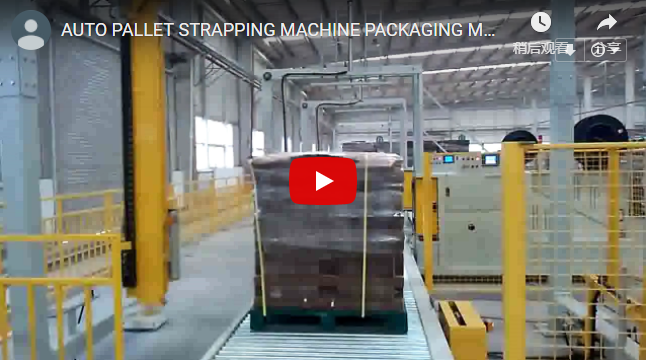
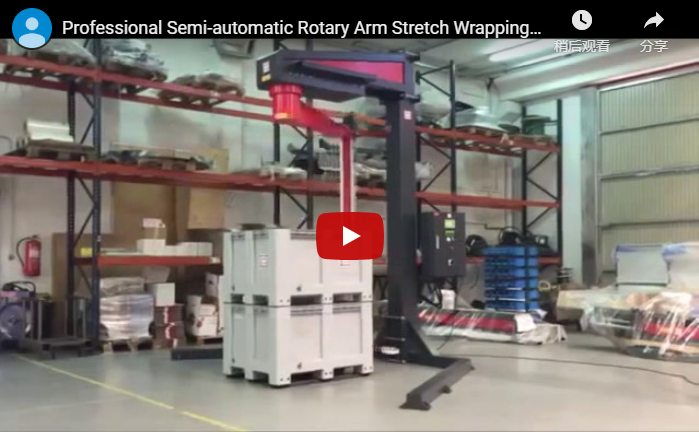
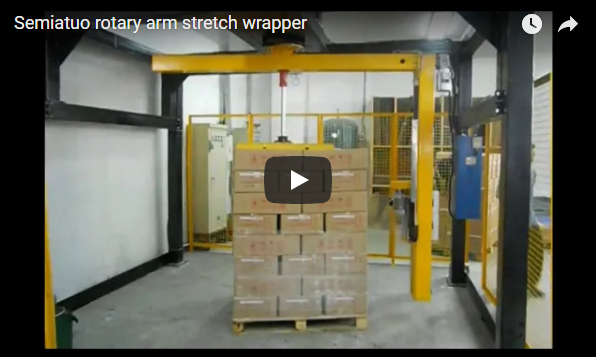
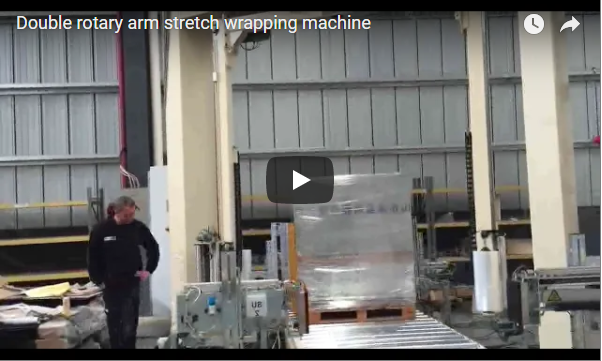
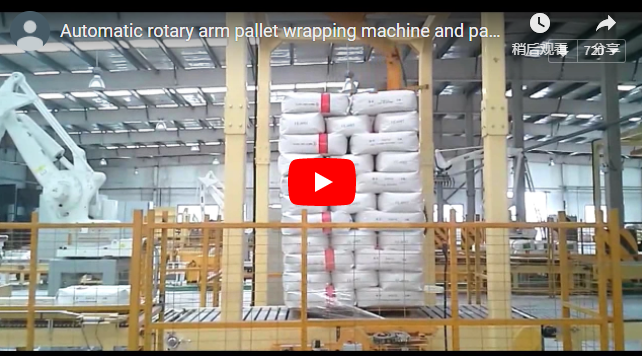
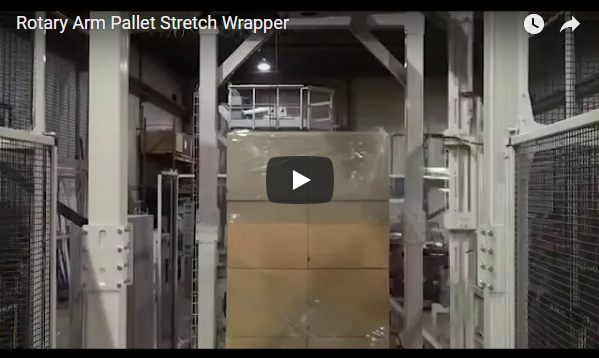
Rotary arm wrappers resolve load instability by keeping the pallet stationary while a motorized film carriage orbits the perimeter, eliminating rotational stress and enabling precise tension calibration. This architecture supports heavy or tall loads without weight restrictions while integrating seamlessly into existing conveyor networks.
The recommended engineering approach utilizes a PLC-based control system, which functions as an automated industrial computer that coordinates motor speed, film tension, and sensor inputs to execute precise wrapping sequences. By decoupling the load from the rotation mechanism, the system accommodates pallets exceeding 2,000 kg or standing over 2.5 meters without structural compromise. The film carriage employs powered pre-stretch technology, a mechanical process that elongates the polyethylene film by 200–300% before application, significantly reducing material consumption while maintaining structural integrity. Operators can select from multiple wrapping patterns and adjust tension levels dynamically, ensuring optimal film overlap and consistent containment force across diverse inventory profiles.
🛡️ Implementation
System commissioning requires precise conveyor alignment, PLC recipe programming, and operator calibration to ensure consistent film application. Standardized testing protocols validate mechanical performance and safety compliance before full production deployment to guarantee long-term operational reliability.
Deployment typically spans three to five business days, encompassing mechanical integration, software configuration, and comprehensive staff training. Engineers establish distinct wrapping recipes tailored to specific load categories, adjusting parameters such as top/bottom wrap counts, arm speed, and film overlap ratios. During the validation phase, technicians verify mechanical properties of the applied film against ASTM D5456/D5456M standards for tensile strength and ISO 9703:1989 specifications for shrink performance. Containment force measurement is recommended once per shift using calibrated tension meters to ensure the applied wrap pressure remains within ±5% of the target specification. Engineers also calibrate the carriage motor torque to match specific film densities, ensuring uniform overlap ratios regardless of ambient temperature fluctuations that affect polyethylene elasticity. This rigorous calibration protocol minimizes operator intervention, reduces film waste, and guarantees that every pallet meets international transit safety requirements.
🔗 See Also: Related equipment
⚙️ Results Data
Automated rotary arm systems consistently achieve up to 40 loads per hour in semi-automatic configurations, delivering measurable reductions in film consumption, labor dependency, and transit-related load damage across high-volume operations.
Post-deployment performance metrics demonstrate immediate operational improvements across key efficiency indicators. The stationary load architecture eliminates rotational instability, allowing operators to maintain optimal wrapping speeds without compromising safety or film integrity. Standardized tension control and powered pre-stretch mechanisms reduce polyethylene consumption by approximately 30–40% compared to manual or mechanical stretch methods. Furthermore, consistent wrap application virtually eliminates rework requirements, as visual inspections no longer reveal tilt, loose film, or compromised structural integrity. Real-time telemetry from the PLC controller logs wrap cycles, tension variance, and film usage rates, providing plant managers with actionable data for continuous process improvement. These performance gains directly translate to higher throughput capacity and reduced per-unit packaging costs.
| Metric | Baseline (Turntable/Manual) | Optimized (Rotary Arm) | Operational Impact |
|---|---|---|---|
| Throughput Capacity | 12 loads/hr | Up to 40 loads/hr | +233% volume handling |
| Film Consumption | 45 g/load (mechanical) | 28 g/load (pre-stretch) | −38% material cost |
| Load Damage Rate | 3.5% | <0.5% | −86% transit claims |
| Operator Interventions | 8/shift (breaks/rework) | 1/shift (routine maintenance) | −88% downtime |
🛠️ ROI Analysis
Capital expenditure for semi-automatic rotary arm systems typically ranges from $15,000 to $30,000 USD, with full payback achieved within 6 to 12 months through combined labor reallocation, material savings, and damage reduction.
Financial modeling demonstrates rapid capital recovery driven by three primary cost centers. Labor optimization occurs as automated wrapping eliminates repetitive manual tasks, allowing personnel to be reassigned to higher-value production or quality control functions, typically saving $35,000–$40,000 annually per repurposed role. Material efficiency gains stem directly from the 200–300% pre-stretch capability, which reduces annual polyethylene procurement costs by approximately $4,000–$5,000 for mid-volume facilities. Additionally, the elimination of transit-related load damage prevents an estimated $3,500–$4,000 in annual returns, processing fees, and expedited shipping replacements. When aggregated, these operational efficiencies generate $40,000–$48,000 in annual savings, ensuring a conservative payback period of 8 to 10 months even after accounting for installation, training, and initial calibration overhead.
🏗️ Purchase-Decision Checklist
Procurement validation requires verifying maximum load capacity, pre-stretch specifications, PLC programming flexibility, and safety compliance against ISO and ASTM standards before finalizing equipment acquisition to ensure long-term operational reliability and measurable cost efficiency across all production shifts.
Facilities must evaluate technical specifications against actual production requirements. Confirm that the machine’s weight and height limits exceed your heaviest and tallest pallet configurations. Verify that the semi-automatic model supports up to 40 loads per hour, matching standard industry throughput benchmarks. Ensure the control system includes programmable wrapping modes and adjustable tension levels to accommodate varying product profiles. Additionally, validate that the supplier provides comprehensive on-site commissioning, operator training, and readily available spare parts to minimize unplanned downtime.
-
[ ] Load profile match: Confirm max load weight and height do not exceed wrapper specifications.
-
[ ] Throughput requirement: Choose semi-automatic (up to 40 loads/hr) or fully-automatic (higher speed, conveyor integrated).
-
[ ] Pre-stretch capability: Look for ≥200% pre-stretch to minimize film cost.
-
[ ] Control flexibility: Ensure PLC supports multiple wrapping recipes for different load types.
-
[ ] Safety compliance: Verify light curtain, emergency stop, and fencing meet local regulations.
-
[ ] Installation footprint: Floor-level loading saves ramp costs; measure conveyor height compatibility.
-
[ ] Spare parts availability: Confirm common wear parts (blades, rollers) are stocked by the supplier.
-
[ ] Training support: Ask for on-site commissioning and operator training package.
📈 Technical Clarifications
Technical clarifications address common operational questions regarding load stability, film stretching mechanics, and system integration requirements to support informed procurement decisions and optimize daily packaging workflows across diverse industrial environments and varying product profiles.
Q: How do rotary arm wrappers compare to turntable machines for unstable loads? A: Rotary arm systems maintain a stationary load while the film carriage orbits the perimeter, eliminating centrifugal displacement. This design prevents heavy or tall pallets from shifting during rotation, making it the preferred solution for off-center or elevated cargo. Turntable systems inherently risk load migration when rotational speed exceeds safe thresholds.
Q: Can the machine handle very heavy loads, like 2 tons? A: Yes. Because the pallet remains stationary, there is no turntable weight restriction. The system only requires a level floor or conveyor to support the static load. This architecture safely accommodates pallets exceeding 2,000 kg without mechanical strain or safety hazards.
Q: What is the typical film stretch percentage? A: Most rotary arm wrappers utilize powered pre-stretch carriages that elongate polyethylene film by 200–300% before application. Pre-stretch is a mechanical process that thins the film layer while maintaining tensile strength, reducing material consumption by 30–50% compared to manual wrapping. Always verify the supplier’s pre-stretch range and confirm compliance with ASTM D5456/D5456M tensile standards before purchase.