> **Executive summary**
> A rotary arm pallet stretch wrapper keeps the pallet still and swings the film carriage around it, which suits light, tall or unstable loads that should not spin on a turntable. In this clip the arm runs one wrap from about 6 s to about 24 s and a second from about 40 s to about 50 s.
> Our equivalent solution, the R100 semi-automatic rotary arm wrapper, is rated for 35 pallets per hour and loads up to L1300 × W1300 × H2300 mm, configured per project.
Table of Contents
- What the clip shows, in order
- Why a rotary arm instead of a turntable
- Wrapping cycle time on the clip
- R100 specifications
- Takt check
- Selection checklist for a rotary arm pallet wrapper
- Controls and safety
- Engineering FAQ
- Next step
- Related reading
- Sources
What the clip shows, in order
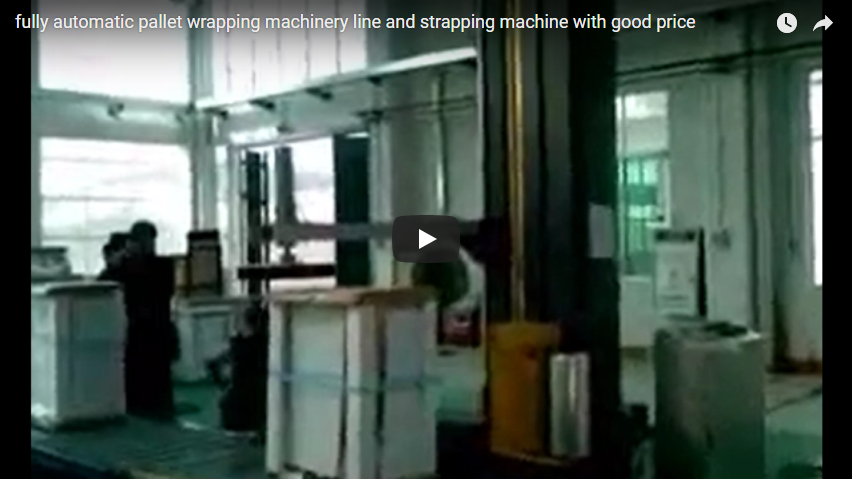
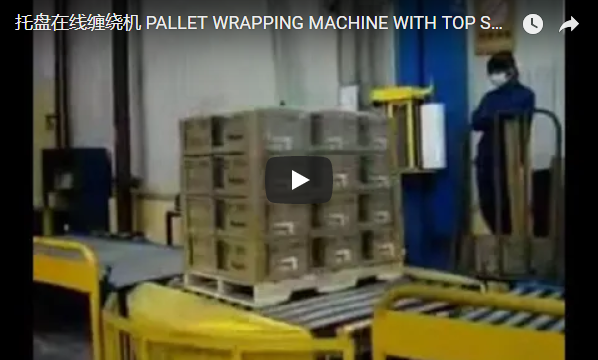
The wrapper is a black steel frame with two columns and a top beam, carrying a yellow rotating arm with the film carriage at its end. A yellow mesh fence surrounds the cell. The load is a stack of cartons on a wooden pallet.
1. **0 to about 4 s.** The arm is parked above the stack and nothing moves.
2. **About 6 to 10 s.** The arm starts to swing round and the film carriage moves down toward the side of the stack. A person in a blue vest appears at the right-hand column.
3. **About 12 to 22 s.** The arm carries on round the stack, laying film onto the sides while the person stands by the right-hand column.
4. **About 24 to 28 s.** The arm returns to its parked position and the cell is at rest.
5. **About 30 to 38 s.** The cell is at rest with the arm parked over the pallet.
6. **About 40 to 46 s.** A second wrap starts: the arm swings round and the film covers most of the sides.
7. **About 48 to 50 s.** The arm swings back and rises clear. A person enters through the opened gate in the fence on the right while the arm is still moving.
Why a rotary arm instead of a turntable
On a turntable wrapper the pallet spins and the film carriage stays on its mast. On a rotary arm wrapper the pallet stays still and the arm carries the film around it. That matters when:
– **The load is light or tall.** A spinning turntable throws an unstable stack outward; a still pallet does not move.
– **The load is heavy.** The arm does not have to accelerate the load, so the load weight does not limit the wrap speed.
– **The pallet arrives on a conveyor or by pallet truck.** No turntable step to climb, and the floor stays level.
| Rotary arm wrapper element | Role on our R100 |
|—|—|
| Rotating arm | Carries the film carriage around the still load |
| Film carriage | LLDPE film roll, OD 250 mm, ID 76 mm, 500 mm wide |
| Force control | Film force set by a separate motor |
| Photo-eye | Senses the load height |
| Anti-collision device | Protects against contact with the arm |
Wrapping cycle time on the clip
| Step on the clip | First wrap | Second wrap |
|—|—|—|
| Arm starts | about 6 s | about 40 s |
| Arm moving around the load | about 6 to 22 s | about 40 to 48 s |
| Arm parked again | about 24 s | after about 50 s |
| Arm motion | about 18 s | about 8 to 10 s |
The two cycles differ because the wrap programme sets the number of bottom, middle and top winds; on our R100 each can be set from 0 to 99.
R100 specifications
| R100 semi-automatic rotary arm wrapper | Specification |
|—|—|
| Working mode | Semi-automatic |
| Loads per hour | 35 pallets |
| Arm rotating speed | 10 to 14 rpm, variable by inverter |
| Max. load size | L1300 × W1300 × H2300 mm |
| Wrap layers | Bottom, middle and top, 0 to 99 winds each |
| Film | LLDPE, OD 250 mm, ID 76 mm, 500 mm wide |
| Control | PLC, photo-eye load height sensing |
Takt check
The R100 is rated for 35 pallets per hour, a takt of 3,600 ÷ 35, or about 103 s per pallet. At 10 to 14 rpm, the 10 to 18 s of arm motion on the clip is only a few turns, a short wrap. A full bottom, middle and top programme on a 2,300 mm load runs longer, and still leaves time free within the takt.
The pallet truck or fork-lift uses that free time to bring the pallet in, attach the film tail and take the pallet out. For a higher rate the bottleneck is pallet handling, not the arm, so a conveyor feed is the next step.
Selection checklist for a rotary arm pallet wrapper
– [ ] Load size within L1300 × W1300 × H2300 mm, and weight.
– [ ] How stable the load is, and whether it can spin on a turntable.
– [ ] Pallets per hour against the 35 per hour rating.
– [ ] Loading method: pallet truck, fork-lift or conveyor.
– [ ] Fence and gate layout around the arm’s swing.
– [ ] Wrap programme: bottom, middle and top winds, film width.
Controls and safety
The swing of the arm and the film carriage is the danger zone, and the fence keeps people out of it. The person who enters through the opened gate at about 48 to 50 s, while the arm is still moving, is the move to design out. A gate interlock that stops the arm when the gate opens is part of the risk assessment we carry out with you.
Stop, isolate and lock out the wrapper before anyone enters the fence to adjust the load, attach film or work on the arm. The anti-collision device on the arm is a last line of defence, not a substitute for the fence and the lockout.
The standards that apply depend on the destination market. For CE markets, EN 415-6 covers pallet wrapping machines and ISO 12100 sets the risk-assessment method, which fixes guarding and the emergency-stop arrangement.
Engineering FAQ
Q: When is a rotary arm wrapper better than a turntable?
A: When the load is light, tall or unstable and should stay still, or heavy enough to make a turntable slow. Our R100 handles loads up to L1300 × W1300 × H2300 mm.
Q: How many pallets per hour does the R100 wrap?
A: It is rated for 35 pallets per hour in semi-automatic mode, with the arm at 10 to 14 rpm.
Q: Which film roll does it take?
A: LLDPE stretch film, roll OD 250 mm, ID 76 mm and 500 mm wide, with film force set by a separate motor.
Next step
We size a rotary arm pallet wrapper in three steps:
1. **Submit your layout drawing** with the load size, weight, pallets per hour and loading method, to **info@fhopepack.com**.
2. **Receive a proposal within 48 hours**, including the frame, the fence and gate layout and the cycle check against your takt.
3. **Book a site survey** so we confirm the floor, the frame anchoring and the pallet route into the cell.
Related reading
– [Semi-automatic rotary arm stretch wrapper R100](https://www.fhopepack.com/Rotary-arm-wrapping-machine/Semiauto-rotary-wrapper-R100.html)
– [Rotary arm wrapping machines](https://www.fhopepack.com/Rotary-arm-wrapping-machine/)
– [Pallet wrapping machine with top press](https://www.fhopepack.com/videos/height-pallet-packing-machine-with-top-press-device/)
– [Semi-automatic orbital wrapper for long profiles](https://www.fhopepack.com/videos/fhope-semi-auto-orbital-wrapper/)
Sources
– Wrapper specifications: [R100 semi-automatic rotary arm stretch wrapper product page](https://www.fhopepack.com/Rotary-arm-wrapping-machine/Semiauto-rotary-wrapper-R100.html)
– Clip timing: frame timings taken from the clip, 2 s between frames
– Machine in action: [the video on YouTube](https://www.youtube.com/watch?v=imeIfBafhs0)
– Standards scope: [ISO 12100:2010](https://www.iso.org/standard/51528.html), [EN 415-6:2013](https://www.nen.nl/en/nen-en-415-6-2013-en-183810)
Last reviewed: 2026-10-05