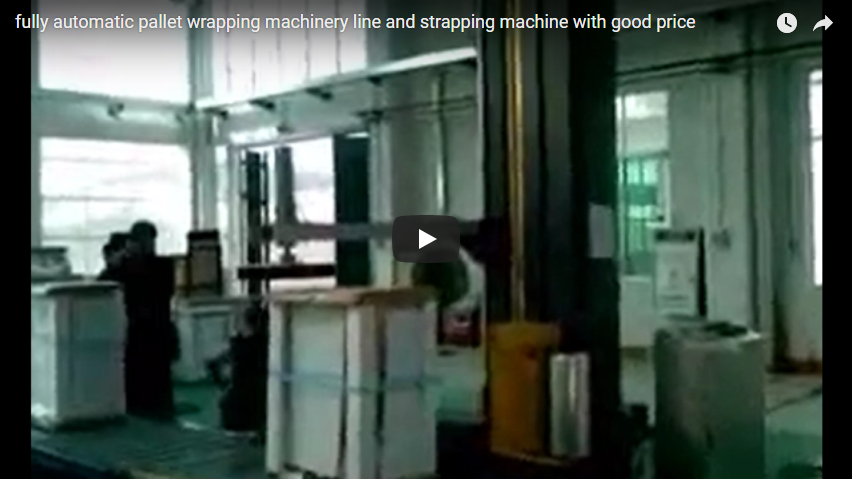
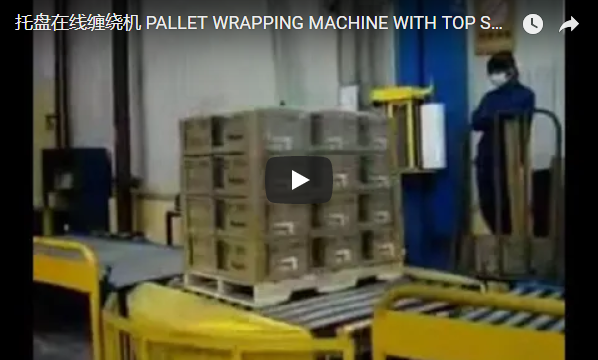
Pallet Wrapping Machine With Auto Film Cutting

Executive summary The video shows one complete wrapping cycle of a turntable pallet wrapper on a 24-carton load: film is laid over the top of the stack, carried down the mast along the sides, and the film tail ends up detached once the wrap is finished — the automatic cut this post is about. The operator’s only visible role is to stand clear after the cycle starts; no manual wrapping, tying, or cutting appears on screen. Performance figures — cycle time, load capacity, cutter type — are not visible in the footage, so they are listed below as items to confirm with the manufacturer.

Automatic film cutting is the feature that separates a pallet wrapper that truly finishes the job from one that still leaves an operator holding a knife at the end of every cycle. In the video above, a turntable-style machine wraps a stacked pallet of cartons, spins the load through a full layer of stretch film, and releases the film tail by itself at the end.

This article walks through what the footage actually shows, what it does not prove, and which questions a buyer should settle before ordering. Every factual statement traces back to the video; the analysis method is described further down this page.

What the video shows: one cycle, start to a detached film tail

The footage is sampled at 2-second intervals, so the steps below follow the frame sequence rather than a stopwatch-verified cycle time.

  • 0–2 s — Load in position, machine idle. A wooden pallet stacked with cartons rests stationary on the round yellow turntable. The machine’s vertical mast stands at the right of frame, and several similar pallet loads are stacked in the background, which suggests routine batch work rather than a one-off demonstration.
  • Around 4 s — Film comes out over the top. The turntable begins turning at an even pace and stretch film starts releasing from the carriage, laying the first film across the top of the load. The start command itself is not captured, but the machine clearly responds and the cycle is under way.
  • 4–8 s — The carriage works down the side. The film carriage travels down the mast to the side of the pallet. Film sits tight against the carton walls while the platform keeps spinning, giving full 360° coverage. A close-up at roughly 8 s shows film being stretched and pressed onto the stack; the carriage appears to adjust height slightly to hold tension even, though motion blur makes that the least certain detail in the sequence.
  • Final sampled frames — One layer done, tail released. By the last frame the load carries essentially one full layer of transparent stretch film. The film end is no longer attached, consistent with the automatic cut that gives this machine its name. The cutter mechanism itself never enters the frame.

What the operator does — and does not do

An operator is visible from about the 6-second mark: dark work boots and part of a standing figure at the right edge of frame, close to the machine but not touching it. Through the entire wrap, the operator stands still.

No film threading, no hand pressure on the film web, and no knife work appear at any point. The start of the cycle is the one operator action the sequence implies; how the load arrives, and how the finished pallet leaves, are simply not shown.

That is the practical meaning of auto film cutting: the human’s job at the wrapper shrinks to positioning loads and supervising, not finishing every pallet by hand.

Direct observation notes

The block below stays close to the underlying frame-by-frame facts, with only grammar-level cleanup. It is the evidence base for everything else in this article.

  • At the start of the clip, a pallet stacked with cartons rests stationary on a yellow turntable; the vertical machine body is at the right of frame and multiple similar pallet loads are stacked in the background. No person is in frame.
  • At around 4 s, stretch film starts releasing from the carriage and lays over the top of the load while the turntable rotates at an even pace. The carriage has not yet come down the mast.
  • At around 6 s, the carriage is down at the side of the pallet and film sits tight against the carton walls. An operator’s boots and part of a standing figure are visible at the right edge of frame, without contact with the machine.
  • At around 8 s, a close-up shows film being stretched and pressed onto the side of the stack while the turntable continues turning. The operator remains standing in place.
  • By around 10 s, roughly one full layer of film has been applied; the turntable is still rotating and the operator has not intervened.
  • The machine frame is black painted steel with a wide base; the wrap carriage is a yellow assembly with upper and lower guide rollers and a film-tension adjustment; a large white film-roll carriage sits below the wrap arm with the roll carried upright.
  • The turntable is round and yellow, visually estimated at roughly 1.2–1.5 m across, with a non-slip surface, a center locating hole, and black rubber edging around the rim.
  • The load is 24 cartons in a 3 × 2 pattern, four layers high, on a wooden pallet. A single box measures roughly 25 cm high × 30 cm wide × 20 cm deep; the stack is about 100 cm tall with a footprint near 90 × 60 cm. Cartons are yellow with dark printed graphics, including a brand logo that is not reliably readable frame by frame.
  • The control panel sits on the upper right of the mast: a small LCD, three round buttons in a vertical row (red, yellow, green), two to three gray function keys, and one or two status LEDs. On-screen characters are not readable.
  • At the end of the clip, the film tail is no longer attached to the load; no cutting action and no person are seen performing it.

Machine structure at a glance

Component What the footage shows Role in the cycle
Frame and mast Black painted-steel frame, vertical mast, wide base for stability Carries the film carriage and the control unit
Film carriage Yellow assembly with upper and lower guide rollers and a tension adjustment Holds the film, pays it out, and keeps tension as the load turns
Film roll Large roll carried upright on a white carriage below the wrap arm Supplies stretch film to the carriage
Turntable Round yellow platform, visually ≈ 1.2–1.5 m, non-slip surface, center locating hole, rubber-rimmed edge Rotates the pallet so every face passes the film web
Control panel Mounted high on the mast: LCD, three colored round buttons, gray function keys, status LEDs Starts and governs the cycle; exact functions not readable on screen
Auto film cutter Not visible as a mechanism; the film tail is detached at cycle end Severs the film without manual cutting

Control panel notes

The panel integrates into the upper right of the mast, within easy view of someone standing beside the machine. The display shows numeric or status content, but the footage resolution makes every character illegible. What each button does cannot be read from the video — the keys carry no discernible labels.

One gap matters more than the rest: no emergency-stop button is clearly visible anywhere on the machine. It may be integrated into the panel or positioned out of frame. Treat E-stop location as a mandatory pre-purchase question, not an assumption.

What the video does not show

None of the following are criticisms — they are simply outside the frame, and each belongs on a buying checklist.

  • Performance data. Rated power, motor speed, maximum load weight, accepted pallet size range, cycle time per pallet, and overall machine dimensions are all absent.
  • Build documentation. No certification marks, control-system identification, film specification (thickness, width, material), or cutter type (hot or cold blade) can be confirmed from the footage.
  • Process edges. How the film is anchored to the load at cycle start, how the finished pallet is removed, and what happens when the film roll runs out are not shown.
  • Safety hardware. No light curtain, photoelectric sensor, fixed guarding, or warning signage appears; interlocks are presumed, not proven.
  • Operating extremes. Irregular, over-width, or over-height loads never appear, so adaptability beyond standard rectangular stacks is untested on camera.

Source and method

The embedded video is the sole factual source for this post. Frames were sampled at 2-second intervals and analyzed with a vision-language model; the clip carries background music only, with no narration, so no speech transcription was used. Every claim above traces to a visible frame, and anything not visible is explicitly marked as needing confirmation from the manufacturer.

Where this pallet wrapper fits

Based on what the footage supports, this machine category lines up as follows.

Good fit Why
Uniform carton loads on standard pallets The demo load is 24 cartons in a 3 × 2 pattern, four layers, about 100 cm high on a wooden pallet
Transit protection against moisture, dust, and tipping Stretch film unitizes the stack so it behaves as one solid block in transit
Repetitive daily wrapping with one attendant The wrap runs without manual intervention; the operator stands clear throughout
Poor fit, or confirm first Why
Irregular, over-width, or over-height loads The analysis flags poor adaptation outside standard rectangular stacks
Fully fenced, unattended operation No guarding or light curtain is visible in the clip
Lines needing fault detection (missing cartons, film-out alarms) No such detection is evident on screen

Safe operation and upkeep checklist

  • Keep every person out of the turntable’s rotation path, especially at start-up and shutdown — the clip itself shows an operator standing at the platform edge while it turns.
  • Locate the emergency stop and agree on an emergency power-off routine with your team; none is clearly visible in the footage (verify with the manufacturer).
  • Inspect carriage guide-rail lubrication and film tension on a fixed schedule — the two upkeep points called out in the frame analysis.
  • Confirm the machine’s behavior at end-of-roll and whether a film-out alarm is fitted (verify with the manufacturer).
  • Treat the rubber-edged turntable as a live rotating surface during operation, not a staging shelf.

Verify with the manufacturer before ordering

  1. Cycle time for your typical pallet size, not a demo load.
  2. Turntable diameter and maximum load weight measured against your heaviest, widest pallet (the observed platform is visually about 1.2–1.5 m).
  3. Cutter type — hot blade or cold blade — and how the severed film tail is handled.
  4. Wrap options: double wrap, top sheets, or corner reinforcement if your loads need extra protection.
  5. Controls: film-out detection, fault alarms, and communication options for line or MES integration.
  6. Safety package: E-stop placement, guarding options, and available certifications.

Frequently asked questions

Does the machine really cut the film automatically?

The footage never shows the cutting mechanism itself, but at the end of the cycle the film tail is detached with no person or hand tool near it — the machine has released it. Whether the cutter is a hot or cold blade is not visible; confirm that detail with the manufacturer.

How long does one wrap cycle take?

It cannot be measured from this clip, which is a sampled frame sequence rather than a timed run. Ask the manufacturer for a cycle-time figure quoted against your actual pallet dimensions and weight.

What load was used in the video?

Twenty-four cartons in a 3 × 2 pattern, four layers high — a stack roughly 100 cm tall on a 90 × 60 cm wooden pallet footprint, with single boxes near 25 × 30 × 20 cm. The cartons carry a printed brand logo in dark ink.

Does the operator have to hold or tie the film?

No such action appears anywhere in the clip. The start command is the only operator action the sequence implies, and the operator then stands clear. How the film is anchored at the very start of a cycle is not shown, so confirm that step if your team needs to know it for training.

Can it wrap irregular or oversized loads?

The analysis treats standard rectangular pallet loads as the design case and flags poor adaptability for irregular, over-width, or over-height items. If your product mix includes non-standard loads, put a sample wrap test on the table before committing.

Related reading

Next step

If your daily output includes standard palletized carton loads and end-of-cycle knife work is eating operator time, this is the machine category to shortlist. Bring three numbers to the conversation — your heaviest pallet weight, your largest pallet footprint, and your target cycle time — and ask the manufacturer to demonstrate the auto film cutting behavior on that exact load. Contact FHOPE via the video contact page to match a wrapper to your line.