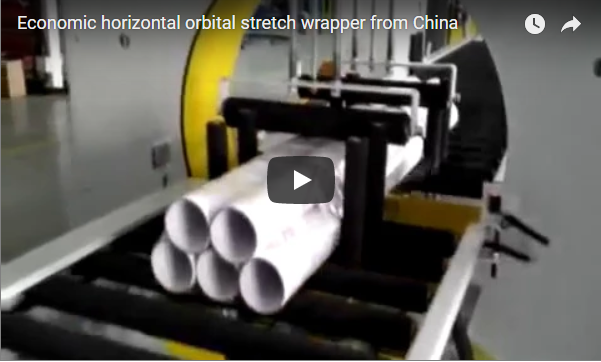
Orbital stretch wrapping machine with V-shape roll

Executive summary: This review covers a short manufacturer clip of an orbital stretch wrapping machine — the rotating-ring class of equipment used to wrap long products as they pass through the machine on a roller feed — working in an industrial setting. The footage, sampled every two seconds from the roughly 45-second clip, giving 24 still frames, repeatedly shows the same enclosed machine: a ring carriage wrapped in a wire-mesh safety cage that rotates while paying out transparent stretch film around the outer circumference of a long cylindrical product moving through a feed section with guide rollers formed into a V shape. Three honest qualifications matter up front. First, no readable specification appears in any frame — no size range, weight, ring speed, film data, or power figure — so none of the older article’s technical table is repeated here as fact. Second, the wrapped product’s material is not legible from the footage (reads vary), so this review does not name a specific material. Third, no readable brand or nameplate appears in the footage — the only marking is a textless logo — so this review does not claim a specific machine brand; FHOPE appears here only as the site hosting the article and the maker that sells this class of equipment.

This review is written for plant engineers, maintenance managers, and buyers evaluating an orbital stretch wrapping machine / orbital wrapper for long products — profiles, tubes, pipes, rods, or bundles — and for anyone comparing this machine against a horizontal banding line, a coil wrapper, or a manual stretch-film hand-wrap process. It documents what this short clip actually demonstrates frame by frame, what it conspicuously does not show, and the exact data and evidence to request from the supplier before quoting.

What the video shows

The footage is a workshop sequence where the machine runs a long cylindrical product through a rotating ring on a roller feed:

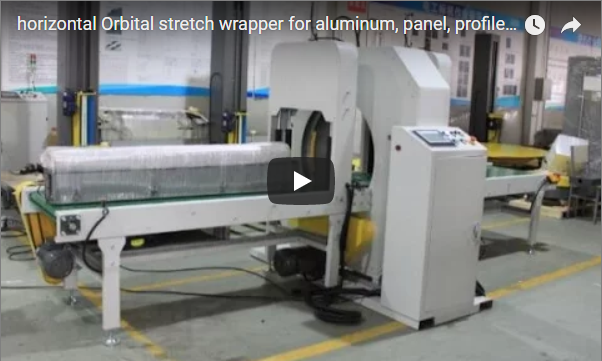
  • An enclosed rotating-ring wrapper for long products. The consistent subject is a white-and-metal machine enclosed in a wire-mesh safety cage, with a yellow handrail, guide posts with foam caps, and a control box on the feed side.
  • A rotating ring that applies film around the product. Focused, temperature-zero re-checks of multiple frames confirm a ring carriage that rotates around the outer circumference of the long product while paying out transparent stretch film, paying film along the product as it feeds through — the signature orbital-wrapper motion of this machine class.
  • A V-shaped roller feed. The feed section uses guide rollers arranged in a V shape that cradle the long product; this V-roller arrangement is visible in the large majority of frames (the frames where it reads absent are mostly cage-grid and motion occlusion, not a different feed). The “V-shape roll” of the article title is supported by the footage.
  • A long cylindrical workpiece, not legible as a material. The product being wrapped reads differently in different frames — light-coloured profile, metal profile, green-sleeved cylinder, yellow tube, white cable-like tubing — so this review deliberately does not name a specific material. It is clearly a long cylindrical product, which is what matters for the orbital-wrapper class.
  • One person at the feed, in the opening frame only. A single person’s hand and arm appears in the first frame, guiding the workpiece into the feed; in all later frames the machine runs with nobody visible.
  • No readable brand anywhere. No nameplate, model, or brand text appears in any frame. The only marking is a stylized black-and-yellow logo on a white sign that carries no readable text, so no machine-brand claim is made here.

The repeatable message of the footage is that an enclosed rotating-ring machine with a V-shaped roller feed wraps a long cylindrical product in transparent stretch film as it passes through, with a single person helping at the feed and nobody visible while the ring runs. It does not show a readable specification, a legible material, or a readable brand, and it proves the wrapping motion but not the precise cut, seal, overlap, or end-of-cycle behavior of the machine.

Direct observation notes

These points stay close to the visual evidence:

  • The machine is an orbital / rotating-ring stretch wrapper for long products: a ring carriage inside a wire-mesh cage rotates around the outer circumference of a long cylindrical workpiece while applying transparent film.
  • The feed section uses guide rollers arranged in a V shape that cradle the product — the “V-shape roll” feature named in the article title is supported by the footage in most frames.
  • The wrapped product is a long cylindrical object whose material is not legible from the stills — the review does not name a specific material.
  • A single person’s hand/arm appears only in the opening frame, guiding the workpiece at the feed; the ring then runs with no person visible in the remaining frames.
  • No readable brand, nameplate, model, or serial appears in any frame. The only marking is a textless black-and-yellow logo; no machine-brand claim is made, and FHOPE is named only as the site and vendor behind the article.
  • No readable specification anywhere: no size range, no weight, no ring RPM, no film data, no power figure, no model number appears in any frame.
  • All frames are stills: they prove the machine, the V-roller feed, a rotating ring, film application, and the feed assist — not continuous unattended throughput, not the cut/seal sequence, not the exact overlap, and not any measured specification.

What the title promises vs what the footage proves

Claim (title) Visible in footage? Verdict
Orbital wrapping machine A rotating ring orbits the product while applying film Demonstrated (machine class)
Stretch wrapping Transparent stretch film is paid out around the product Demonstrated (wrapping motion)
V-shape roll The feed uses guide rollers arranged in a V shape Supported (majority of frames)
Automated A person helps at the feed in the opening frame; ring runs with nobody visible Semi-managed — automated ring, one feed assist shown
200% efficiency boost (YouTube title) No measurement appears in the footage Not shown — marketing figure, not repeated as fact

The footage reliably demonstrates an enclosed rotating-ring stretch wrapper with a V-shaped roller feed that wraps a long cylindrical product in transparent film, with one person helping at the feed and nobody visible while the ring runs. It does not demonstrate a readable specification, a legible material, or a readable brand, and it does not prove the “200% efficiency” figure from the video’s YouTube title — precisely the evidence a buyer needs before sizing an orbital stretch wrapping machine against their own profiles or tubes.

What the video does not show

For a decision, the following are not observable in the footage and must be confirmed with the manufacturer:

Missing information Why it matters
Product size range (width, height, length) Whether your profiles or tubes fit the machine
Load weight capacity Whether the machine handles your heaviest bundles
Ring speed and output (products per hour) Whether throughput meets your line target
Film types and film stretch/pre-stretch ratio Whether the protective barrier and film economy you need are available
Film overlap adjustment How tightly and consistently the wrap is applied
Cut, seal, and end-of-cycle behavior What the finished wrap actually looks like
Level of automation and required operators Operator workload and line integration effort
Power and air utilities required Site planning for the install
Machine brand, model, and datasheet Only a textless logo is visible, so the maker and model are unconfirmed

The clip never shows a nameplate, never shows a readable material identification, never shows a fully wrapped-and-sealed product from end to end, and never states a size, weight, speed, film, or power figure. The older article’s specification table (its product dimensions, load weight, ring speed, conveyor speed, film stretch, and power figures) and its cost-saving “about 30%” claim were marketing text, not footage, so they are not repeated here as facts. Treat the footage as a short demo of an enclosed orbital stretch wrapper, and confirm every number with the supplier.

How the filmed machine works, as filmed

Reading the sampled frames in sequence gives a working picture: a long cylindrical product is guided by V-shaped roller guides into the feed of an enclosed machine; a ring carriage inside a wire-mesh cage rotates around the product while paying out transparent stretch film, wrapping film around the circumference as the product feeds through on the rollers; a single person’s hand helps guide the workpiece in the opening frame, and the ring then runs with nobody visible. Because all frames are stills, the video proves the existence of the machine, the V-roller feed, a rotating ring, film application, and the feed assist — but not the finished wrap quality, not the sealing step, and not any measured specification. Request a full-cycle video that shows several products wrapped from start to finish, and state your product sizes, weights, and target output so the supplier can confirm size range, load capacity, ring speed, films, and automation level.

Where “Orbital stretch wrapping machine with V-shape roll” stands in the footage

The article title promises an orbital stretch wrapping machine with a V-shape roll, and the footage largely lives up to it: an enclosed rotating-ring wrapper whose feed uses V-shaped guide rollers wraps a long cylindrical product in transparent film, with one person helping at the feed and nobody visible while the ring runs. The honest corrections are what the footage cannot confirm: the wrapped product’s material is not legible, no readable brand or model appears (only a textless logo), and no readable specification appears in any frame. This review therefore describes the machine class and the V-roller feed accurately, does not name a material or brand, and sends every technical figure to the manufacturer’s datasheet.

Buyer’s verification checklist

Use this as a short pre-order checklist for an orbital stretch wrapping machine / orbital wrapper for long products:

  • Confirm the product size range (width, height, and length) against your profiles, tubes, pipes, rods, or bundles.
  • Confirm the maximum load weight the machine can carry for your heaviest bundles.
  • Ask for ring speed and realistic output per hour for your product sizes.
  • Confirm which films are supported, the stretch/pre-stretch ratio, and whether film overlap is adjustable.
  • Ask how the finished wrap is cut and sealed, and ask for a full-cycle video of several products wrapped start to finish.
  • Confirm the level of automation and how many operators the line actually needs.
  • Ask about power and air requirements for your site.
  • Ask for the maker, model, and datasheet behind the clip — the footage shows no readable brand or nameplate.
  • Compare operator workload and footprint here against a horizontal banding line, a coil wrapper, or a manual hand-wrap process for your volumes.
  • Ask the supplier to confirm the product material the machine and films are rated for, since the footage does not identify the material.

FAQ

Does the video show a V-shape roll feed? Yes. The feed section’s guide rollers are arranged in a V shape that cradles the long product, and this V-roller arrangement is visible in the large majority of the 24 frames; the darker, grid-occluded frames simply do not read the feed clearly. The “V-shape roll” in the article title is supported by the footage.

What machine brand is in the video? No readable brand. The clip shows no nameplate, model, or brand text; the only marking is a textless black-and-yellow logo that cannot identify a maker. This review therefore does not claim a machine brand, and names FHOPE only as the site and vendor behind the article.

Why does the review avoid repeating the older specifications and cost claims? The old text lists product size, load weight, ring speed, conveyor speed, film stretch, power figures, and an “about 30%” cost saving, but none of these appears as a visible, legible, or measured fact in the footage. Repeating them as facts would be unverified, so they are left to the manufacturer’s datasheet.

How can I evaluate this orbital stretch wrapper for my own line? Send your product sizes, weights, target output, preferred films, and power supply details — and ask for the maker, model, datasheet, and a full-cycle video of several products wrapped start to finish.

Related reading

Next step

If an orbital stretch wrapping machine for long products suits your line, the fastest next step is a technical exchange: send your product sizes, weights, target output, and preferred films, and ask specifically for the size and weight range, ring speed and output, supported films and overlap adjustment, cut and seal behavior, level of automation, and the maker, model, and datasheet behind this clip. Visit the contact page to start the conversation.

Published: 2026-09-17