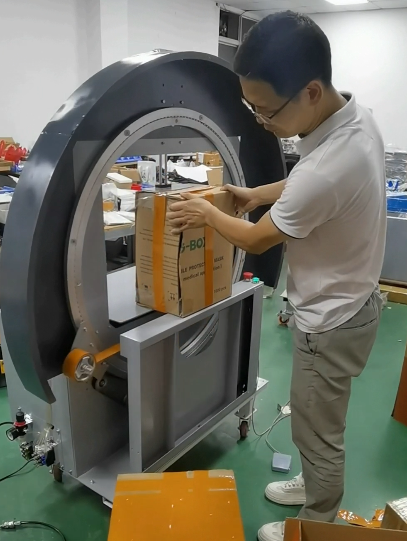
Executive summary A BOPP tape banding machine winds a self-adhesive BOPP tape band around a carton or bundle inside the ring, cuts it, and the carton is turned for a second band across. The tape path and cutting head sit inside the machine. A tape band holds flaps and small bundles without seals or a strapping head.
Table of Contents
- How the banding cycle works
- Why BOPP tape
- Tape per carton
- What we set per job
- Selection checklist
- Safety
- Engineering FAQ
- Next step
- Related reading
- Sources
How the banding cycle works
| Station / Step | Functional role and mechanism |
|---|---|
| Ring structure | Rotating ring frame with an integrated digital touch screen for cycle parameter control |
| Primary banding cycle | The carton enters the rotating ring; the orbital mechanism applies a self-adhesive BOPP tape band under controlled tension and cuts the band cleanly |
| Cross banding cycle | The carton is rotated 90° manually or by transfer table to apply a second transverse band across the package |
| Cutting & feed assembly | Internal precision tape feeding channel and integrated mechanical cutting head ensure clean cut-off without adhesive buildup |
| Line automation option | Configurable for automatic tape wrapping with 2 or 4 straps [manufacturer rating], integratable with telescopic raceway infeed and outfeed conveyors [manufacturer rating] |
Why BOPP tape
- Clean finish. BOPP tape is clear or printed and closes the carton without metal clips, friction welds, or heat-sealing smoke.
- No seals. The band holds by self-adhesion, eliminating costly mechanical seals and high-maintenance strapping seal heads.
- Light hold. Ideal for lightweight cartons, bundles of leaflets, extruded profiles, cables, or loose small parts.
- Printable. Tape can carry high-resolution company logos, traceability bar codes, or batch security text.
Tape per carton
Worked example (illustrative).
| Item | Dimension / Calculation | Result |
|---|---|---|
| Carton footprint (illustrative) | Length 300 mm × Width 200 mm × Height 150 mm | Baseline bundle |
| Band around the length | 2 × (300 + 150) mm | 900 mm |
| Band around the width | 2 × (200 + 150) mm | 700 mm |
| Total tape applied (one band each way) | 900 mm + 700 mm | 1,600 mm plus overlaps |
Note: Add nominal tape tab overlap (typically 50–100 mm per band depending on required flap retention force).
What we set per job
| Operating parameter | Engineering criteria | Reference specifications |
|---|---|---|
| Machine and ring size | Chosen for the largest carton cross-section | Accommodates products up to approximately W400 × H300 mm [manufacturer rating] |
| Tape specification | BOPP film, clear or surface printed | Width 24–48 mm; roll core units 50–200 m long [manufacturer rating] |
| Bands per carton | Product weight, rigidity, and flap hold force | Configurable for 1, 2, or 4 tape bands per cycle [manufacturer rating] |
| Material feeding | Production speed and automation level | Manual positioning table or motorized telescopic raceway conveyors [manufacturer rating] |
| Power supply | Factory utility connection | Standard single-phase 220 V / 50 Hz [manufacturer rating] |
Selection checklist
- Largest and smallest carton dimensions (Length × Width × Height in mm).
- Maximum and average carton weight (kg).
- Number of bands per carton (single, cross 2 bands, or parallel 4 bands).
- Tape type: clear, opaque, or pre-printed branded BOPP tape.
- Target throughput (cartons or bundles per hour).
- Available floor footprint and integration with packing tables or raceway conveyors.
Safety
- Keep hands and fingers clear of the rotating ring pathway and cutting zone during operation.
- Disconnect or engage safe stop interlocks before reloading tape rolls or cleaning tape guides.
- Operators must wear fitted clothing; keep loose sleeves, ties, and hair away from the rotating ring axis.
- For CE-regulated markets, machines comply with standard industrial safety principles according to ISO 12100:2010 and EN 415-10:2014.
Engineering FAQ
Q: What is a BOPP tape banding machine? A: It is an orbital ring machine that winds a continuous band of self-adhesive BOPP tape around a carton, bundle, or product group without requiring mechanical seals or heat-sealing strapping heads.
Q: Does the tape band require heat-welding or metal seals? A: No. The adhesive layer bonds directly to the carton surface and to the tape backing at the overlap, creating an instant structural hold without heat or crimping tools.
Q: How much tape does a single carton use? A: Girth per band plus tab overlap. For example, a 300 × 200 × 150 mm carton with one band applied each way uses approximately 1,600 mm of tape plus overlaps.
Q: Can the machine use custom-printed tape? A: Yes. The tape guide and feed path accept clear, solid-color, or customized printed BOPP tape carrying logos, branding, or security seals.
Q: Can the machine apply tape bands in two orthogonal directions? A: Yes. The operator or an automated cross-transfer mechanism turns the carton 90° between cycles to apply intersecting cross bands.
Q: Which design and safety standards apply to this equipment? A: Equipment supplied to CE territories conforms to ISO 12100 (Safety of machinery — General principles for design) and EN 415-10 (Safety of packaging machines — General requirements).
Next step
We match the proper tape banding machine to your packing requirements in three straightforward steps:
- Submit your packaging line requirements: Send your carton dimensions, package weights, hourly output targets, and table layout to info@fhopepack.com.
- Receive a formal proposal within 48 hours: Our engineering team will return comprehensive equipment data sheets, layout drawings, and operational cost calculations.
- Book a technical site survey or trial: Verify carton presentation tables, conveyor feed heights, and tape tension settings prior to dispatch.
Related reading
- Tape Banding Machine for Cartons and Small Bundles
- Tape Wrapping and Sealing Machine
- Carton Sealer with Side Belts
- Bottle Shrink Bundling Machine
- Automatic Packing Lines
Sources
- Machine design & technical documentation: FHOPE engineering team, 2026-10-10
- Horizontal tape wrapping technical specifications: Tape Wrapping and Sealing Machine Product Page
- Tape consumption calculation: Engineering worked example (illustrative parameters)
- Packaging safety standard: ISO 12100:2010 (Risk assessment and risk reduction)
- European packaging machine safety: EN 415-10:2014 (Safety of packaging machines – Part 10: General requirements)
- Service Level Agreement: Standard factory technical response timeline (proposal within 48 hours)
Last reviewed: 2026-10-10
Last updated: 2026-10-29