Executive summary
A load that must change orientation usually has to travel to a fixed inverter station, and bringing every pallet to that station slows the flow. This mobile pallet inverter combines an electric lift with a tilting inverter: it raises a stretch-wrapped pallet, tilts the load backward under power to change its orientation, and repositions it in place. We build mobile pallet inverters. Load range and travel are confirmed per project.
Table of Contents
- Why a mobile inverter
- What the machine does
- The tilting motion
- Lift, transport and hold
- What the footage shows
- Typical configuration
- Selection checklist
- Operation and safety
- Engineering FAQ
- Next step
- Related reading
- Sources and standards
Why a mobile inverter
A load that must change orientation usually has to travel to a fixed inverter station, and bringing every pallet to that station slows the flow and blocks the aisle. A mobile unit carries its own lift and tilt, so the orientation change happens where the pallet already is. Lift, tilt and repositioning ride with the machine instead of the load.
The trade-off is a real one: the mobile inverter needs one operator’s line of sight, with the load moving in an open area. That flexibility is why buyers compare it with a fixed station. Load range and travel are confirmed per project.
What the machine does
The machine is a mobile, walk-behind electric pallet handling unit with an inverter function. Forks raise a stretch-wrapped pallet, the machine tilts the load backward under power to change its orientation, and repositions it before setting down. The operator works at the control handle while the load is raised.
The unit combines lift, tilt and transport, so the pallet does not have to reach a fixed inverter. The motion runs hydraulically with the load held on the machine. Load range and motion are confirmed per project.
The tilting motion
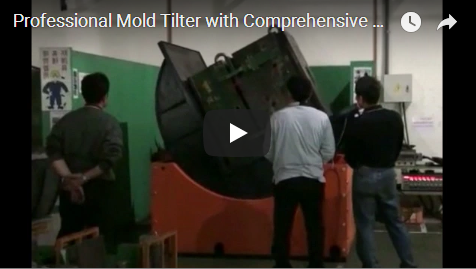
The clip shows the load rotating continuously backward from near vertical to near horizontal, the pallet turning with it through the angle change. The movement is smooth and single-direction, with no pauses or reversals, and the machine base stays in place as the load tilts. The tilt is the inverter part of the machine.
One continuous motion changes the load’s orientation under power. Tilting and holding are confirmed per project.
Lift, transport and hold
The machine lifts the pallet from the floor, holds it at height without sway, and repositions it laterally across the aisle before setting it down. The operator backs the unit, aligns to the target and completes the move from the control handle. The load stays on the machine through the whole cycle.
Lift height, travel and holding are the settings that match the machine to the aisle and the load. Position and holding are confirmed per project.
What the footage shows
Our footage shows a mobile pallet inverter lifting, tilting and repositioning a stretch-wrapped pallet in a live warehouse. It is a general demonstration, so your load range and travel needs are confirmed with us per project.
Typical configuration
Figures below list functional design boundaries rather than numeric values, and are confirmed per project.
| Parameter | Typical range, confirmed per project |
|---|---|
| Load | stretch-wrapped pallets |
| Lift | electric lift |
| Tilt | powered inverter |
| Travel | walk-behind transport |
| Hold | pallet on machine |
| Electrical supply | 380 V three phase 50 Hz, or 220 V single phase for light machines, selected per project |
Selection checklist
| Question | Confirm per project |
|---|---|
| Load range | pallet sizes, weights |
| Lift | height, capacity |
| Tilt | angle, holding |
| Travel | aisle width, distance |
| Control | control handle, PLC |
| Electrical supply | voltage, phase and frequency on site |
Operation and safety
Run the lift and tilt from the control handle and the machine moves the load under power. Keep clear of the raised load, tilt zone and travel path while the machine runs, with guarding and emergency stops at the operator position. The load stays on the machine through the cycle.
Routine checks cover the lift, tilt drive, forks, sensors and control, per the machine manual. Confirm the lift and tilt against the load before each run so pallets change orientation without damage.
Engineering FAQ
Q: What does the machine do? A: It lifts a stretch-wrapped pallet, tilts it backward under power and repositions it.
Q: Why mobile? A: The unit carries its own lift and tilt, so the pallet does not travel to a fixed station.
Q: How is the tilt driven? A: The load rotates continuously under power with the machine base in place.
Q: Is the load held during the move? A: Yes, the pallet stays on the machine through lift, tilt and travel.
Q: What does the footage prove? A: Lift, tilt and repositioning of a pallet in one live warehouse run.
Next step
- Email us at info@fhopepack.com with your pallet range and travel needs.
- We send an inverter proposal and a layout drawing within 48 hours.
- We arrange a site survey to confirm load range and travel requirements.
Related reading
- Pallet inverter
- Hydraulic tilter and hydraulic upender
- Semi-automatic pallet wrapping machine
- FHOPE packing machinery product lines
Sources and standards
- ISO 12100:2010 Safety of machinery, general principles for design and risk assessment
- EN 415-10:2014 Safety of packaging machines, general requirements
- EN ISO 13849-1:2023 Safety of machinery, safety-related parts of control systems
FHOPE mobile pallet inverter demonstration video. Reviewed as a general demonstration; load range and travel confirmed per project.
Last reviewed: 2026-10-11