Executive summary
An electric clamper pallet changer swaps the pallet under a unit load without breaking the stack apart. The machine grips the load as one unit, lifts it clear of the old pallet, travels on its wheels to a fresh pallet and sets the load down. The unit drives under walk-behind control, and pallet size, load weight and aisle width are confirmed per project.
Table of Contents
- Why change a pallet without restacking
- What the machine does
- Clamper arm and mobile layout
- Change cycle and control
- What the footage shows
- Typical configuration
- Selection checklist
- Operation and safety
- Engineering FAQ
- Next step
- Related reading
- Sources and standards
Why change a pallet without restacking
A pallet can crack or bow while the load on top of it is still in good order, and a changeover should not mean restacking the whole unit. A clamper changer grips the complete stack, lifts it clear and sets it on a new pallet, so the load never comes apart.
Because the machine travels to the load, the changeover happens where the load stands instead of at a fixed station. Load weight and pallet size are confirmed per project.
What the machine does
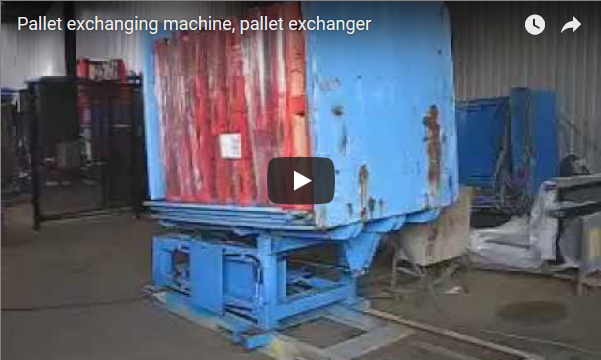
The machine is a mobile pallet changer with a side clamper. The clamp grips the load on its sides, the mast lifts the load clear, and the unit travels on its wheels to a fresh pallet, where the load is set down.
The load is carried as one unit, so the stack keeps its faces in contact through the whole move. Rated load and travel distance are confirmed per project.
Clamper arm and mobile layout
A clamp arm at the front of the machine grips the unit load on its side faces, and the base carries the machine on wheels across the floor. A walk-behind handle lets an operator steer and control the unit.
The clamp holds the load while it is lifted and carried, and releases only when the load sits on the new pallet. Clamp opening range is confirmed per project for your load.
Change cycle and control
The change runs as clamp, lift, travel, set and release. An operator drives the unit to the loaded pallet, the clamp closes on the load, the mast lifts the load clear, the unit travels to the fresh pallet, and the load is lowered and released.
Controls on the walk-behind handle run the clamp and the travel, and the operator supervises each move. Cycle path and travel distance are confirmed per project.
What the footage shows
Our footage shows a cylindrical unit load wrapped in film standing on a wooden pallet in a workshop. A mobile clamper machine drives up beside the load, extends its clamp arm, grips the load, lifts it clear and moves it to an empty pallet. An operator supervises the move from the handle.
The operator drives the unit beside the load and steers the clamp into position. It is a general demonstration, so your load weight, pallet size and aisle width are confirmed with us per project.
Typical configuration
Figures below list functional design boundaries rather than numeric values, and are confirmed per project.
| Parameter | Typical range, confirmed per project |
|---|---|
| Load | cylindrical unit load, wrapped, on a wooden pallet |
| Clamp | side clamp arm grips the load as one unit |
| Lift | mast raises the load clear of the old pallet |
| Travel | wheels carry the machine across the floor |
| Set and release | load lowered onto the fresh pallet and released |
| Control | walk-behind handle with clamp and travel controls |
| Power | electric drive, recharged between jobs |
| Electrical supply | 380 V three phase 50 Hz for charging, or 220 V single phase by site, selected per project |
Selection checklist
| Question | Confirm per project |
|---|---|
| Load range | load weight, stack height and footprint |
| Pallets | inbound and outbound pallet sizes and types |
| Aisle | aisle width and floor condition for travel |
| Cycle | moves per shift and recharge cadence |
| Clamp | opening range and product type on the pallet |
| Electrical supply | voltage, phase and frequency on site for charging |
Operation and safety
Drive the unit to the load, close the clamp, lift the load clear and travel to the fresh pallet before lowering and releasing. Keep the travel path clear and supervise the load during every move.
Routine checks cover the clamp, the wheels and the lift mast, per the machine manual. Confirm the landing pallet is in place before the load is set down.
Engineering FAQ
Q: How does the clamper change a pallet without restacking? A: The clamp changes the pallet by gripping the complete stack as one unit, lifting it clear and setting it on the new pallet.
Q: Does the load need to be wrapped or strapped first? A: No, the unit shown moves a wrapped cylindrical load as it is, and your packaging state is confirmed when you send your details.
Q: Does it need a fixed station? A: No, the machine requires only floor space, because it travels on its wheels to the load.
Q: What load can it carry? A: The page designation rates this mobile clamper unit for 1-ton (1,000 kg) paper-roll handling; the exact rated load for your rolls is confirmed per project from your weight details.
Q: What does an operator do during the change? A: An operator steers the unit from the walk-behind handle through the clamp, lift, travel and set sequence.
Next step
- Email us at info@fhopepack.com with your load weight and pallet sizes.
- We send a pallet changing proposal within 48 hours.
- We confirm the clamp range and travel path for your loads.
Related reading
- Electric Clamper Pallet Changer | 1 Ton Mobile Paper Roll Pallet Exchange Machine
- Pushing type machine for double pallet changing testing in workshop
- Automatic Pallet Wrapping Machine with Corner Protector Applicator: Architecture & Technical Analysis
- FHOPE packing machinery product lines
Sources and standards
- ISO 12100:2010 Safety of machinery, general principles for design and risk assessment
- EN 415-10:2014 Safety of packaging machines, general requirements
- EN ISO 13849-1:2023 Safety of machinery, safety-related parts of control systems
FHOPE electric clamper pallet changer demonstration video, shown as a mobile unit for paper roll pallet exchange. Reviewed as a general demonstration; load weight, pallet size and travel path confirmed per project.
Last reviewed: 2026-10-12