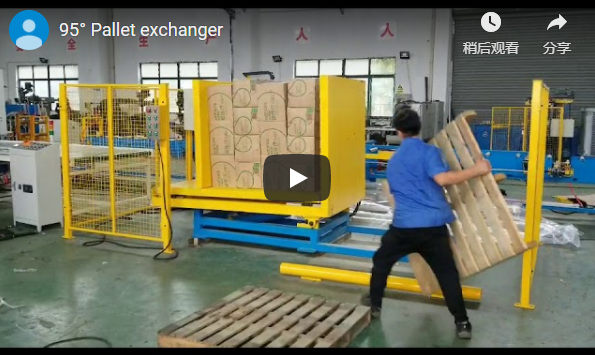
Executive summary This video shows a mobile pallet changer performing a full pallet exchange on a tall, film-wrapped load inside a compact footprint — no fixed conveyor line, no forklift lifting of the load itself. The machine clamps the loaded pallet, lifts the load clear, and lets an operator remove the empty pallet from below by hand. The load stays upright throughout. Read on for the step-by-step sequence, what the machine does and does not show, and the questions to ask before buying.
Why pallet changing in tight spaces is hard
In many warehouses and production ends, loads arrive on one pallet type and must be transferred to another — for export, for hygiene reasons, or because the destination pallet belongs to the customer. The classic solution is a fixed pallet changer built into a conveyor line. That works, but it needs a dedicated lane of floor space, infeed and outfeed conveyors, and room for forklifts to maneuver around it.
Not every facility has that. End-of-line corners, narrow storage aisles, and small packing areas often can only offer a few square meters. This is the gap the machine in this video is built for: a mobile pallet changer that travels to the load, performs the swap in place, and needs only enough clearance for an operator to pull the empty pallet away.
How the machine works, step by step
The footage follows one complete cycle on a tall stack of film-wrapped cartons, roughly twelve layers high. Here is what happens, in order:
- Setup (0–8 s). The machine stands on the plant floor with the loaded pallet and its high stack positioned on its base. The side guarding arms are folded close to the body.
- Guarding opens and the platform lowers (≈12 s). The two side arms swing outward to a horizontal position, forming a working envelope around the load. The lifting platform begins to descend.
- Alignment (≈16–24 s). The platform reaches its low position and pauses. The loaded pallet is now aligned with an empty pallet waiting underneath it, but the two pallets have not yet separated.
- Lift and separation (≈28–40 s). The platform rises, carrying the loaded pallet and the entire stack upward. The empty pallet beneath is lifted clear of the ground and held by the machine’s supporting structure, ready to be taken out.
- Manual removal (≈44–56 s). An operator steps in, bends down, and pulls the suspended empty pallet out from under the raised load, dragging it away by hand. The machine holds the loaded pallet steady at height the whole time.
- Ready state (≈60 s onward). The operator leaves the frame. The machine remains stationary with the load held high, and a red hand pallet truck is visible nearby, positioned to bring in the replacement pallet.
Later in the video, the cycle continues from another angle: the clamping arms close on the pallet sides, and an operator uses the hand pallet truck to position the next pallet at the machine’s base, ready to receive the load. One pallet goes out, one comes in — a discrete exchange, not a continuous conveyor flow.
Machine structure at a glance
| Component | What the video shows |
|---|---|
| Main frame | Black painted steel structure with silver-gray metal side panels and guides |
| Lifting platform | Central elevating platform with horizontal rail/rack elements for vertical travel |
| Side clamping/guard arms | Extendable arms with black-and-yellow hazard striping; they close on the pallet sides and open outward during the cycle |
| Lift mechanism | Central column-style lifting assembly with visible guides and drive components, including a finned housing near the top (likely motor/gearbox) |
| Control unit | Panel integrated into the right column with a small screen and physical buttons (display content not readable in the footage) |
| Mobility | Base legs/rollers that let the unit be positioned against the load |
| Hydraulics | Visible hydraulic hoses and quick-connect fittings on the right side |
Direct observation notes
- The machine is a mobile pallet changer standing on the plant floor, carrying a high stack of film-wrapped cartons (about 12 layers) on a wooden pallet.
- At around 12 seconds, the base platform begins to lower while two side guard panels extend outward to a horizontal position, forming a working enclosure; the pallet and load remain stationary.
- Between roughly 16 and 24 seconds, the platform holds at its lowest position; the loaded pallet is aligned with an empty pallet below but not yet separated.
- At about 28 seconds the platform rises, raising the loaded pallet to a high position; the empty pallet beneath is lifted off the floor and held by the machine.
- At about 44 seconds an operator enters, bends down, and removes the empty pallet from the front of the machine by hand; the loaded pallet stays held at height.
- Between about 48 and 56 seconds the operator drags the empty pallet away; the machine performs no other motion.
- From about 60 seconds the machine is static with the loaded pallet held high; a red manual hydraulic pallet truck is visible at the lower left of the frame.
- In later frames the machine’s side arms are closed on the pallet sides, and an operator pushes a pallet into the machine base area using the manual hydraulic truck.
- Readable text in the footage appears only on the cartons’ blue printed bands; no equipment nameplate, model, capacity, or warning labels are legible.
What the video does not show
The footage is a real working demonstration, but several things a buyer would want to know are simply not visible. Do not assume them — confirm with the manufacturer:
- Rated load capacity and maximum stack height
- Cycle time per pallet change
- Machine footprint, weight, and travel/height dimensions
- Power source and drive details (electric, hydraulic, or pneumatic; motor rating)
- Pallet size compatibility (e.g., 1200×800, 1200×1000, custom sizes)
- Control system details, HMI language, and fault diagnostics
- Safety certifications (CE or others) and whether an emergency stop is fitted — no standalone e-stop is clearly visible in the footage
- Whether fully automatic infeed/outfeed options exist
Where this machine fits best
Based on what the video demonstrates, the mobile pallet changer suits these situations:
| Situation | Fit | Why |
|---|---|---|
| End-of-line in a cramped production corner | Strong | No conveyor lane required; the machine comes to the load |
| Occasional pallet swaps in a warehouse zone | Strong | Mobile base means one unit can serve several spots |
| High-volume, continuous line changeover | Limited | Cycle includes a manual step (removing the empty pallet), so it is not a fully automatic closed loop |
| Very unstable, top-heavy loads above the height shown | Check first | Tall stacks raise center-of-gravity concerns; confirm load limits with the manufacturer |
The clearest benefit shown in the footage is that the load itself is never lifted by people or a forklift. The machine takes the full weight of the stacked goods, and the only manual task is pulling away the lightweight empty pallet. That removes the riskiest part of a manual pallet swap — moving a tall, wrapped, top-heavy stack by hand.
Operator notes
For anyone running this type of machine, the video suggests a few practical points:
- Clear the area before the cycle starts. The side arms swing outward and the platform travels vertically; nobody should stand within that envelope.
- Confirm the arms are fully positioned before lifting. The clamping and guarding arms define how securely the load is held.
- Handle the empty pallet only after it is fully supported by the machine, as the operator in the video does at around 44 seconds.
- Keep the floor flat and clean. A tall stack on a mobile base is sensitive to uneven ground.
- Long pauses: power down and tag the machine if it will sit idle, per your site’s lockout procedure. The video shows no visible e-stop or light curtain — verify what safety devices are fitted before commissioning. (Verify with the manufacturer.)
Frequently asked questions
Does the load tilt or rotate during the change? In the footage, the stack stays upright and square to the machine throughout; only vertical movement is visible. Whether the machine offers tilt or rotate functions for other applications — check with the manufacturer.
Is it fully automatic? No. The video shows an operator manually removing the empty pallet and manually positioning the next pallet with a hand pallet truck. It is a mobile, operator-assisted solution rather than a closed automatic loop.
How long does one pallet change take? The video does not state a cycle time and no timer is visible. Ask the manufacturer for cycle time figures for your load weight and height.
What loads can it handle? The video shows a roughly 1.8–2.0 m tall film-wrapped carton stack. Capacity, pallet size range, and maximum stack height are not shown — verify with the manufacturer.
Why choose a mobile unit over a fixed pallet changer? The mobile base means you do not dedicate floor space or build conveyors. For facilities with one or a few changeover points and limited room, that is the main advantage; for high-throughput lines, a fixed automatic system may suit better.
What safety features does it include? Only the hazard-striped side arms are clearly visible. No e-stop, light curtain, or warning signage can be confirmed from the footage — request the full safety specification before purchase.
Questions to ask before you buy
- What is the rated load capacity, and does it match my heaviest stack?
- Which pallet sizes and types (wood, plastic, single/double face) are supported?
- What is the cycle time for my typical load?
- What safety devices are fitted (emergency stop, sensing, guarding), and what certification applies?
- What power supply and installation requirements apply?
- What training, spare parts, and hydraulic-system servicing support is included?
Source and method
This article is based on a single demonstration video of the machine. The footage was analyzed frame-by-frame using a vision model; the video contains background music only, with no narration or speech, so no spoken content was transcribed. All observations above come from what is visible on screen; capacity figures, cycle times, certifications, and control details are not shown and must be confirmed with the manufacturer.
Related reading
- Semi-automatic pallet wrapping machine — a hands-on option for securing loads after a pallet change
- Automatic pallet wrapping machine — for higher-throughput end-of-line wrapping
- Stretch wrapping machine overview — the full range of stretch wrapping options
- Rotary arm wrapping machine — wrapping for unstable or heavy loads
- Rotary ring stretch wrapping machine — high-speed ring-style wrapping
Next step
If you change pallets in a tight corner of your plant and want to see whether a mobile pallet changer fits your loads and floor, contact the FHOPE team with your pallet size, stack height, and load weight — we will confirm the right configuration and the numbers the video cannot show.
Published: 2026-09-03