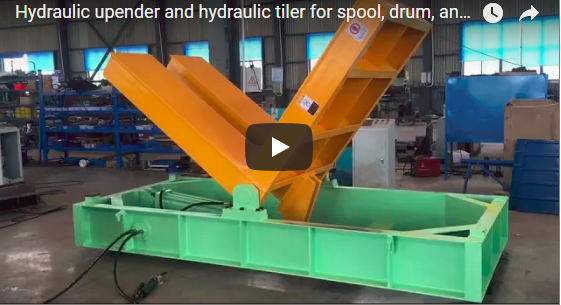
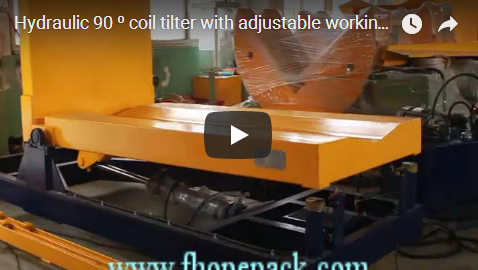
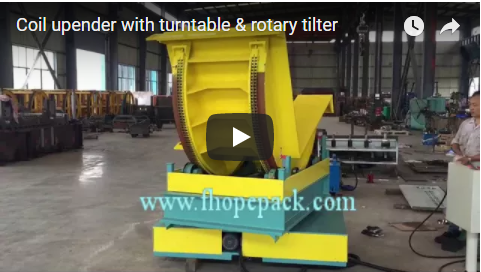
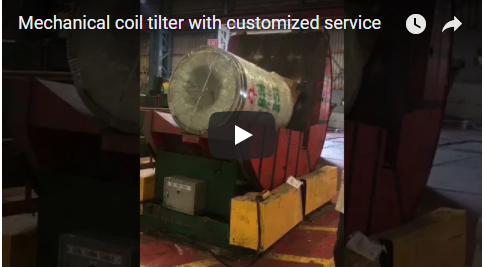
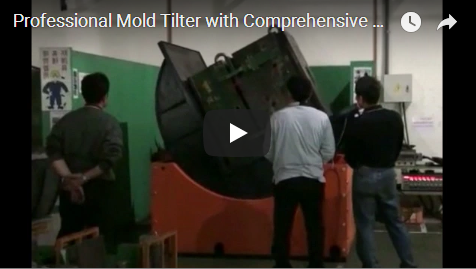
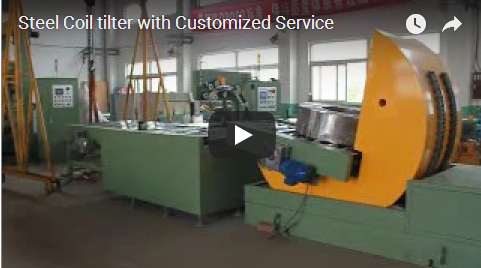
Executive summary This clip shows a 90° tilter turning a palletised stack of flat panels. The stack sits on the platform, a side plate stands against its face, and the round-sided frame rolls through 90° so the stack ends up standing on edge. The footage carries no FHOPE marking, so we give the data of our equivalent solution, our 90° upender, which tilts in about 50 s and can stop at any angle. Below we cover the cycle, the data and a worked example for stacks per hour.
Table of Contents
- What the clip shows
- Why tilt panel stacks through 90°
- Our equivalent solution: 90° upender data
- Stacks per hour
- Selection checklist
- Safety
- Engineering FAQ
- Next step
- Related reading
- Sources
What the clip shows
The clip is filmed in portrait in a modern production hall.
| Step | What you see |
|---|---|
| Load | A pallet carrying a tall stack of flat panels, strapped and edge-protected, sits on the upender platform |
| Clamp | A side plate on the C-shaped frame stands against the stack face |
| Tilt | The round-sided frame rolls through 90°, so the stack goes from lying flat on its pallet to standing on edge |
| Hold | The stack stands upright against the frame, with the pallet now vertical at its side |
| Machine | Close-ups show the curved frame, the drive and cable chains, and the base on a floor plate |
The footage carries no FHOPE marking, so we describe it as an example and give the data of our equivalent solution, our 90° upender.
Why tilt panel stacks through 90°
- Edge loading. Many panel lines feed or unload panels on edge, so the stack must stand up before it is handled.
- No crane turning. A stack of thin, wide panels is hard to turn safely by crane or forklift.
- Even support. The frame supports the whole stack face while it turns, so the panels are not bent.
- Back again. The same machine tilts the stack back to flat for storage.
Our equivalent solution: 90° upender data
Our published data for our online upender:
| Item | Published value |
|---|---|
| Tilt | 90° in about 50 s |
| Platform | Roller table on the platform, motor driven, with photo eyes |
| Contact faces | Nylon panels on the support faces |
| Control | Control desk away from the working area, or remote control; manual and auto modes |
| Speed | Inverter adjusted |
| Safety | Emergency stop, position lock, two displacement limiters, stop at any angle |
The machine is customised, so the frame, platform and clamping follow your stack size and weight.
Stacks per hour
Worked example (illustrative). If one tilt takes about 50 s and the stack is tilted up and the empty frame returned, the machine needs about 2 × 50 = 100 s per stack. That gives 3,600 ÷ 100 = 36 stacks per hour before loading and unloading time is added.
Selection checklist
- Stack length, width and height, and pallet size.
- Stack weight.
- Panel type and how much face support it needs.
- Tilt direction and end position.
- Forklift or conveyor loading.
- Stacks per hour.
Safety
The frame tilts a heavy stack through 90°, so nobody may stand in the swept area. We fit position locking, displacement limiters and an emergency stop, and set the control desk away from the working area. For CE markets we apply ISO 12100:2010 for the risk assessment and EN 415-10:2014 for general packaging-machine requirements.
Engineering FAQ
Q: What does a 90° upender do with a panel stack? A: It turns the stack from lying flat on its pallet to standing on edge, or back again.
Q: How long does a tilt take on your equivalent? A: About 50 s for 90°.
Q: Can the frame stop part way? A: Yes. It can stop at any angle, with a position lock.
Q: How is the upender controlled? A: From a control desk away from the working area or by remote control, in manual or auto mode.
Q: Can the platform take loads from a conveyor? A: Yes, our online version has a motor-driven roller table with photo eyes on the platform.
Q: How many stacks per hour? A: About 36 stacks per hour of machine time (50 s tilt plus 50 s return), before loading and unloading.
Q: Which standards apply? A: For CE markets, ISO 12100 and EN 415-10.
Next step
We size a 90-degree tilter for panel stacks in three steps:
- Submit your layout drawing with stack and pallet sizes, weight, tilt direction and stacks per hour, to info@fhopepack.com.
- Receive a proposal within 48 hours with the machine data and layout.
- Book a site survey so we confirm the floor space and loading access.
Related reading
- Steel Sheet Upender for 180 Degree Safety Turning
- 180° Pallet Inverter for Pallet Exchange
- Big Frame Flipper for 180 Degree Turning
- Online upender data
Sources
- Clip (example footage, no FHOPE marking): the video on YouTube
- Tilt time, platform, contact faces, control and safety: Online upender data
- Stacks per hour: our worked arithmetic
- Standards scope: ISO 12100:2010; EN 415-10:2014
- Proposal timing: approved house CTA (proposal within 48 hours)
Last reviewed: 2026-10-10