Executive summary This 14 s clip shows a crane-hung chain turner rolling a long welded steel frame in mid-air. Our equivalent solution for repeated 180° turns is a floor-mounted flipper: our FPMF range covers 2–40 t with a listed turning time of 20–35 s. The choice comes down to load shape, how often you turn, and whether you want the load in the air or on a table while it turns.
Table of Contents
- What the clip shows
- How a chain turner rolls a load
- Our equivalent solution: the floor-mounted 180° flipper
- Chain turner or floor flipper: how we choose
- Turning long welded frames safely
- Selection checklist for a big frame flipper
- Controls and safety
- Engineering FAQ
- Next step
- Related reading
- Sources
What the clip shows
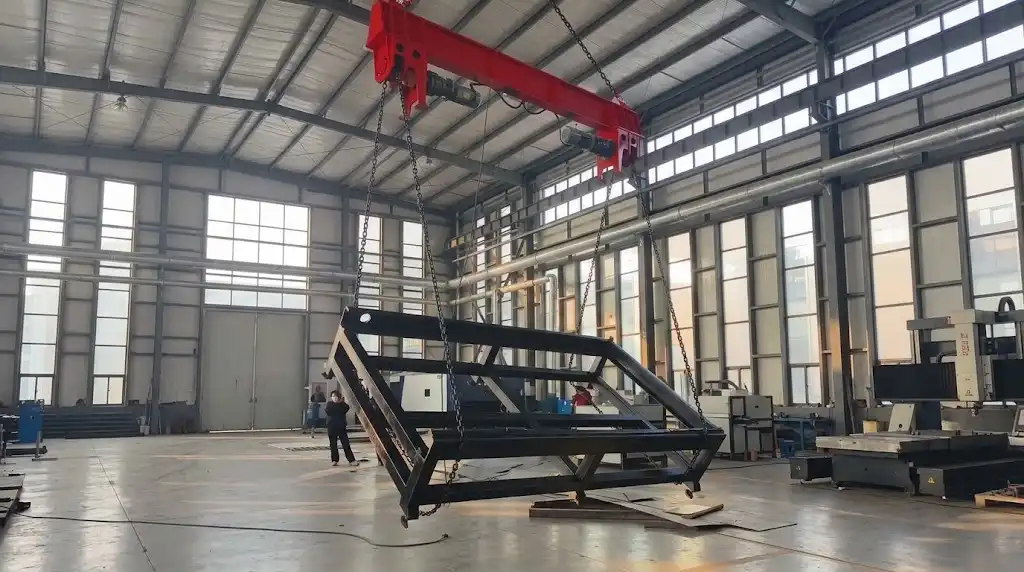
The clip is a vertical recording of 14 s in a fabrication hall.
- A long, rust-brown welded frame with large lightening holes hangs in two chain loops.
- The chain loops run from a motorised turner hanging on the hook of an overhead bridge crane.
- As the chains run, the frame rolls from a tilted position to lying flat, still in the air.
- One worker stands well back; another walks past in the background.
The machine in the clip is a crane accessory, not a floor machine. We use the clip to explain the method and compare it with the flipper we build.
How a chain turner rolls a load
A chain turner hangs from the crane hook. Two endless chain loops pass under the load. A motor drives the loops, so one side of the load rises while the other lowers, and the load rolls inside the slings.
What this means in practice:
- The crane carries the full weight for the whole turn. The crane rating, not the turner alone, sets the limit.
- The load turns about its own centre of gravity. If the slings sit off-centre, the load swings or slides towards the low side.
- Any angle is possible, because the load is not clamped to a table. That is useful for welding positions on a frame.
- No floor space: the turner travels with the crane.
Our equivalent solution: the floor-mounted 180° flipper
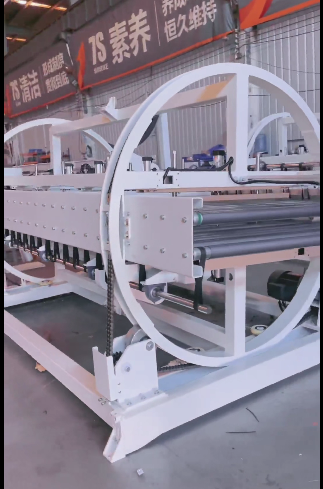
For parts that are turned over many times a day, we build a floor-mounted flipper. The load sits on a table, is held between two platens, and the machine turns it through 180°. The crane only places and removes the part.
Values from our 180° flipper range (FPMF, listed on our mould flipper page):
| Model | Max. loading | Power | Turning time | Machine weight |
|---|---|---|---|---|
| FPMF-02 | 2 t | 4.5 kW | 20–30 s | 2.0 t |
| FPMF-05 | 5 t | 5.5 kW | 20–30 s | 2.5 t |
| FPMF-10 | 10 t | 8.5 kW | 20–30 s | 3.0 t |
| FPMF-20 | 20 t | 10.5 kW | 20–30 s | 3.5 t |
| FPMF-30 | 30 t | 12.5 kW | 20–35 s | 4.0 t |
| FPMF-40 | 40 t | 16.5 kW | 20–35 s | 5.0 t |
Table size and machine size are designed per load. For a long frame we lengthen the table, so the frame is supported along its length rather than at two sling points. Like all our machines it is configured per project, so power and machine weight move with the size of the part.
Chain turner or floor flipper: how we choose
| Question | Chain turner | Floor-mounted flipper |
|---|---|---|
| Turns per shift | occasional | frequent, repeatable |
| Load shape | long, open frames that can hang in slings | moulds, blocks, frames that sit flat |
| Crane time | crane busy for the whole turn | crane only loads and unloads |
| Angle | any angle | 180° (or 90° on an upender) |
| Floor space | none | fixed footprint |
If your crane is the bottleneck, or the same part is turned many times a shift, the floor flipper usually pays back first. If turns are rare and the parts vary a lot in shape, a crane-hung turner is the lighter investment.
Turning long welded frames safely
Long frames have two specific risks: they flex, and their centre of gravity is easy to misjudge.
- Support along the length. A frame hung at two points can sag between them. On a floor flipper, a long table supports it continuously.
- Find the centre of gravity first. For a fabricated frame, take it from the CAD model, not by eye. Place slings or the table centre on it.
- Protect machined pads. Turning contact should land on raw steel, not on machined mounting faces.
- Keep people out of the turning zone. A rolling or flipping frame can move sideways if it slips.
Selection checklist for a big frame flipper
- Heaviest part, its length, width and height, and its centre of gravity.
- Turns per shift and how much crane time you can spare.
- Turning angle you need: 180°, 90° or free positioning.
- Faces that must not carry load during the turn.
- Crane rating and hook height at the turning location.
- Floor space and foundation if a floor flipper is chosen.
Controls and safety
The standards that apply depend on the destination market. For CE markets, ISO 12100 sets the risk-assessment method and EN 415-10 covers general requirements for packaging machines, which fixes guarding and the emergency-stop arrangement.
On a floor flipper the turning zone is fenced or marked, and the table only turns with the load clamped. With a crane-hung turner, everyone stays clear of the swing path for the whole turn.
Engineering FAQ
Q: What is the machine in the clip? A: A crane-hung chain turner, which we use here as a comparison. Our equivalent solution is a floor-mounted 180° flipper, with the FPMF range covering 2–40 t.
Q: How long does a 180° turn take on a floor flipper? A: Our FPMF table lists 20–30 s up to 20 t and 20–35 s for the 30 t and 40 t models.
Q: Can a floor flipper take a long frame? A: Yes. Table size is designed per load, so we lengthen the table to support the frame along its length.
Q: When is a chain turner the better choice? A: When turns are occasional, the crane has spare time, and parts vary widely in shape or need odd angles.
Q: How does a floor flipper relieve a crane bottleneck? A: The crane only places the part on the table and lifts it off again. A chain turner ties up the crane for the whole turn.
Q: What decides the machine size? A: Weight, size and centre of gravity together. A bulky part can need a larger frame and motor than its weight alone suggests.
Next step
We size a big frame flipper in three steps:
- Submit your layout drawing with the part drawing, weight, centre of gravity and turns per shift, to info@fhopepack.com.
- Receive a proposal within 48 hours, with the flipper type, table size and turning time for your part.
- Book a site survey so we confirm crane access, floor space and the loading direction.
Related reading
- 180 Degree Load Inverter: Turning a Board Stack Over
- Industrial Mold Tipper and Upender: Heavy Mold Handling
- The ROI of Safety: 90-Degree Mold Upenders Instead of Crane Flipping
- Steel Sheet 180-Degree Turning and Upending Process
- Upender with Custom Fixture for Heavy Castings
- Mold flipper
Sources
- Comparable machine in action: the video on YouTube (14 s)
- 180° flipper range, loading, power, turning time, machine weight: Mold flipper
- Standards scope: ISO 12100:2010; EN 415-10:2014
- Proposal timing: approved house CTA (proposal within 48 hours)
Last reviewed: 2026-10-06