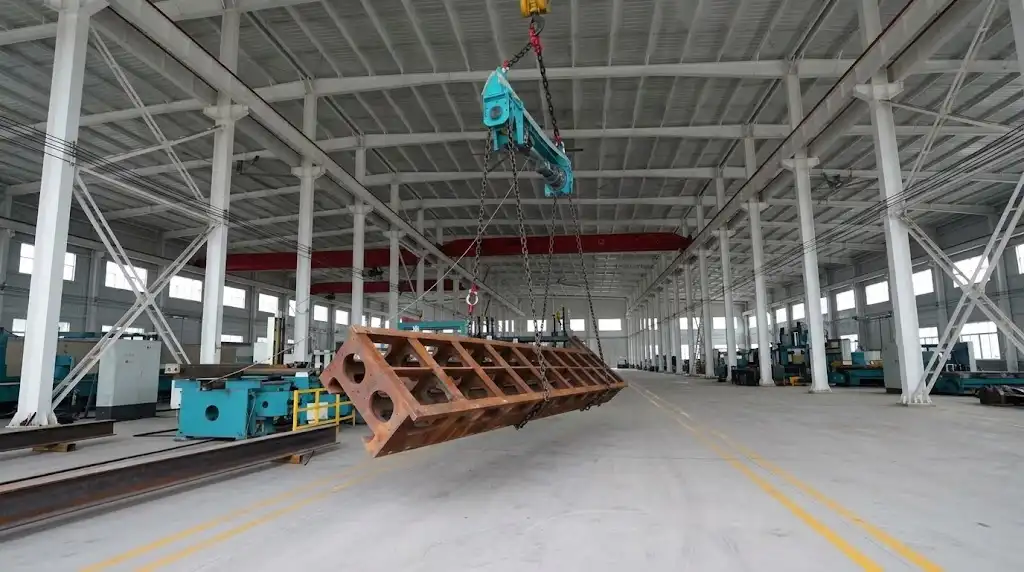
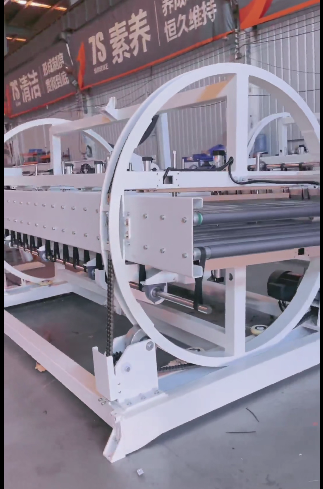
Executive summary A beam-type chain turner rolls rigid welded frames hanging in slings. Steel sheets and plate stacks do not hang well: the sheets slide, bend or scratch. For them the solution is a floor-mounted C-type 180° steel sheet upender, rated up to 15 t, that clamps the stack hydraulically and turns it on the floor.
Table of Contents
- What the machine does
- Why sheet stacks need clamping, not slings
- Our equivalent solution: the C-type steel sheet upender
- Chain turner or C-type upender: matching the load
- Making a 180° turn safe
- Selection checklist for a steel sheet upender
- Controls and safety
- Engineering FAQ
- Next step
- Related reading
- Sources
What the machine does
A beam-type chain turner rolls a large welded steel frame from a steep incline towards flat, and then lowers it towards the floor. The frame hangs in chains from both ends of a beam on an overhead runway. The method relies on the frame being one rigid body: nothing inside it can shift as the angle changes. That is why it suits welded frames, girders and machine beds — and why it cannot be applied safely to sheet packages or plate bundles.
Why sheet stacks need clamping, not slings
A welded frame is one rigid body. Chains can roll it, because nothing inside the frame can move.
A stack of steel sheets is different:
- The sheets can slide on each other. In a sling, the stack can fan out as it passes vertical.
- Thin sheets bend where a chain bears on them, and the edge marks stay.
- Coated or polished sheets scratch where they rub on chain links.
So for sheets and plate stacks, the load must be clamped as one block for the whole turn. That is what a C-type upender does.
Our equivalent solution: the C-type steel sheet upender
Our steel sheet upender is a C-type frame on the floor. The stack is driven or placed into the C, hydraulic cylinders clamp it, and a motor turns the C through 180°.
Data from our steel sheet upender page:
| Parameter | Baseline Value | Engineering Unit |
|---|---|---|
| Max. load | 15 t | |
| Load length | 100–3000 mm | |
| Load width | 250–1850 mm | |
| Load height | 10–350 mm | |
| Turning motor | 2.5 kW | |
| Hydraulic system | 4.5 kW | |
| Hydraulic cylinder | OD 100 mm, double acting | |
| Machine size | approx. L3000 × W2200 × H2600 mm | |
| Machine weight | 4 t |
Turning speed is adjustable. Like all our machines, it is configured per project, so the opening, clamp stroke and power follow your sheet range. Our hydraulic flipper range also covers steel sheet models of a different capacity class, with machine size issued with the drawing after design [manufacturer rating].
Chain turner or C-type upender: matching the load
| Load | Better fit | Reason |
|---|---|---|
| Welded frames, machine bases | chain turner or floor flipper | rigid, can hang in slings |
| Steel sheet stacks | C-type upender | must be clamped as one block |
| Single heavy plates | C-type upender | no chain marks on the faces |
| Moulds and blocks | floor flipper or upender | sit flat on a table |
For welded frames with a floor-mounted alternative, see our article on the big frame flipper for 180 degree turning.
Making a 180° turn safe
The riskiest moment in any 180° turn is the vertical point, where the weight moves from one support side to the other.
- Clamp before turning. The hydraulic clamp closes on the stack before the C-frame turns.
- Control the speed. Adjustable turning speed lets you slow down through the vertical point.
- Keep the centre of gravity inside the C. Place the stack centred along its length.
- Keep people clear. No one stands in the turning zone, whichever method you use.
Selection checklist for a steel sheet upender
- Sheet or stack length, width and height, smallest and largest.
- Heaviest stack weight.
- Surface finish: bare, coated or polished.
- Turning angle: 180°, or 90° for upending.
- How the stack arrives: forklift, crane or roller conveyor.
- Turns per shift and floor space at the turning point.
Controls and safety
The standards that apply depend on the destination market. For CE markets, ISO 12100 sets the risk-assessment method and EN 415-10 covers general requirements for packaging machines, which fixes guarding and the emergency-stop arrangement.
On our C-type upender, the hydraulic clamp holds the load during rotation. The turning area is fenced or marked to suit the layout of each project.
Engineering FAQ
Q: What is the primary operational difference between a beam chain turner and a C-type upender? A: The chain turner rolls a rigid frame in slings hanging from a beam. The C-type upender clamps the load as one block and turns it on the floor, which is what sheets and plate stacks need.
Q: What is the maximum load capacity of the baseline C-type steel sheet upender? A: It handles up to 15 t, with loads up to 3000 mm long, 1850 mm wide and 350 mm high.
Q: How is the sheet stack secured against shifting during the 180° rotation? A: By double-acting hydraulic cylinders, OD 100 mm, which clamp it inside the C-frame while the motor turns it.
Q: Is the rotational speed adjustable? A: Yes. Turning speed is adjustable, so you can slow the turn through the vertical point.
Q: What are the connected drive power requirements for this equipment? A: A 2.5 kW turning motor and a 4.5 kW hydraulic system for the clamp, on the listed model.
Q: What floor space is required for the machine footprint? A: The listed machine is approx. L3000 × W2200 × H2600 mm. Add access for the forklift or conveyor feeding it.
Next step
We size a steel sheet upender in three steps:
- Submit your layout drawing with the sheet or stack sizes, weights and feeding method, to info@fhopepack.com.
- Receive a proposal within 48 hours, with the C-frame opening, clamp range and turning time.
- Book a site survey so we confirm floor space, feeding direction and the turning zone.
Related reading
- Big Frame Flipper for 180 Degree Turning: Crane Chain Turner or Floor-Mounted Flipper
- Steel Sheet 180-Degree Turning and Upending Process
- C-Type 180 Degree Pallet Turnover and Pallet Inverter
- Steel Sheet Pallet Inverter
- Steel sheet upender
Sources
- Comparable machine in action: the video on YouTube
- C-type structure, 15 t, load size, motor, hydraulic system, cylinder, machine size and weight, adjustable speed: Steel sheet upender
- Standards scope: ISO 12100:2010; EN 415-10:2014
- Proposal timing: approved house CTA (proposal within 48 hours)
Last reviewed: 2026-10-29