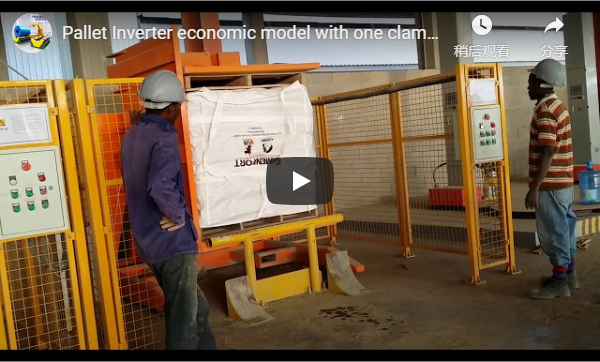
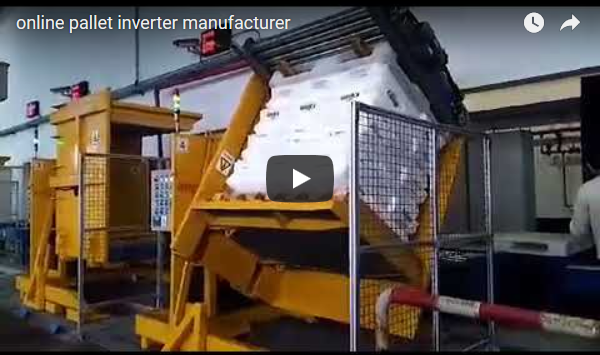
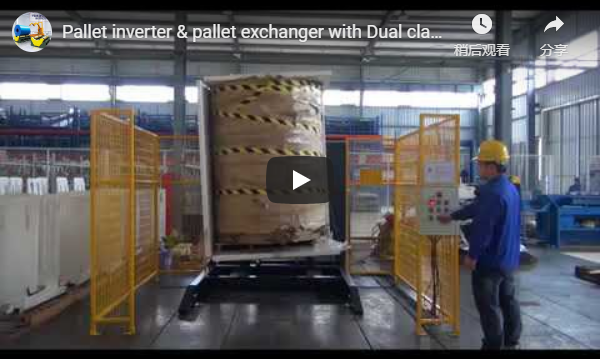
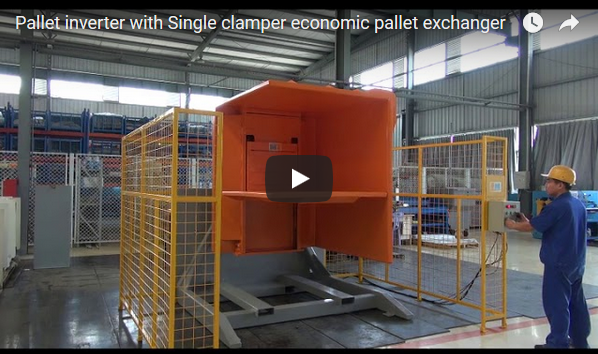
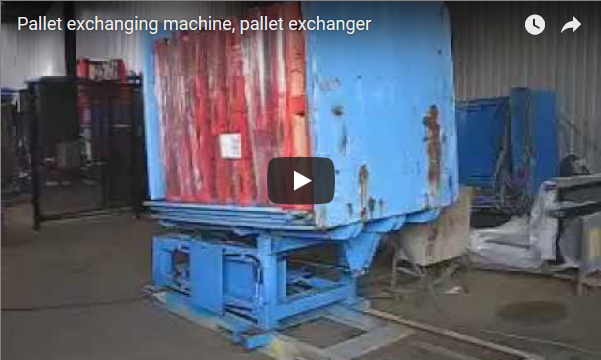
A 180° pallet inverter solves the problem of damaged or incompatible pallets by clamping a wrapped load, rotating it fully to invert the stack, allowing the old pallet to be removed and a new one inserted, and then rotating the load back to its upright position. This process enables the complete replacement of the pallet base without manually unloading or handling the goods, ensuring product integrity while changing pallet types, repairing damage, or preparing for slip-sheet shipping.
Overview
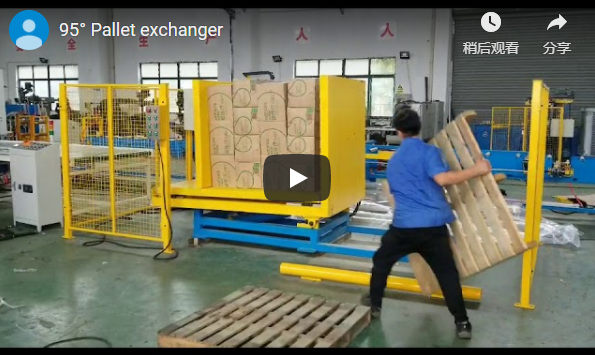
The page describes the core mechanical cycle of a stationary pallet inverter in a controlled workshop environment. It illustrates how the machine secures a load, executes a full 180-degree rotation, facilitates pallet exchange, and returns the load to a stable, upright position for continued handling.
The Inversion and Pallet Exchange Cycle
The page describes the cycle as recorded in a workshop setting beside a fenced test bay. The steps below are the page’s description of how the machine works, not a frame-by-frame verification of the pallet exchange: the clip is a demonstration, and the swap of the old pallet for a new one is described rather than shown step by step.
| Step | Page description |
|---|---|
| Load in | A film-wrapped pallet load sits inside a blue box-shaped inverter frame |
| Clamp | The frame closes on the load, so it is held between the platens |
| Turn | The frame rotates and inverts the load |
| Exchange | With the load turned, the old pallet comes free and a pallet is taken out of the frame |
| Return | The frame turns back and the load sits upright on its new base |
| Control | An operator runs the cycle from a stand-alone control cabinet outside the yellow fence |
Turning the load lets a pallet be swapped without lifting the goods by hand.
What a Pallet Inverter Is Used For
The primary function of this equipment is to facilitate pallet changes without disturbing the load. There are four specific industrial applications for this process:
- Damaged pallets: When a pallet is broken or compromised, the load is turned and the broken pallet is replaced without unloading the goods. This prevents product damage that might occur during manual offloading.
- Pallet change: Goods can be transferred from a wooden pallet to a plastic or export-grade pallet.
- Pallet-less loading: Turning the load 180° allows a facility to keep its pallets in-house while shipping the load on a slip sheet.
- Inspection: The inversion process exposes the base of the load, allowing for thorough checking of the bottom layer of packaging or product integrity before the load is re-palleted.
FPFZ-1 Data and Configuration
The page documents one model, the FPFZ-1. The manufacturer publishes the values in the table below as the baseline design. Final technical confirmation is per project, because load stability, pallet type and floor conditions change the configuration.
| Item | Published value |
|---|---|
| Load size | L1,200 mm × W1,100–1,200 mm × H1,200–2,000 mm |
| Capacity | Max 1.2 t |
| Turnover angle | 180° |
| Turnover time | About 50 s |
| Base | Profile welding, fixed by dead weight |
| Operation | Wireless remote control |
| Motor | About 2.2 kW |
| Power supply | 380 V 50 Hz three-phase |
| Pressing device | Adjustable to package size |
| Safety | Mechanical and electric stop blocks; separate electrical box |
The machine utilizes a profile-welded base that is fixed by dead weight, meaning no floor bolting is listed in the standard configuration. This simplifies installation but requires the floor to support the static load. The pressing device is adjustable to accommodate different package sizes. Turning speed is adjustable, and the start and stop functions are automatic, controlled via a wireless remote or stand-alone cabinet.
How Many Loads Per Hour Can It Process?
Calculating throughput requires distinguishing between the machine’s cycle time and the total operational time, which includes auxiliary tasks. The source material provides an illustrative calculation based on the machine’s mechanical speed.
A full cycle consists of one turn over and one turn back. At approximately 50 seconds per turn, the machine itself requires about 100 seconds (2 × 50 s) per load. That gives a gross mechanical threshold of 36 loads per hour (3,600 seconds ÷ 100 seconds), with no exchange time inside the figure.
36 loads per hour is a gross mechanical threshold, not a net operational throughput. It does not account for clamping, forklift positioning, pallet extraction, new pallet insertion, and unclamping, so the net figure is lower and depends on the efficiency of the pallet exchange process and the skill of the operator. Buyers must evaluate their specific workflow to determine the realistic loads per hour.
Safety and Risk Assessment
Safety is a primary concern when handling loads up to 1.2 tons that are being rotated. The design incorporates multiple layers of protection to prevent injury.
The machine is equipped with mechanical and electric stop blocks to limit movement and prevent over-rotation. A separate electrical box isolates the control systems. The page states the machine is housed within a yellow safety fence, and the operator controls the cycle from a stand-alone control cabinet located outside this fence. This ensures that no personnel are within the turning zone while the machine is active.
For CE markets, the design uses ISO 12100:2010 as the risk-assessment method and EN 415-10:2014 as a design reference for the general requirements of packaging machines. Neither document makes a delivered machine compliant on its own: conformity of the machine actually supplied is confirmed in the project ordering agreement.
Selection Checklist for Buyers
To ensure the selected inverter meets your operational needs, you must provide the following data to the supplier. These parameters determine whether the standard configuration is sufficient or if custom modifications are required.
- Load dimensions: Length, width, and height of the wrapped or loose load.
- Load weight: Total weight of the stack, including the pallet.
- Load stability: How stable the stack is when inverted. Loose loads or damaged shrink wrap may require additional clamping pressure or support fixtures.
- Pallet types: The type of pallet entering the machine (e.g., wooden, plastic, export) and the type of pallet exiting (e.g., slip sheet, different pallet type).
- Throughput requirements: The target number of loads per hour.
- Feed method: Whether the load is fed by forklift, conveyor, or pallet changer, and any existing layout constraints.
Engineering FAQ
Q: What does a pallet inverter do?
A: It clamps a pallet load and turns it 180°, allowing the pallet to be replaced or removed without unloading the goods.
Q: How heavy a load can the FPFZ-1 turn?
A: The published capacity is up to 1.2 t. This value is confirmed per project based on load stability and dimensions.
Q: What load sizes fit?
A: The standard range is L1,200 mm × W1,100–1,200 mm × H1,200–2,000 mm. Custom sizes may require configuration adjustments.
Q: How long does a turn take?
A: Approximately 50 s per turn. The turning speed is adjustable.
Q: How is it operated?
A: By wireless remote control, with automatic start and stop. A stand-alone control cabinet is also available.
Q: Does it need anchoring to the floor?
A: No floor bolting is listed for the standard model; the profile-welded base is held by its own dead weight. Floor conditions must be verified per project.
Q: Which standards apply?
A: For CE markets, the design applies ISO 12100:2010 and EN 415-10:2014. Certification is confirmed in the project ordering agreement.
Next Step
To receive a real configuration and a formal proposal, please send the following data to the supplier:
- Load specifications: Exact length, width, height, and weight of the load.
- Pallet details: Type of incoming pallet and type of outgoing pallet or slip sheet.
- Operational requirements: Target loads per hour and feed method (forklift or conveyor).
- Layout information: Available floor space and power supply details.
We reply with a proposal after we confirm the details.