Pallet Wrapping Machine with Black Pallet Detection

Executive summary This video shows a stainless-steel pallet wrapping machine wrapping a stacked, dark pallet load on a rotating turntable. A vertical carriage travels up and down the mast while the film spirals around the load. The footage demonstrates the standard wrap cycle — but it does not visibly demonstrate the black pallet detection function named in the title, so buyers should verify that capability directly with the manufacturer.

Why dark loads are a special case

Dark or black pallets are one of the classic trouble cases for automatic stretch wrapping. Most turntable wrappers rely on a photo-eye to find the top of the load before the carriage starts its wrap. A glossy black surface absorbs and scatters light unpredictably, so a standard sensor can miss the load entirely — read “nothing there” — and send the carriage all the way down, or overshoot it and leave the top unwrapped.

A machine described as having black pallet detection is built to handle exactly that: the sensing method or logic is adapted so that dark, reflective, or low-contrast loads are still detected correctly, and the wrap height adapts to the actual load. If your product line includes black crates, dark plastic trays, black stretch-wrapped layers, or matte board stacks, this feature is worth understanding before you buy.

What the video shows

The footage is a single continuous demonstration shot, with background music only — there is no narration. Based on frame-by-frame analysis:

  • 0–6 seconds: A black rectangular pallet load sits stationary on the polished round turntable. The control panel on the right-hand mast is lit with a blue screen. The machine is idle.
  • ~9–18 seconds: The turntable begins rotating and the wrap carriage descends from the right, moving film onto the side of the load. The first horizontal layers of transparent stretch film appear.
  • ~21–33 seconds: The carriage continues downward along the load height, roughly two-thirds of the way covered. The turntable keeps rotating and the film wraps in a spiral pattern around all four sides. A white film band is visible near the base.
  • ~36–42 seconds: The carriage reaches its lower position and returns upward; the film tightens at the top to complete the enclosure. The machine returns to standby.
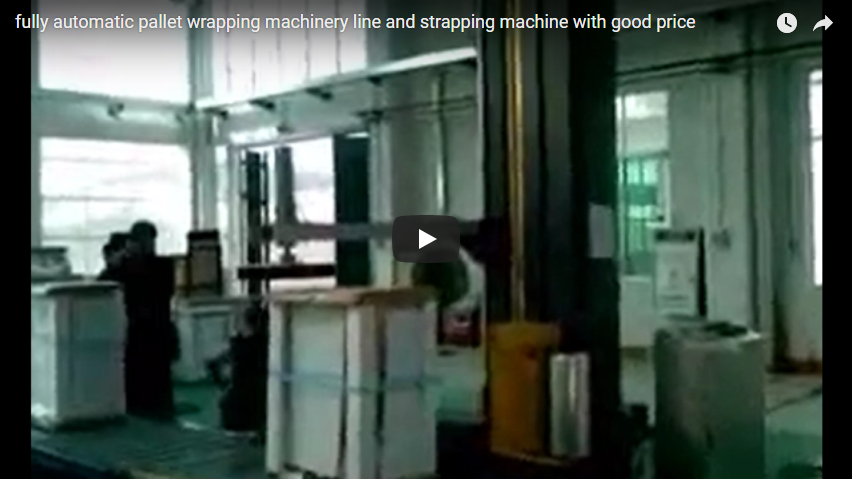
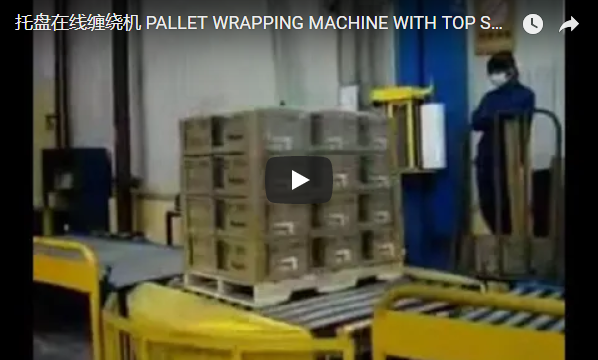
  • Later in the video (~45–69 seconds): A second wrap cycle on a stacked carton load. The load rotates on the turntable while film is applied around its sides; the carriage carriage assembly remains visible at the top of the mast. The video ends before this second cycle completes — no film cut or sealing action is shown in this portion.

The machine structure visible in the video:

Component Observed detail
Frame Stainless-steel construction, brushed finish — consistent with hygiene-sensitive industries
Turntable Round, polished, roughly 1.2 m diameter; carries the pallet load; rotates counter-clockwise
Mast / column Vertical column on the right; carries the film carriage and top beam
Film carriage Film roll (white roll visible), tension rollers, guide rollers mounted on the mast
Control panel Recessed in the mast, blue backlit LCD screen plus a row of physical buttons including a clearly red button
Environment A wall-mounted notice board is visible; no operators appear on screen

Direct observation notes

The following points stay close to the frame-analysis report and are stated as observed facts only:

  • A dark-colored rectangular pallet or stacked load rests on the center of a circular turntable; the machine is not running at the start.
  • The turntable rotates counter-clockwise while the wrap carriage descends and moves film onto the load surface; horizontal film wrinkles appear on the first layers.
  • The carriage travels down approximately two-thirds of the load height; the turntable keeps rotating; film covers all four sides in a spiral pattern; a white sealing band forms at the bottom.
  • The carriage rises to the top and stops; the turntable completes a final turn; film tightens at the top forming a complete wrap; the machine enters standby.
  • The machine frame is stainless steel with a silver-grey metallic sheen, composed of the turntable base on the left and a tall column on the right connected by a beam.
  • The control panel is embedded in the lower-middle of the column: a blue backlit LCD screen and physical buttons below (red, green, and blue buttons are distinguishable).
  • The workpiece is a large black rectangular pallet or stack, matte black with some reflective grey areas; height approximately 1.2–1.5 m, width approximately 0.8–1.0 m.
  • No physical safety fence, light curtain, or interlock indicator is visible in the frame. No independent emergency-stop button is clearly visible; the red button on the panel is presumed but not confirmed to be the e-stop.
  • A later segment shows a second, lighter-colored stacked carton load being wrapped; the carriage assembly remains at the top of the mast and the wrap is not completed within the footage.
  • No film cutting, sealing, or clamp action is visibly captured; no black-pallet detection event (alarm, pause, repositioning) is visibly triggered in the footage.

What the video does not show

This matters if you are evaluating the machine, so it is stated plainly:

  • The detection event itself. The footage shows normal wrapping cycles, but no moment where a dark pallet is detected — no indicator light, pause, or height-adaptation event that would demonstrate the feature in action.
  • Specifications. Power rating, voltage, maximum load capacity, turntable speed, cycle time, film thickness, model number — none appear on screen.
  • Certifications. No CE/UL marks or certification labels are legible.
  • Film cutting and sealing. The tail-handling (cut/clamp/wipe) sequence is not captured.
  • Safety equipment. No guarding, light curtain, or interlock is visible; whether the machine is supplied with these must be confirmed.
  • Maintenance and controls detail. Screen contents, parameter settings, and any labels are unreadable at video resolution.

Verify with the manufacturer before purchase: whether black pallet detection is standard or optional, what sensing method is used, the supported load size range, whether wrap layers and film tension are programmable, whether automatic film cut/seal is included, available safety options (fencing, light curtain, e-stop placement), and after-sales/spare-part support.

Who this machine suits

Based on what is visible — stainless-steel frame, turntable design, automatic spiral wrap — this type of machine fits:

Scenario Fit
Food, beverage, and hygiene-industry plants (washdown / clean environments) Strong — stainless frame suits hygiene requirements
Warehouses wrapping mixed dark and light loads Good, if black pallet detection is confirmed
Carton and box stacking operations needing load stabilization Good — the video shows a carton load being wrapped
Very irregular or off-center loads Uncertain — turntable machines assume a reasonably centered, stable load; confirm with the manufacturer
Fully automatic in-line integration (conveyor in/out) Not shown — the video appears to show load-and-wrap operation without automatic feeding

Operational and safety notes

These are derived from the observed layout, offered as good practice rather than demonstrated facts:

  • Keep personnel clear of the turntable’s rotation radius while the machine runs.
  • Never stand under the carriage’s travel path on the mast.
  • If film jams, isolate power before clearing it by hand.
  • Confirm the function of the red panel button and the location of the emergency stop before first use.
  • Given that no guarding is visible in the video, ask the manufacturer about safety options appropriate to your local regulations.

Buying checklist

Use this before requesting a quote:

  • Confirm black pallet detection: how it works, and whether it can be demonstrated (a test wrap on your own dark load is ideal).
  • Provide your load dimensions (L × W × H), weight range, and pallet types (dark wood, plastic, euro, custom).
  • Ask whether wrap layers, top/bottom wraps, and film tension are programmable per recipe.
  • Confirm whether film cutting/clamping is automatic and where the film tail ends up.
  • Ask about stainless-steel grade and suitability for washdown if you are in food or pharma.
  • Confirm power supply requirements, footprint, and installation needs.
  • Clarify warranty, spare parts availability, and remote support options.

Frequently asked questions

Does the video prove the black pallet detection works? No. The footage shows normal wrapping of a dark load, but no visible detection event (indicator, pause, or height adaptation). Treat the feature as claimed-but-not-demonstrated and confirm with the manufacturer — ideally with a test on your own black pallets.

Why does the frame material matter? The mast and base appear to be stainless steel, which suits hygiene-sensitive environments such as food, beverage, and pharmaceutical packaging where washdown and corrosion resistance are expected.

How does a turntable wrapper wrap the load? As observed: the load sits on the rotating turntable while a film carriage moves vertically along the mast, so the film lays down in a spiral covering all four sides and, per the visible cycle, is tightened at the top.

Is loading automatic? No automatic infeed is shown — the load is placed on the turntable and the cycle starts. Whether conveyor loading or pallet-transfer options are available, check with the manufacturer.

What should I do if my loads vary in height? Variable-height loads are the normal use case for the carriage-based wrap shown, but exact height range and detection reliability on dark surfaces should be verified with the manufacturer using your actual products.

Related reading

Next step

If your facility handles dark, black, or low-reflectivity pallets and you need reliable automatic wrapping, send FHOPE your load dimensions and pallet photos. The team can confirm whether black pallet detection suits your product range, propose the right configuration, and arrange a demonstration wrap.

Contact FHOPE


Source and method: This article is based on the demonstration video above. The footage was analyzed frame-by-frame using a vision model on sampled frames; the video contains background music only, with no narration, so no speech content was transcribed. Observations reflect what is visible on screen; where the video does not show something, that is stated rather than assumed.