Executive summary
A hose or pipe coil wrapping machine passes a film ring through the eye of the coil while rollers turn the coil, so the film spirals over the whole ring and seals it against dust and scuffing. Our FPH-300N takes coils of 300–700 mm ID, 500–1,000 mm OD, 100–300 mm wide and 10–100 kg, at 23–35 s a coil. Below: the packing steps, the machine data, a worked film example, and what to send us for a quotation.
Table of Contents
- Why wrap hose and pipe coils
- How the coil is packed, step by step
- FPH-300N data
- Worked example: film and cycle time
- Overlap, tension and wrap material
- Selection checklist
- Safety: EN 415-10 and ISO 12100
- Engineering FAQ
- Next step
- Related reading
- Sources
Why wrap hose and pipe coils
Hydraulic hose, garden hose, PE pipe and cable leave the coiler as a loose ring. Unwrapped, the outer turns pick up dirt, get scuffed on pallets and can spring apart. A spiral of film through the eye binds every turn together, keeps the surface clean and gives a neat, stackable pack that carries a label well.
Wrapping by hand is slow and the overlap varies from coil to coil. A machine lays the same overlap on every coil, in 23–35 s.
How the coil is packed, step by step
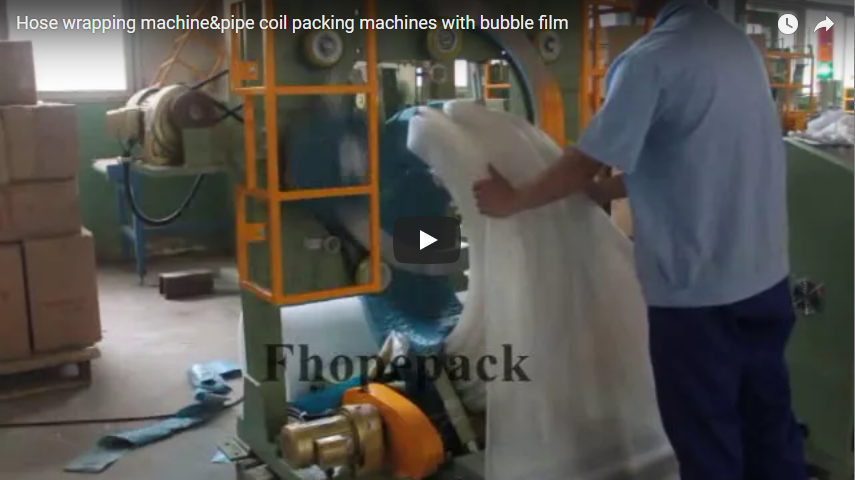
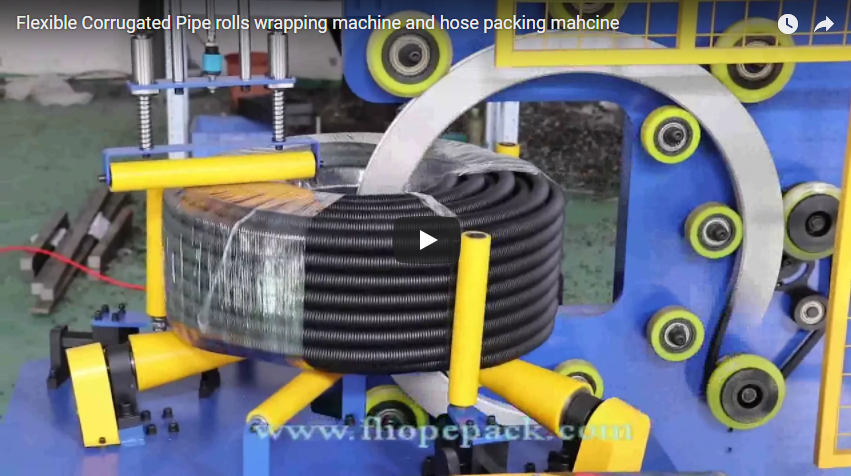
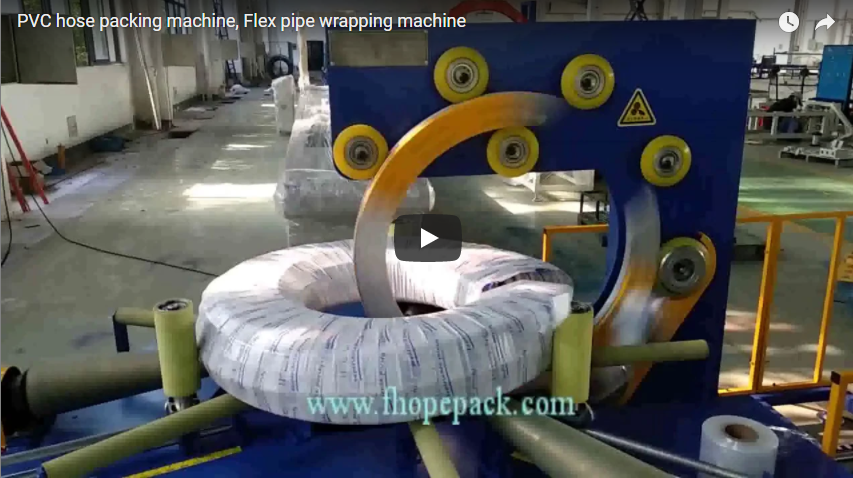
- Load. The operator sets the coil upright on the yellow support rollers so that the wrapping ring runs through its eye. The white guide arms hold the coil in line.
- Start. With the guards in place, the cycle is started from the cabinet. The ring entry design, and whether it opens, is matched to your coil range at quotation.
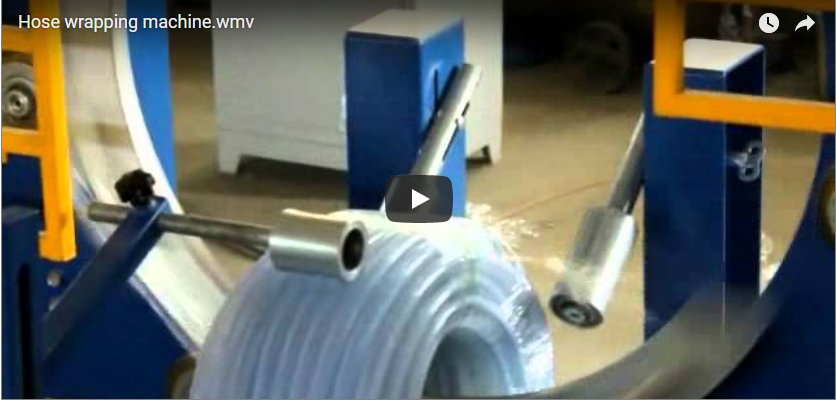
- Wrap. The ring turns and lays film over the cross-section of the coil while the rollers turn the coil forward. Each new turn overlaps the last by the set amount.
- Finish. After one full revolution of the coil the ring stops. On the standard model the operator cuts the film and presses the tail down only once the ring is at a full stop; an automatic cutter and feeder is an option.
- Unload. The operator lifts the wrapped coil off. The next coil goes on.
The control cabinet beside the machine carries start, stop and emergency stop buttons and status lamps. The yellow mesh guards on both sides keep hands away from the rollers and the turning ring.
FPH-300N data
| Item | Value |
|---|---|
| Coil ID | 300–700 mm |
| Coil OD | 500–1,000 mm |
| Coil width | 100–300 mm |
| Coil weight | 10–100 kg |
| Cycle | 23–35 s per coil |
| Ring speed | up to 120 r/min |
| Overlap | 10%–90% |
| Film | OD 100–180 mm, core 50 mm, width 90–100 mm |
| Other wraps | paper or HDPE, optional |
| Power | 1.9 kW; 380 V, 60 Hz, 3-phase |
Larger coils go to the FPH-400 and FPH-500.
Worked example: film and cycle time
Illustrative coil: 800 mm OD, 400 mm ID, 200 mm wide, wrapped with 100 mm film at 50% overlap. Each ring turn advances 50 mm round the outside of the coil.
| Check | Calculation | Result |
|---|---|---|
| Outer circumference | π × 800 | ≈ 2,513 mm |
| Ring turns | 2,513 ÷ 50 | ≈ 51 turns |
| Wrapping time | 51 ÷ 120 r/min | ≈ 0.43 min ≈ 26 s |
| Radial wall of the coil | (800 − 400) ÷ 2 | 200 mm |
| Film per turn (cross-section perimeter) | 2 × (wall 200 + width 200) | 800 mm |
| Film per coil, before stretch | 51 × 0.8 | ≈ 41 m |
| Cycle with 15 s loading | 26 + 15 | 41 s |
| Output | 3,600 ÷ 41 | ≈ 87 per hour |
Result. About 26 s of wrapping and some 41 m of film per coil, so close to 87 coils an hour if loading takes 15 s. Loading time is the big variable: a heavy coil handled by one person takes longer.
Overlap, tension and wrap material
- Overlap. Settable from 10% to 90%; the worked example uses 50%. Raise it for export packs or coils stored outside.
- Tension. Set the film brake so the film lies tight without crushing soft hose. Soft, thin-walled coils need less.
- Film gauge. Our quotations specify 25 micron stretch film; 32–50 micron film also runs.
- Rollers. Where soft hose must not be marked, polyurethane-coated rollers can be specified, as on our other coil lines.
- Material. PE stretch film is standard. Paper or HDPE can be used where the customer wants a breathable or printable wrap.
- Labels. A logo tape option lays a printed tape with the film.
Selection checklist
- Smallest and largest ID, OD and width.
- Coil weight and how it reaches the machine.
- Coils per hour.
- Film, paper or HDPE, and any logo tape.
- Manual or automatic film cut.
- Link to an upstream coiler or a downstream stacker.
Safety: EN 415-10 and ISO 12100
Coil wrappers are built to EN 415-10, with the risk assessment done to ISO 12100. The hazards are the turning ring, the driven rollers and the coil itself. Fixed mesh guards cover both sides, an emergency stop sits on the cabinet, and the ring must be stopped before anyone reaches into the eye.
Engineering FAQ
Q: Can one machine take garden hose and hydraulic hose? A: Yes, if both fall inside 300–700 mm ID, 500–1,000 mm OD and 100–300 mm width. Tension is reset for each.
Q: How fast is it? A: 23–35 s per coil, depending on size and overlap.
Q: Does the film have to be cut by hand? A: On the basic machine, yes. An automatic cutter and feeder is an option.
Q: What about coils above 100 kg? A: Look at the FPH-400 or FPH-500; send your sizes and we will choose.
Next step
- Send coil ID, OD, width, weight and output to info@fhopepack.com.
- We set the ring size, film and options.
- We reply within 24 hours with a proposal and quotation.
Related reading
- Hose coil wrapping machine FPH-300 (product)
- Hose coil wrapping machine FPH-300
- Hose coil wrapping machine by film
- HDPE pipe coil wrapping machine
- Double wall hose coiling and strapping machine
Sources
- FHOPE product page: hose coil wrapping machine FPH-300N
- FHOPE quotations and project correspondence (film gauge, roller coating)
- Our hose coil wrapping machine shown above
- Worked example: illustrative figures
- Standards: EN 415-10; ISO 12100:2010
Last reviewed: 2026-10-19