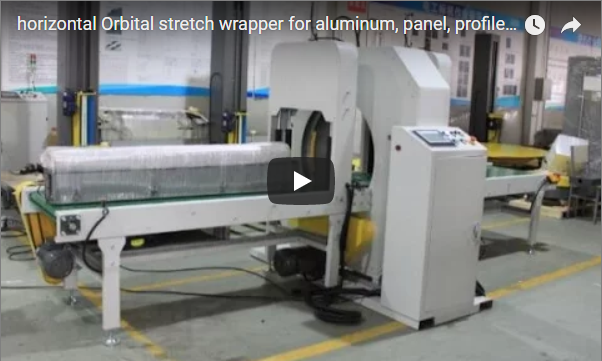
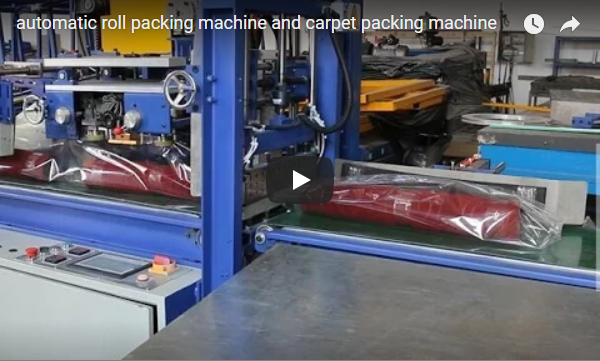
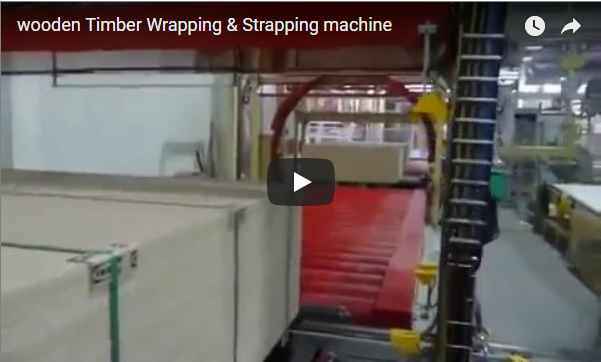
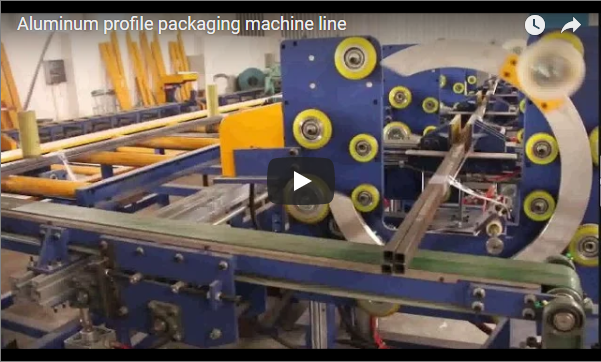
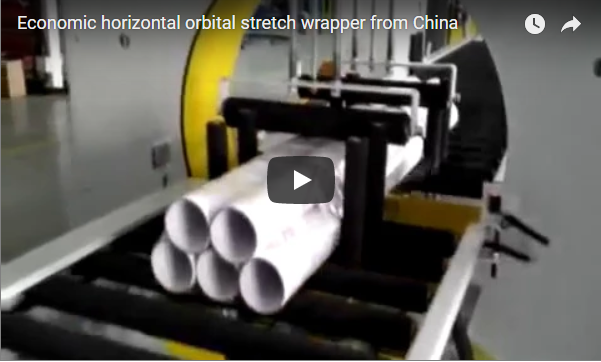
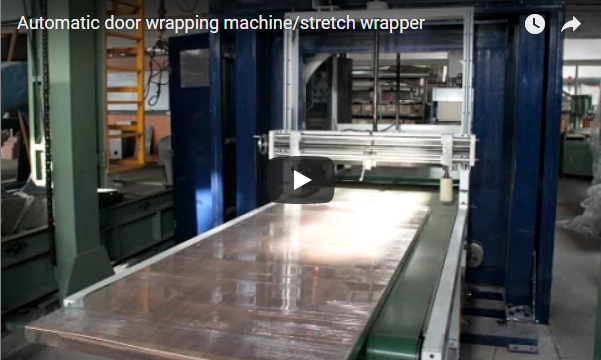
Executive summary: This factory clip shows a manual orbital stretch wrapper — a white, single-station machine with a rotating red ring around a central opening and a roller conveyor. An operator guides long, rigid products — mostly flat timber or lumber planks, with one segment showing a cylindrical metal bar or pipe — through the ring, while the ring itself applies clear plastic stretch film around each piece as it passes through. The equilibrium is close to the machine’s name: the film application is machine-driven by the rotating ring, but a human loads, feeds, and guides the product. The footage demonstrates the machine’s ring wrapping of long products with operator-assisted feeding, but it does not show automatic/manual film cutting, film attachment by the operator, or any readable specification — no ring size, speed, film width, capacity, or power figure appears anywhere in the clip. The older text’s technical parameters are therefore not repeated here: none of them is verifiable from these frames.
This review is written for packaging engineers, plant managers, and buyers evaluating an orbital (ring) stretch wrapper for long products such as timber, lumber, pipes, bars, or extrusions — and for anyone comparing a manually-fed semi-automatic wrapper against a fully automatic line. It documents what this short manufacturer clip actually demonstrates frame by frame, what it conspicuously does not show, and the exact data and evidence to request from the manufacturer before quoting.
What the video shows
The footage is a shop-floor sequence sampled every second from the roughly 24-second clip, giving 25 still frames. Reading them in order gives a consistent picture:
- A ring-orbit (orbital) stretch wrapping machine. The consistent subject is a white-bodied machine holding a red rotating ring around a central opening, with a roller conveyor running through it. The film roll rides on the ring mechanism, and the ring orbits the product to apply the film.
- Long, rigid products pass through the ring. The majority of frames show flat, rectangular timber or lumber planks (single pieces or a bundle), with visible wood grain. One frame and its focused re-check show a cylindrical metal bar or pipe section — golden-brown with a coppery, metallic sheen — being wrapped the same way, so the demonstration covers both square-edged timber and a round profile.
- Clear plastic stretch film around each passing piece. In most frames the film is visibly being applied and wrapped around the product as it travels through the ring; a few tail frames show just the long piece being transported on the roller conveyor, with no wrap in view.
- An operator guides and feeds the product. Several frames (and the focused re-checks) show an operator’s hand or the operator leaning over the machine, guiding the bundle into the ring, while the film application itself is machine-driven on the rotating ring. Other frames run empty, but the human role in loading and guiding is what the clip actually demonstrates.
- Control buttons, but no readable text, brand, or model plate. Red and green control buttons appear on the machine side, but every text attempt — on the body, buttons, or film carriage — is unreadable. No brand, logo, model number, or specification label is legible in any frame.
The repeatable message of the footage is that a manual orbital stretch wrapper uses a rotating ring to apply clear stretch film around long, rigid products that an operator loads, feeds, and guides through the machine. It does not show the inside of an automatic cut-and-hold cycle, and it shows no identifiable brand or any specification data.
Direct observation notes
These points stay close to the visual evidence, with only light interpretation:
- The machine is a ring-orbit (orbital) stretch wrapper: a white body, a red rotating ring around a central opening, and a roller conveyor feeding the product through the ring; the film roll sits on the ring mechanism.
- The wrapped products are long and rigid: mostly flat timber/lumber planks showing wood grain, and in one segment a cylindrical metal (copper/brass-coloured) bar or pipe.
- The film is clear plastic stretch film, applied around the product as it moves through the rotating ring.
- Operator involvement is visible and manual in character: the operator guides/feeds the product into the ring (hands visible in several frames; the operator leans over the entry in others). The ring performs the wrapping — this is not hand-wrapping, but the feeding and guiding are human.
- Tail frames show the long piece being transported on the roller conveyor after or between wrap passes, with no wrap visible in those frames.
- No brand, logo, model plate, or readable text appears anywhere; the only panel elements are red and green buttons.
- All frames are stills: they prove the machine’s ring wrap of long products and the human feeding role, not continuous automatic throughput, not film tension or pre-stretch, not the cut-and-secure cycle, and not any specification.
- No ring diameter, product dimensions, ring speed, film width, power supply, or capacity figures are readable anywhere. The older text’s marketing parameters (ring sizes, RPM range, film widths, voltages, product limits) do not appear in the video and are not repeated here.
What the title promises vs what the footage proves
| Claim (title) | Visible in footage? | Verdict |
|---|---|---|
| Manual | Operator guides and feeds the product into the ring in several frames | Demonstrated (human feeding/guiding) |
| Orbital | A red rotating ring orbits the product and applies the film | Demonstrated |
| Stretch | Clear plastic film is applied around the product under wrapping | Demonstrated |
| Wrapper | The machine wraps long rigid products passing through the ring | Demonstrated |
| (Implied) hands-off automatic wrapping | Film application is machine-driven on the ring, but the operator still feeds and guides the product | Partial — semi-automatic feeding, not full automation |
The footage reliably demonstrates that a ring-type orbital wrapper applies clear stretch film around long rigid products, with the operator feeding and guiding each piece through the ring. It does not demonstrate a fully automatic, unattended operation; it does not demonstrate automatic film cutting or securing; and it contains no readable brand or specification — the precise evidence a buyer needs before sizing a machine against their products.
What the video does not show
For a decision, the following are not observable in the footage and must be confirmed with the manufacturer:
| Missing information | Why it matters |
|---|---|
| Ring diameter and maximum product cross-section | Whether your largest piece fits through the ring |
| Product weight and how it is supported (rollers, carts, cranes) | Loading and line-integration planning |
| Ring speed and wrap overlap | Cycle time and film usage per piece |
| Film width, film type, and tension control | Film cost and load containment |
| Automatic film cut and tail securing | Operator workload per wrap |
| Machine models, motor sizes, and control options | Quoting, spares, and service |
| Brand confirmation of the filmed machine | Badge text is illegible in the footage |
| Power supply and energy consumption | Site utility planning |
The clip never shows a readable nameplate, never shows the film cut/secure step, and never states a ring size, speed, width, capacity, or power figure. Treat the footage as a hardware demo of a manually-fed orbital stretch wrapper, and treat the older article’s specification list as unverified marketing to confirm separately.
How the filmed manual orbital stretch wrapper works, as filmed
Reading the sampled frames in sequence gives a working picture: the operator stands at the machine entry and guides a long, rigid piece — timber planks in most frames, a cylindrical metal bar in one segment — into the central opening; the red rotating ring orbits the piece and applies clear plastic stretch film around its length; the wrapped piece continues onto the roller conveyor, and the tail frames show it being transported. Because all frames are stills, the video proves the existence and very act of ring wrapping with operator-assisted feeding, not the continuous automatic cycle and not any measured specification. Request a full-cycle video that shows a complete wrap from film start to automatic/ manual cut, and state your product dimensions and weight so the supplier can confirm ring size, speed, and film system fit.
Where “Manual Orbital Stretch Wrapper” stands in the footage
The article title promises a manual orbital stretch wrapper, and the footage lives up to the “manual orbital” part: an operator feeds and guides long rigid products while a rotating ring applies clear stretch film around them — machine-run film application on the ring, human-run feeding. The clip never shows a fully automatic unattended operation, never shows the film being hand-applied or hand-cut, and contains no readable brand or specification. For an honest evaluation, accept this as a semi-automatic, operator-fed orbital wrapper demonstrated on timber planks and at least one round metal bar, and request the datasheet — ring diameter, speeds, film system, capacities — plus a full-cycle video to confirm the complete wrap sequence.
Buyer’s verification checklist
Use this as a short pre-order checklist for a manual orbital stretch wrapper:
- Confirm the ring diameter versus the largest product cross-section you need to wrap.
- State your product dimensions, weight, and length range, and ask which support system the machine uses (rollers, carts, or cranes).
- Ask for the ring speed range and the resulting cycle time per piece.
- Confirm the film width, film type, and whether pre-stretch or tension control is available.
- Clarify how the film is cut and secured after each wrap — automatic or by the operator.
- Request machine model, motor sizes, and control system details for quoting and spares.
- Ask the supplier to confirm the machine brand, since the footage badge is not readable.
- Request the power supply and energy consumption figures for your site.
- Ask for a full-cycle video showing one complete wrap from film start through cut.
- Compare the operator workload here against a fully automatic orbital line for your volumes.
FAQ
Does the video prove this wrapper runs fully automatically? No. The clip shows the rotating ring applying the film, but an operator feeds and guides the product into the ring in several frames — the machine is demonstrated as semi-automatic (machine-run wrapping, human-run feeding), not unattended. Confirm the actual automation level and cycle with the supplier.
What can the machine wrap, per the footage? The clip shows long rigid products passing through the ring: mostly flat timber or lumber planks, and one segment with a cylindrical metal bar or pipe. So the demonstrated use case is long, straight products; confirm your specific profile, dimensions, and weight with the manufacturer.
What machine brand is in the video? No brand, logo, model plate, or readable text is visible in any frame, including the control buttons. The article and website are FHOPE’s, but the filmed machine carries no legible badge. Confirm the actual model and manufacturer with the supplier.
Why does the review avoid repeating the older specifications? The old text lists ring diameters, ring speeds, film widths, product limits, and power requirements. None of these is visible, legible, or measured in the footage, so repeating them as facts would be unverified. They belong in the manufacturer’s datasheet.
How can I evaluate this wrapper for my own line? Send your product material, maximum cross-section, length, and weight, your desired wrap rate, film preference, and whether you need automatic film cut — along with a request for a full-cycle video and a ring-size/speed recommendation.
Related reading
- Orbital stretch wrapper
- Customize orbital wrapper
- Stretch wrapping machine
- Rotary ring stretch wrapper
- Semi-automatic horizontal wrapper
Next step
If a manual orbital stretch wrapper fits your long-product packaging, the fastest next step is a technical exchange: send your product material, maximum cross-section and length, piece weight, desired wrap speed, and film preference, and ask specifically for the ring diameter and capacities, the ring speed and cycle time, the film and tension system, the automatic-cut option, and a full-cycle video of one complete wrap. Visit the contact page to start the conversation.
Published: 2026-09-16