Executive summary An industrial bearing wrapping machine orbital-wraps a single bearing in film for dust-proof and anti-rust packaging. The bearing sits on a rotating turntable, clamps center it, a press arm holds it, and an orbital carriage builds a layered barrier, typically in VCI film. The machine is set up for cylindrical, tapered and automotive hub bearings, 5 to 70 kg, at 20–35 seconds per piece. This guide covers the cycle, the specs and the selection points.
Table of Contents
- What the machine does
- How the wrapping cycle runs
- Why VCI film is used
- Key components
- Typical specification range
- Adjustable overlap control
- Machine selection checklist
- Operation and safety basics
- Maintenance essentials
- Engineering FAQ
- Next step
- Related reading
- Sources and standards
What the machine does
An industrial bearing wrapping machine, or bearing packing machine, wraps each bearing in a sealed film layer before it goes into a carton. The bearing sits on a turntable and an orbital film carriage passes film around it, creating a dust-proof, moisture-resistant barrier that keeps the race surface clean for long-term storage and transit.
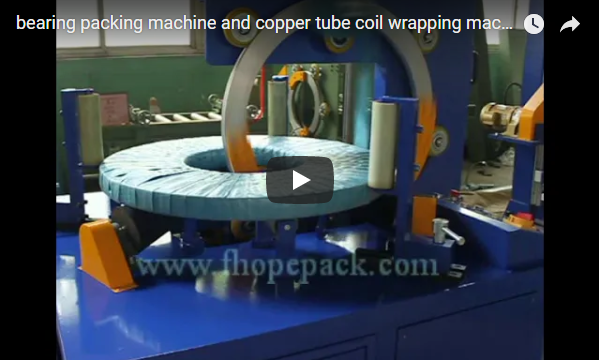
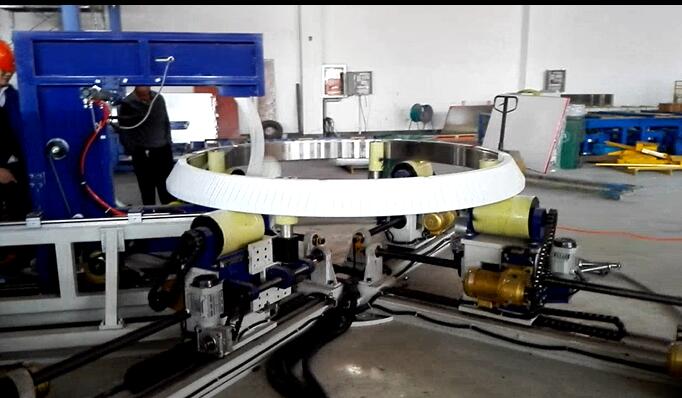
The machine is built around the geometry of bearings. A bearing is an annulus with a bore in the center. The film carriage makes an eye-through pass through the coil and around the outer race in a controlled orbital path, building a seamless multi-layered barrier rather than pressing film onto the part. The result is a layered wrap with uniform tension, which is what high-precision rollers and races need if they are to arrive without contamination or surface damage.
How the wrapping cycle runs
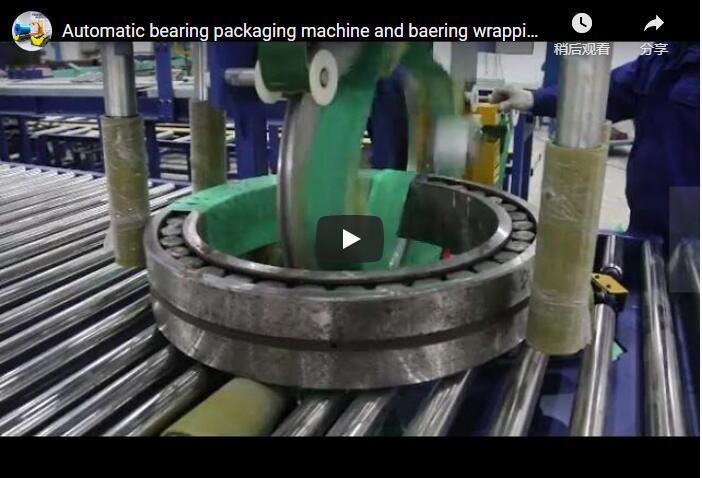
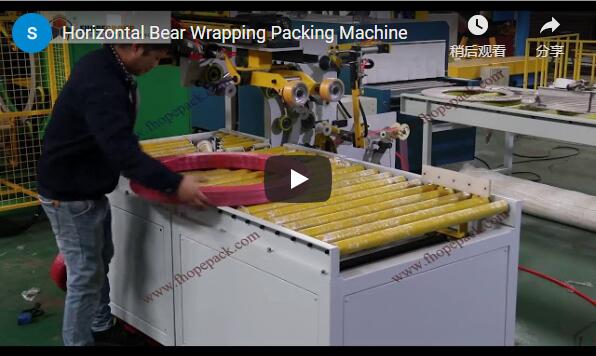
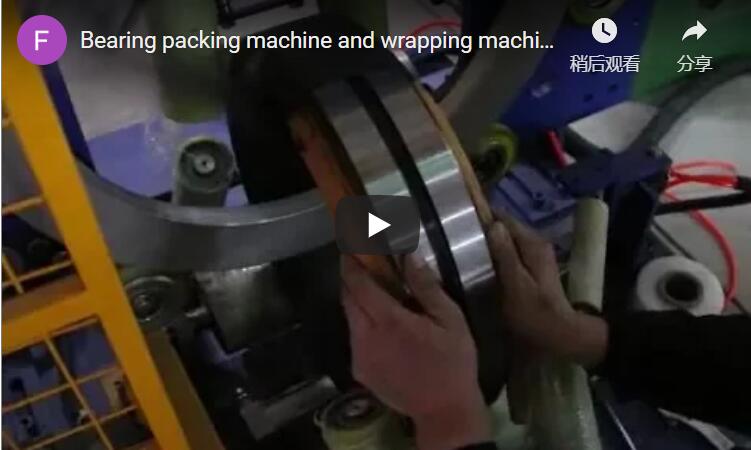
The operator places a bearing on the center of the rotating turntable. Multiple rollers and grippers close in from the sides to center the part, and a vertical press arm lowers to hold it in place through the cycle.
The film carriage then feeds the wrapping material around the bearing while the turntable rotates, building a layered barrier over the outer surface. Frequency converters run the ring and the rollers at set speeds so the wrap is even.
When the set wrap count is reached, the press arm lifts, the clamp releases, and the wrapped bearing is removed and placed in a carton with foam cushioning, where the finished package is sealed. The whole sequence runs in about 20 to 35 seconds per piece depending on wrap settings.
Why VCI film is used
Corrosion is the main threat to a precision bearing in storage or export. Rust starts where moisture and oxygen reach a machined race, and a plain film wrap only delays it. VCI, a volatile corrosion inhibitor, works differently. The film releases a vapor that forms a microscopic protective layer on the metal surface, so the wrapped space stays protected even where the film cannot contact the part directly.
The machine runs VCI film for active corrosion prevention during sea transit and long-term storage, while PVC, PP or PE films cover short-haul dust and scratch protection; the film grade is set per project. For high-precision rollers and races going into long-term storage or an international container, the VCI layer turns a physical shield into an anti-rust barrier, the same principle used on a heavy-duty VCI bearing wrapper.
Key components
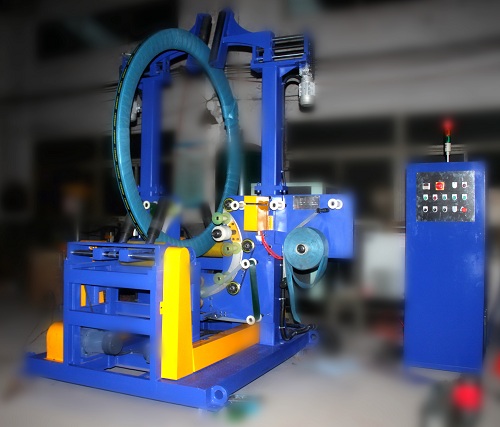
The machine combines a turntable, an orbital film carriage, a press arm, side rollers and a control cabinet.
The turntable carries the bearing and rotates through the wrap. The orbital carriage runs the film around the part, and the vertical press arm holds the bearing against its seat so it cannot lift under film tension. Side rollers center the part and can be adjusted to the bearing size, which also keeps large bearings from shaking at high ring speed.
The control cabinet carries the PLC, an HMI and the drive components, plus a red emergency stop on the panel. A foot switch lets the operator start or pause the cycle hands-free while positioning a bearing, and the motor is fitted with overcurrent protection for continuous running.
Typical specification range
The values below are the published configuration of this machine. Confirm each point against your bearing range per project; where the load exceeds this machine, an automatic bearing packaging machine for steel covers larger sizes.
| Item | Specification |
|---|---|
| Compatible film | VCI film, PVC, PP or PE |
| Bearing bore | 120–270 mm |
| Bearing width | 40–130 mm |
| Weight capacity | 5–70 kg |
| Cycle time | 20–35 seconds per piece |
| Ring speed | up to 100 RPM |
| Power supply | 380 V, 50 Hz, 3-phase |
| Control | PLC with HMI and foot switch |
Adjustable overlap control
A bearing package is only as good as the overlap between film layers. If the layers leave a gap, dust and moisture find the metal even inside the wrap. The machine’s two frequency converters let the operator adjust the ring speed and the roller speed independently, which sets the overlap rate.
That control serves two purposes. It closes any gap in the barrier, and it lets the operator reduce overlap where a lighter film or a shorter storage period allows. Material consumption drops while the surface stays covered.
Machine selection checklist
Work through these points before you ask for a quote, and we confirm the rest against your bearing range and line per project.
| Item | What to confirm per project |
|---|---|
| Bearing | bore, width, weight and outer diameter |
| Film | VCI grade, gauge and overlap target |
| Cycle | pieces per hour and wrap layers per piece |
| Throughput | shift volume and carton handling at outfeed |
| Power | supply voltage and phase on site |
| Control | PLC language, HMI and foot switch preference |
| Site | footprint, guarding clearance and lighting |
Operation and safety basics
Start with the load. Set the bearing on the center locator, confirm the clamps and rollers match the diameter, and check the press arm height before running. A part that is off-center stresses the grippers and can shake at high ring speed.
The work zone is enclosed by yellow mesh guarding around the moving parts. Operators run the cycle with the foot switch and keep hands clear while the turntable rotates and the press arm is down. The red emergency stop on the control panel stops the machine, and servicing follows the lockout procedure in the manual.
Maintenance essentials
Run the daily checks before the first shift. Confirm the film path is clean, the rollers and grippers move freely, and the bearing seat is free of debris, film residue and oil film that could leave marks on the next part.
Keep the turntable, the press arm guides and the film carriage rails lubricated per the manual, and wipe the rollers so the wrap tension stays even. The overcurrent-protected drive motor is designed for continuous running; watch the HMI for drive faults and clear them before restarting.
Engineering FAQ
Q: What films does this bearing wrapping machine run? A: VCI film for active rust inhibition during export or storage, plus PE, PP and PVC for mechanical dust and scratch defense. The grade is selected per project.
Q: How is the bearing held during wrapping? A: Side rollers and grippers center the part on the turntable, and a vertical press arm holds it down through the wrap cycle.
Q: What bearing sizes fit the standard machine? A: The published range covers bores from 120 to 270 mm, widths from 40 to 130 mm, and weights from 5 to 70 kg.
Q: How long does one bearing take to wrap? A: The published cycle is 20 to 35 seconds per piece, depending on film, wrap count and overlap settings.
Q: What electrical utility does the machine need? A: The standard configuration requires a 380 V, 50 Hz, 3-phase power supply.
Q: How is the bearing kept from shifting during wrapping? A: Adjustable side rollers and grippers center the part on the turntable, while the vertical press arm clamps it down against orbital film tension and ring-speed vibration.
Q: How do I change the overlap? A: The ring and roller speeds are set independently on the frequency converters, which controls the overlap rate for a sealed barrier or lower film use.
Next step
- Email us at info@fhopepack.com with your bearing range, film type and throughput.
- We send a layout drawing and a wrapping proposal within 48 hours.
- We arrange a site survey to confirm the guarding, power and outfeed before installation.
Related reading
- Coil and roll stretch wrapping machine
- Automatic horizontal orbital wrapping for one-pass full coverage
- Preventing telescoping on strapped and wrapped steel coils
- Precision orbital wrapping for extra-long panels
- FHOPE packaging machinery product lines
Sources and standards
- ISO 12100:2010 — Safety of machinery. General principles for design, risk assessment and risk reduction
- EN 415-10:2014 — Safety of packaging machines. General requirements
- EN ISO 13849-1:2023 — Safety of machinery. Safety-related parts of control systems
- FHOPE industrial bearing wrapping machine demonstration video, YouTube.
Last reviewed: 2026-10-09