Executive summary Our bearing packing machine lays the bearing flat on a conveyor, centres it, and passes film, paper or knit belt through the bore with a rotating ring. The FPB-400 takes bearings of 500–1,200 mm OD and 100–500 kg in 30–50 s per bearing. We size it from your bearing OD, ID, width and weight.
Table of Contents
- How the bearing wrapper works
- FPB-300 or FPB-400
- Overlap at the OD
- Bearings per shift
- Setup and programs
- Materials
- Utilities and safety
- Selection checklist
- Engineering FAQ
- Next step
- Related reading
- Sources
How the bearing wrapper works
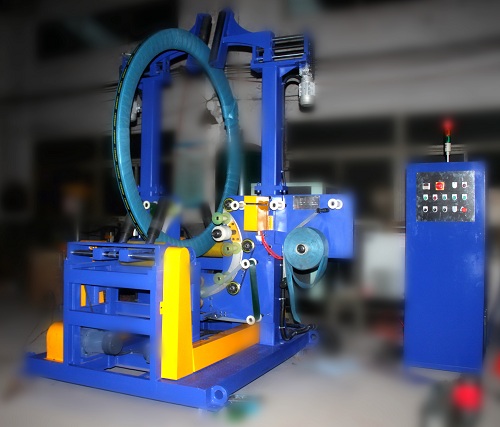
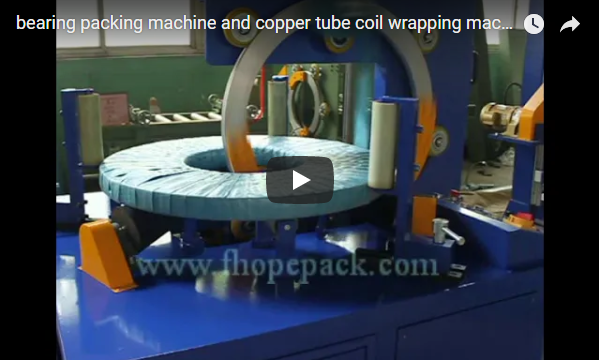
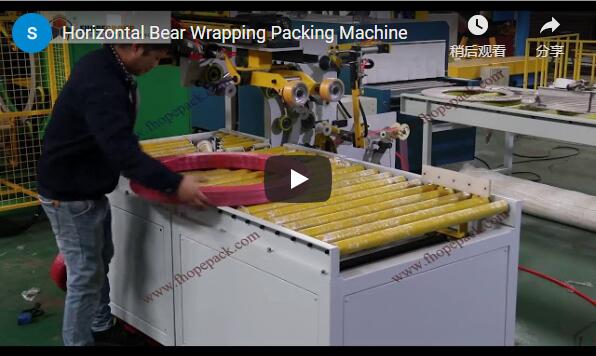
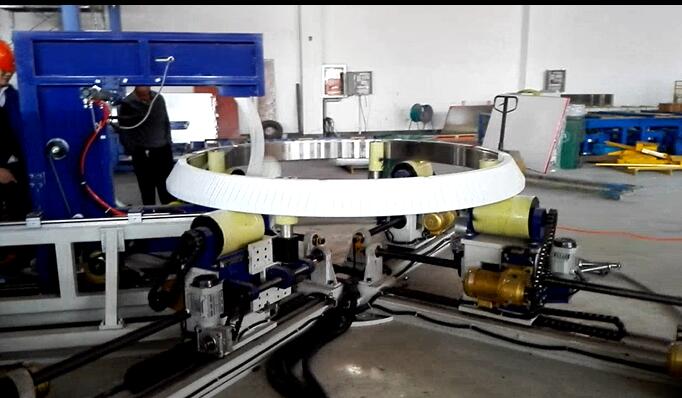
The infeed conveyor brings the bearing into the wrapping station, where automatic positioning centres it. The ring then rotates through the bearing bore while the bearing turns, so the material spirals around the full ring section. After wrapping, a cutting system cuts the material and the outfeed conveyor carries the bearing away.
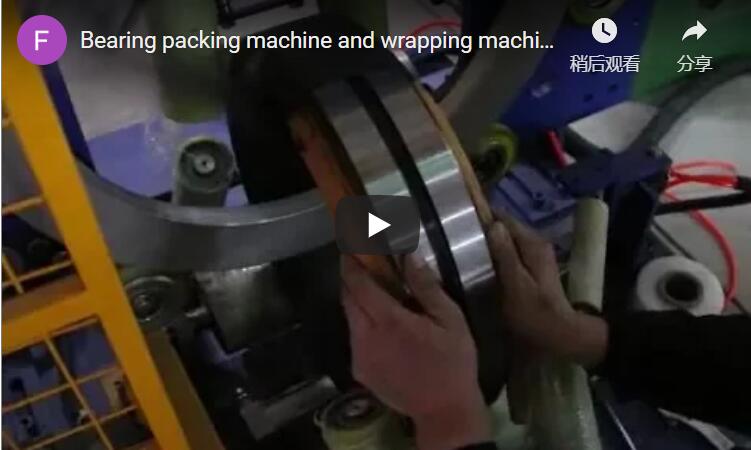
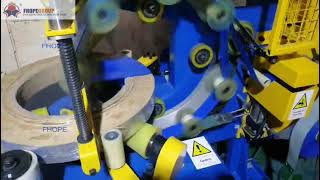
Sensors detect the bearing position to start and stop the machine automatically. In our video, the ring carries green material through the bore of a large roller bearing while the bearing turns, so each wrap overlaps the last until the whole section is covered.

FPB-300 or FPB-400
| Parameter | FPB-300 | FPB-400 |
|---|---|---|
| Bearing OD | 600–1,200 mm | 500–1,200 mm |
| Bearing ID | 300–900 mm | 300–800 mm |
| Bearing width | 20–300 mm | 100–400 mm |
| Bearing weight | 10–500 kg | 100–500 kg |
| Ring speed | 30–70 r/min | 30–70 r/min |
| Wrap time | 40–50 s per bearing | 30–50 s per bearing |
| Overlap | 20–80% | 20–90% |
Choose by width first. Bearings wider than 300 mm need the FPB-400, and narrow bearings under 100 mm wide need the FPB-300. Bearings with an ID over 800 mm also need the FPB-300.
Overlap at the OD
Wraps spread furthest apart at the outer diameter, so overlap is smallest there. We set the overlap at the OD so the outside has no gaps. The listed wrap time limits how many wraps fit. At 70 r/min, 50 s allows 70 × 50 ÷ 60 ≈ 58 wraps.
Illustrative example for a 1,000 mm OD bearing with 100 mm material:
| Overlap at OD | Advance per wrap | Wraps | Time at 70 r/min |
|---|---|---|---|
| 50% | 50 mm | π × 1,000 ÷ 50 ≈ 63 | about 54 s |
| 30% | 70 mm | π × 1,000 ÷ 70 ≈ 45 | about 38 s |
At 50% overlap, this bearing runs just over the listed 50 s. To stay within it, keep the overlap at the OD under about 46%, or use wider material.
Bearings per shift
Illustrative example with a 38 s wrap and 20 s for conveyor transfer and positioning:
| Step | Value |
|---|---|
| Total cycle | 58 s |
| Bearings per hour | about 62 |
| Bearings per 8 h shift | about 496 |
These are run-time figures before material roll changes. The conveyors and automatic positioning let the machine join your bearing production line.
Setup and programs
On the FPB-400, you set the bearing OD, ID and width and a correction value, and no other parameters are needed. Up to 6 programs can be stored in the PLC memory and selected from the keypad. That makes changeovers between bearing sizes quick.
| Item | FPB-300 | FPB-400 |
|---|---|---|
| Control | PLC and HMI | PLC, keypad, 6 stored programs |
| Positioning | automatic, sensor detected | automatic centralised |
| Modes | manual and automatic | automatic |
| Speed | frequency converter | converters |
| Fault display | indicator light alarm, causes shown | not listed on its page |
Materials
Both models take goffered paper, PE, stretch film, knit belt or PVC. Packaging tension is adjustable, and a cutting system cuts the material after each bearing. We confirm the material width with your overlap target.
Utilities and safety
| Utility | FPB-300 | FPB-400 |
|---|---|---|
| Power supply | AC 380 V, 50 Hz, or your requirement | AC 380 V, 50 Hz, or your requirement |
| Power | 2.5 kW | 2.5 kW |
The standards that apply depend on the destination market. For CE markets, ISO 12100 sets the risk-assessment method and EN 415-10 sets general requirements for packaging machines.
Selection checklist for a bearing wrapper
- Bearing OD, ID, width and weight range.
- Number of bearing sizes, for stored programs.
- Paper, film, knit belt or PVC.
- Overlap target at the OD.
- Bearings per shift needed.
- Connection to your production line.
Engineering FAQ
Q: What bearing sizes fit the FPB-400? A: 500–1,200 mm OD, 300–800 mm ID, 100–400 mm wide and 100–500 kg.
Q: When do we need the FPB-300 instead? A: For bearings under 100 mm wide or with an ID over 800 mm.
Q: How long does one bearing take? A: 30–50 s on the FPB-400 and 40–50 s on the FPB-300.
Q: How many bearing sizes can we store? A: Up to 6 programs on the FPB-400.
Q: Which materials can we use? A: Goffered paper, PE, stretch film, knit belt or PVC.
Next step
We plan your bearing wrapper in three steps:
- Submit your layout drawing with bearing sizes, weights and bearings per shift to info@fhopepack.com.
- Receive a proposal within 48 hours, with the model, material and conveyors.
- Book a site survey to fit the wrapper to your line.
Related reading
- Bearing packing machine FPB-400
- Bearing wrapping machine FPB-300
- Bearing packing line
- Video: copper tube and pipe coil packing machine
- Video: steel wire coil wrapping machine
Sources
- FPB-400 data: bearing packing machine FPB-400 page
- FPB-300 data: bearing wrapping machine FPB-300 page
- Machine in action: our big bearing packing machine video on YouTube
- Standards scope: ISO 12100:2010, EN 415-10:2014
Last reviewed: 2026-10-04