Bearing Packing Machine for Indian Climate: NBC Case Study on VCI Paper + Stretch Film Protection

Executive summary This video shows an industrial-sized bearing wrapped on a blue bearing packing machine with an inclined roller conveyor. A worker loads and guides the film, the wrapping arm completes its cycle automatically, and the film is sealed at the end. Corrosion protection performance for humid climates (such as India’s) is not demonstrated in the footage — confirm material and protection claims with the manufacturer.

Bearings are unforgiving products to ship. Their machined, reflective surfaces show every fingerprint, every speck of dust, and every trace of moisture. When a bearing travels from a factory floor to a customer in a humid climate, the packaging is not cosmetic — it is the last line of defense against rust, which can turn a high-value component into scrap.

This article walks through what the video actually shows: a large, circular metallic bearing being wrapped in clear plastic film on a dedicated packing machine. It also states plainly what the video does not show, so buyers — especially those sourcing for humid regions like India — know exactly which questions to raise before committing to a machine.

The machine in action: what the video shows

The footage runs just over ten seconds of active wrapping, and the sequence is easy to follow:

Time What happens
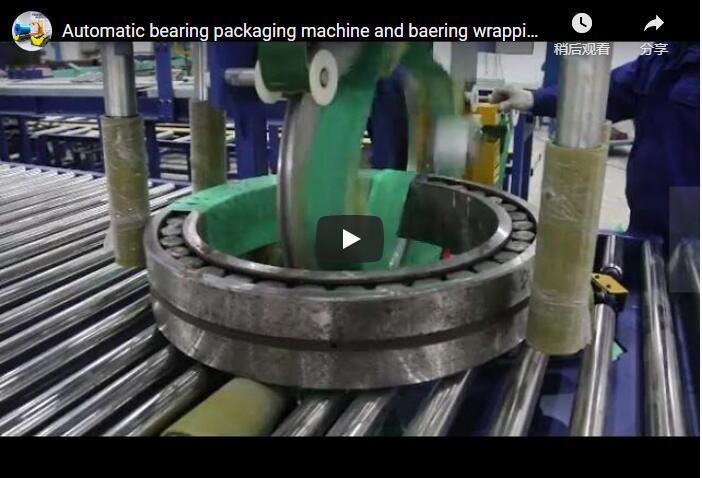
0s–2s The bearing sits on an inclined roller conveyor. A worker in a blue uniform begins guiding the film.
2s–10s The wrapping arm rotates around the bearing, applying clear plastic film in a spiral pattern. The worker assists with initial placement and tensioning.
10s–12s The wrapping arm completes its cycle. The film is sealed at the end.
12s–22s The fully wrapped bearing rests on the conveyor; the machine is idle. The camera angle shifts for a clearer view of the mechanism.

Two things stand out. First, the machine does the rotational work — the worker does not walk around the bearing with a film roll. The wrapping arm, fitted with multiple rollers, travels around the stationary product. Second, the process starts manually and finishes automatically: the worker steps away mid-cycle, and the machine completes and seals the wrap on its own. That hand-off point — manual load, automatic wrap — is the core operating pattern of this class of equipment.

Why a wrapping arm matters for bearings

Wrapping a bearing by hand is slow and inconsistent. Film tension varies from shift to shift, overlap is uneven, and workers spend time circling heavy parts. The machine in the video applies film in a consistent spiral around the full circumference, and the end seal gives a tidy, closed finish.

For buyers, the practical implications are:

  • Consistency. Every bearing gets the same overlap and coverage, regardless of who operates the machine.
  • Ergonomics. The operator loads the part and guides the film start — no repetitive walking around heavy, awkward products.
  • Throughput readiness. Because the wrap cycle runs unattended once started, the machine frees the operator to prepare the next part. Cycle-time figures for your product size should be verified with the manufacturer.

Direct observation notes

The following block stays close to the visual analysis of the footage, with only light grammar-level editing. It is the factual backbone of this article.

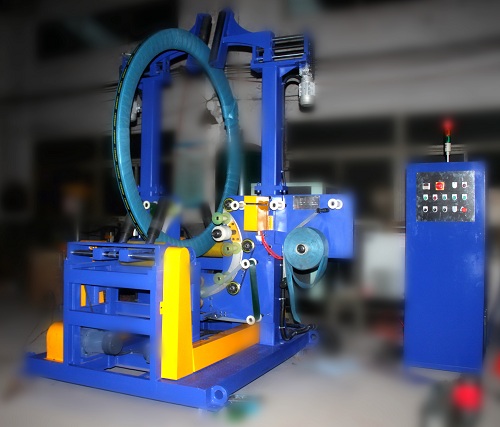
  • The machine is a blue and yellow bearing packing unit; the main frame is painted blue, and the control panel is a blue and yellow combination.
  • A large, circular, metallic bearing — likely a roller or thrust bearing with a central hole — is positioned on a blue, inclined roller conveyor. The bearing appears to be several times larger than a standard hand, indicating an industrial-sized component.
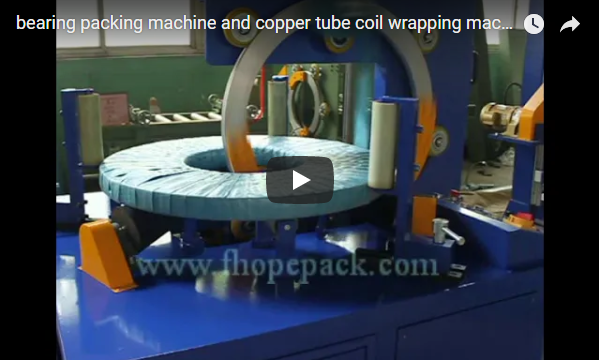
  • The wrapping mechanism uses a rotating arm with multiple rollers. A film roll holder (yellow) supplies the clear, flexible film.
  • The film is applied in a spiral pattern around the entire circumference and is sealed at the end. The film is transparent, so the bearing’s surface remains visible after wrapping.
  • Conveyor and wrapping rollers are metal (likely stainless steel or aluminum), supported by white or light-colored plastic or rubber components.
  • The control panel, on the right side of the machine, has a digital display showing numbers, several push buttons (likely start, stop, and settings), a red emergency stop button, and green and red indicator lights.
  • A protective guard encloses the wrapping mechanism as part of the machine’s frame. No warning labels are clearly visible; no interlocks are visible, though the guard suggests an interlock system may exist.
  • The setting is a factory floor. In the first ten seconds a worker in a blue uniform operates the machine and guides the film; after that the worker steps away and the machine finishes automatically.

Control panel and safety notes

The visible control setup is straightforward: a digital display, push buttons, indicator lights, and a red emergency stop. For an operator, this means the machine is run from a single station — no reaching across the wrap zone during a cycle.

Safety observations worth noting for procurement discussions:

  • Emergency stop present — a prominent red button on the control panel.
  • Guarding present — the rotating arm area is enclosed by a protective guard integrated into the frame.
  • Not visible in the video — warning labels, light curtains, or confirmed interlock wiring. Whether the guard includes an interlock switch should be checked with the manufacturer before purchase.

Applications: where this machine fits

Based on what the footage shows — a large, heavy, circular metallic part wrapped on a roller conveyor — the machine suits:

  • Bearing manufacturers and distributors wrapping large industrial bearings (roller, thrust, and similar large-ring formats) before boxing or shipping.
  • Metal component exporters in humid coastal or monsoon-affected regions who need a sealed, uniform barrier layer around each part.
  • Workshops handling other ring-shaped metal products such as large sleeves, races, or circular machined parts that sit stably on a roller conveyor.

For smaller bearings, ring diameters outside what is shown, or products that cannot roll on an incline, machine suitability must be verified with the manufacturer. The video demonstrates one product on one machine configuration.

Protection for humid climates: what the video does not show

The article title references VCI paper combined with stretch film protection for Indian climate conditions. Here is the honest boundary:

The video shows the bearing being wrapped in clear plastic film only. No paper layer application is visible in the footage. VCI (vapor corrosion inhibitor) paper works by releasing protective vapors inside an enclosed package to prevent rust on metal surfaces, and pairing a VCI paper layer with an outer stretch film is a common approach for moisture-prone destinations. However, nothing in this footage demonstrates a paper wrap, VCI materials, salt-spray testing, or climate-specific protection results.

If corrosion protection over an extended humid season is your deciding factor, treat these as questions for the supplier rather than assumptions from this video:

  1. Can this machine wrap both film and paper, or in combination?
  2. Which VCI paper grades and film thicknesses does it handle?
  3. What corrosion protection duration is claimed, and what test data backs it?
  4. What sealing method secures the film end, and how tight is the final package?

What the video does not show

To keep expectations accurate, the footage does not include:

  • Cycle-time measurements, output rates, or throughput figures.
  • Machine specifications such as bearing weight capacity, maximum outer diameter, or film roll width.
  • Any paper-wrapping step or VCI material handling.
  • Noise levels, power requirements, or installation footprint.
  • Operator training procedures or maintenance routines.
  • Packaging performance tests (drop, vibration, salt spray, humidity chamber).
  • Any customer dialogue, quotation, or delivery terms.

Checklist before you request a quotation

Use this list to turn what you saw in the video into a productive conversation with a supplier:

  • Confirm your bearing’s maximum diameter and weight against the machine’s capacity (not shown in video).
  • Ask whether the wrapping arm handles film only, paper only, or film + paper combinations.
  • Request the typical cycle time for a bearing of your size.
  • Ask about conveyor incline angle and whether it matches your upstream feed method.
  • Confirm guarding, interlocks, and emergency stop configuration against your local safety standards.
  • Ask for corrosion-protection test data if humid-climate storage or ocean freight is part of your distribution chain.
  • Clarify film specifications — width, thickness, and whether pre-stretch is applied.

Frequently asked questions

Does the machine wrap the bearing automatically? Yes, with a manual start. The worker places the bearing, guides the film for initial placement and tensioning, then steps away; the wrapping arm completes the spiral wrap and seals the film automatically, as shown from roughly the 10-second mark onward.

What kind of product is shown being wrapped? A large, circular, metallic bearing — likely a roller or thrust bearing with a central hole — industrial in scale, resting on an inclined roller conveyor.

Is the wrapped bearing visible after packing? Yes. The film is transparent, so the bearing’s metallic surface can be inspected through the wrap — useful for identification and quality checks without unwrapping.

Does this machine apply VCI paper as well as film? The video only shows clear plastic film being applied. Whether the machine supports paper wrapping or film-and-paper combinations is not demonstrated — check with the manufacturer.

What safety features are visible? A red emergency stop button on the control panel and a protective guard around the wrapping mechanism. Warning labels and interlock details are not clearly visible in the footage.

How long does a wrap cycle take? The active wrapping in the video takes roughly ten seconds before the cycle completes and seals, but the footage is edited and shows one product size. Do not treat this as a rated cycle time — confirm figures for your bearing with the manufacturer.

Source and method

This article is based on the video embedded above. The footage was analyzed frame-by-frame with a vision model; the video contains background music only, with no narration or speech, so no spoken content was transcribed. All factual claims about the machine and process come from what is visible in the sampled frames. Statements about VCI paper, climate performance, specifications, and cycle rates are explicitly marked as requiring manufacturer confirmation.

Related reading

Next step

If you pack large bearings or ring-shaped metal components and need consistent, sealed protection for humid or long-distance shipping, send us your product dimensions and packing requirements. We can advise on the right machine configuration and materials — including any paper-plus-film options — and confirm cycle times and capacities for your products. Reach us at our contact page.

Published: 2026-09-03