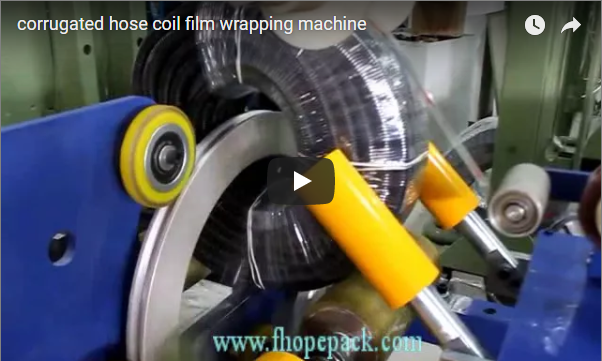
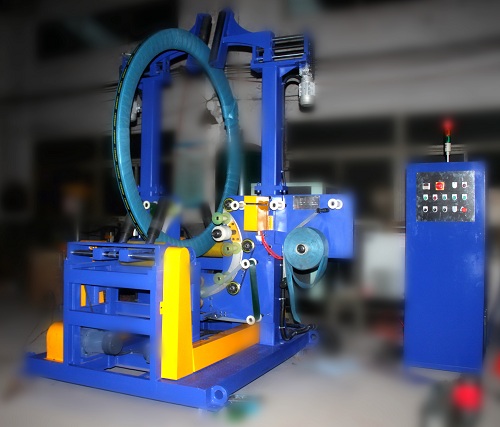
Executive summary We build horizontal bearing wrapping machines that pass film through the bearing bore with a rotating ring while support rollers turn the bearing, so the whole ring section is sealed. Our standard models cover bearing ID 120–900 mm, OD up to 1200 mm and 5–500 kg, at 20–50 s per bearing. Larger slewing and wind bearings run on a big-size machine. This guide shows the cycle, model ranges and a coverage check at the bore.
Table of Contents
- Wrapping cycle
- Model ranges
- Large bearings
- Coverage at the bore
- Packing material
- Controls
- Safety
- Selection checklist
- Engineering FAQ
- Next step
- Related reading
- Sources
How a bearing is wrapped on our horizontal ring machine
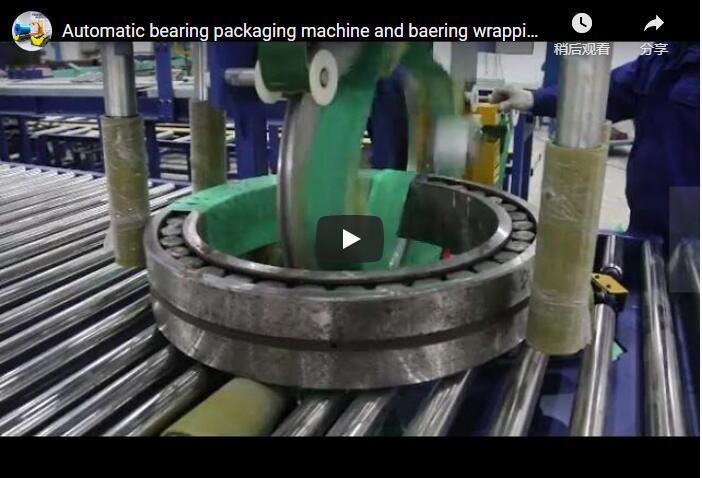
In this video we load rings by hand onto the roller table and wrap them in LLDPE stretch film through the bore and over the outer surface, so the whole section is sealed. The 118 s clip covers two rings plus manual handling, so it runs longer than one 20–35 s machine wrap on our compact model. On our compact model the ring runs at up to 100 r/min. The cycle runs in five steps:
- 0–12 s, load and start. Our operator places the ring flat on the support rollers, steps back and starts the cycle at the panel. On our compact model the station is designed for easy manual loading and unloading.
- 14–28 s, hold. The press-down device lowers onto the ring so it does not shake while the wrapping ring turns.
- 30–58 s, wrap. The ring carries the film roll through the bore. The support rollers turn the bearing, so the film advances around the circumference. On the second ring, the press closes and film runs through the bore from 72 s to 80 s. Ring speed and support-roller speed run through inverters under PLC control, so coverage is a setting, not a manual judgment.
- Cut. An automatic cutter cuts the material when the set coverage is complete.
- 90–118 s, unload. The press-down device holds the wrapped ring while it turns until coverage is complete, then it is released and moved aside on the roller table at 116–118 s. On our inline models an outfeed conveyor carries it out.
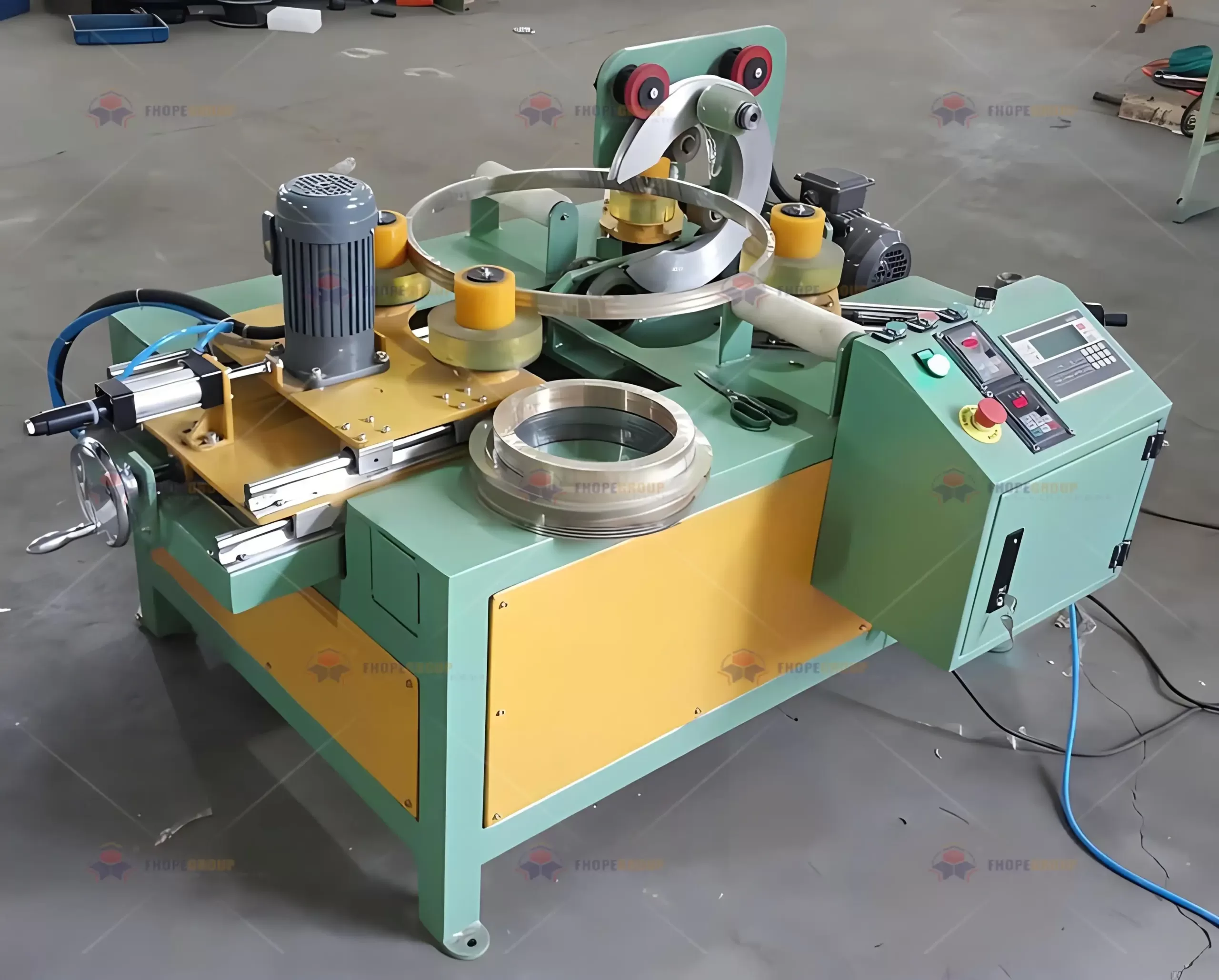
Bearing wrapping machine model ranges
| Parameter | FPBS-200 | FPB-300 | FPB-400 |
|---|---|---|---|
| Bearing ID | 120–270 mm | 300–900 mm | 300–800 mm |
| Bearing OD | see OD − ID | 600–1200 mm | 500–1200 mm |
| OD − ID (section) | < 190 mm | — | — |
| Bearing width | 40–130 mm | 20–300 mm | 100–400 mm |
| Bearing weight | 5–70 kg | 10–500 kg | 100–500 kg |
| Ring speed | max 100 r/min | 30–70 r/min | 30–70 r/min |
| Wrap time | 20–35 s | 40–50 s | 30–50 s |
ID and OD are separate ranges, not paired values: every bearing’s OD exceeds its ID, and on FPBS-200 the section OD − ID must stay below 190 mm. Across the three models the range is ID 120–900 mm, OD up to 1200 mm, 5–500 kg and 20–50 s per bearing. FPB-300 and FPB-400 run at 2.5 kW on AC 380 V 50 Hz, with other voltages on request. Overlap is adjustable: 20–80% on FPB-300 and 20–90% on FPB-400.
Large slewing, wind and supporting bearings
Above 1200 mm OD we move to a big-size bearing packing machine:
| Parameter | FPCA-6000 |
|---|---|
| Package OD | 2900–5000 mm |
| Package ID | 2500–4200 mm |
| OD − ID | < 950 mm |
| Weight | 500–12000 kg |
| Wrap time | about 60–110 s, three layers in one pass |
| Power | about 4.5 kW |
The largest OD and the smallest ID cannot be combined, because OD − ID must stay below 950 mm. A bearing with a 2500 mm ID can reach about 3450 mm OD (2500 + 950 mm) on this machine.
The wrapping station moves to suit the bearing size, and three rolls apply VCI film plus two stretch film layers in one pass. An oil sprayer can coat the bearing while it is wrapped. For one customised large-bearing wrapper covering 1092–3048 mm OD, our engineering estimate was about 50–75 s per bearing.
Coverage check: overlap is highest at the bore
Each ring turn lays one film width across the section, but the bore circumference is shorter than the outer circumference. Set coverage at the OD; the bore then gets more overlap:
- Example bearing: ID 200 mm, OD 360 mm on an FPBS-200 (OD − ID = 160 mm, inside the 190 mm limit).
- Pitch: 40 mm film at 50% overlap gives 20 mm per turn at the OD.
- Turns: OD circumference 1131 mm ÷ 20 mm = 57 turns.
- Time: 57 turns at 100 r/min take 34 s, inside the 20–35 s range.
- Bore check: the same 57 turns over a 628 mm bore circumference give 628 ÷ 57 = 11 mm pitch, so overlap at the bore is 1 − 11/40 = 72%.
So a bearing that looks lightly covered on the outside is already heavily covered at the bore.
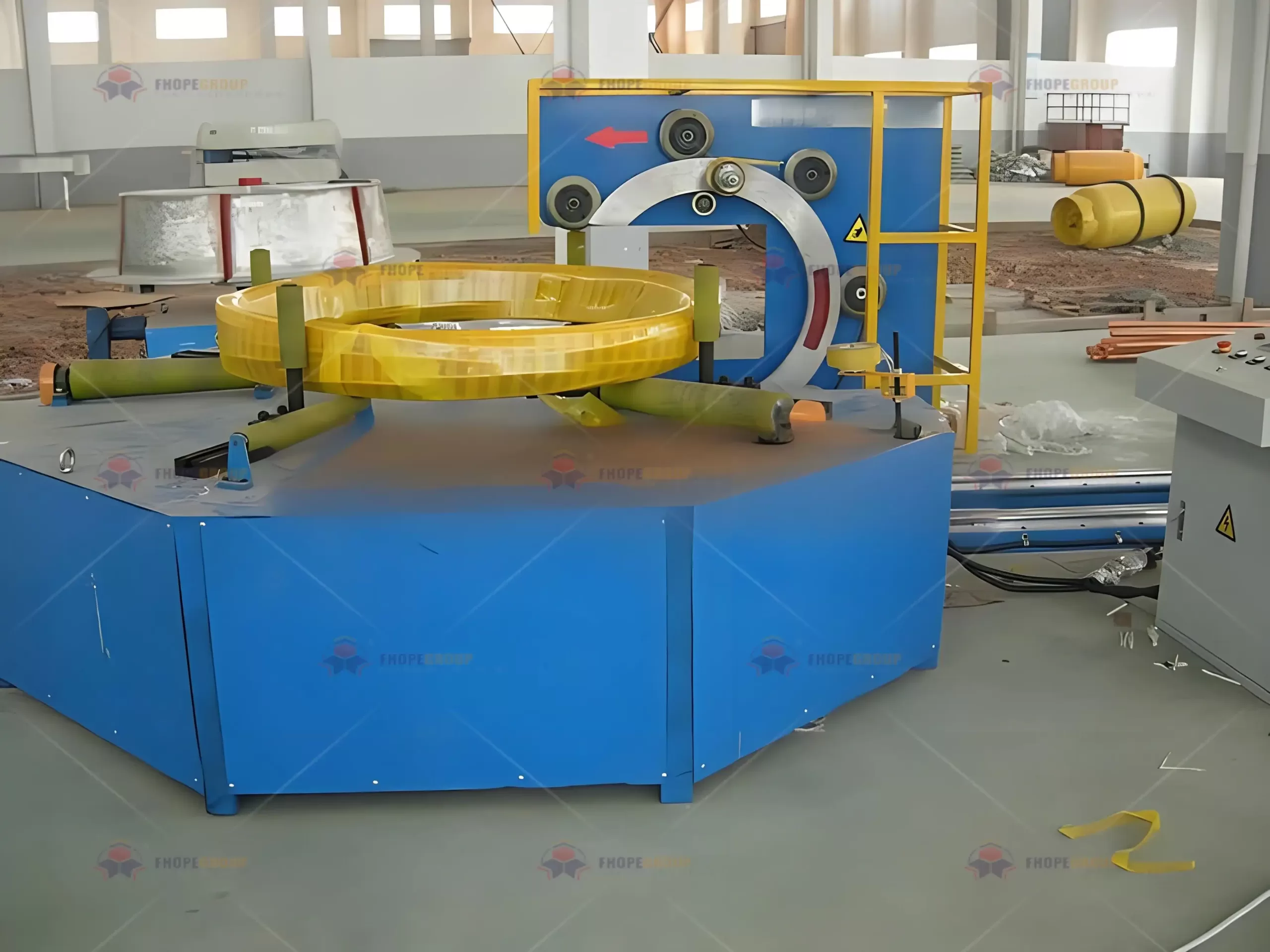
Packing material for bearings
Our FPB models run goffered paper, PE, stretch film, knit belt or PVC. The compact FPBS-200 uses PVC or VCI film rolls of 40 mm width, 60–100 mm OD and 30 mm core ID. Choose by route:
- VCI film: corrosion protection for bare steel bearings in storage and sea freight.
- Stretch film or PVC: dust and moisture sealing, often over a VCI layer.
Two materials at the same time, such as VCI plus film or paper plus film, generally need a bearing ID above 300 mm. The ring then carries both rolls safely through the bore, and each wrapping material is generally 70–80 mm wide. Smaller bores take the two materials in two separate wraps.
- Knit belt or goffered paper: abrasion protection for heavy bearings handled by sling.
Controls and automation
Our bearing wrappers use PLC and HMI control with manual and automatic modes. FPB-400 stores up to 6 programs, selected on the keypad, and the operator sets OD, ID and width. Sensors detect the bearing position for automatic start and stop. Ring and roller speeds are set by frequency converters, and faults are shown on the panel. FPB-300 and FPB-400 can connect to a bearing production line with infeed and outfeed conveyors.
Safety around a bearing wrapping station
The rotating ring and the support rollers are the main hazards. Our compact model has guardrails, soft start and stop, and a foot switch for jog. The drive motor is protected against overcurrent. The applicable standards depend on the destination market. For CE markets, ISO 12100 sets the risk-assessment method and EN 415-10 sets the general requirements for packaging machines.
Selection checklist for a bearing wrapping machine
- Bearing ID, OD and width range, and the smallest bore you must pass.
- Bearing weight range.
- Bearings per hour and whether loading is manual or by conveyor.
- Packing layers: VCI, stretch film, PVC, knit belt or paper.
- Need for oil spraying or multi-layer wrapping in one pass.
- Supply voltage and frequency at site.
Engineering FAQ
Q: What is the smallest bearing bore the machines can wrap? A: The FPBS-200 handles bearing ID from 120 mm, with OD − ID below 190 mm and 5–70 kg. The ring must pass through the bore, so ID is the first value to check.
Q: How long does it take to wrap one bearing? A: 20–35 s on FPBS-200, 40–50 s on FPB-300 and 30–50 s on FPB-400. Big-size bearings take about 60–110 s with three layers in one pass.
Q: Which model suits a bearing of 800 mm OD and 300 kg? A: Check the bore first: FPB-300 takes ID 300–900 mm and FPB-400 takes ID 300–800 mm. If the bore fits, FPB-300 (OD 600–1200 mm, 10–500 kg) or FPB-400 (OD 500–1200 mm, 100–500 kg) both cover 800 mm OD and 300 kg. Choose FPB-400 if the width is above 300 mm, up to 400 mm.
Q: Can the machine apply VCI film and stretch film together? A: Yes. Our big-size machine applies VCI film plus two stretch film layers in one pass. On standard models, VCI and film go on together when the bearing ID is above 300 mm, generally with 70–80 mm wide materials. For smaller bores, such as the 120–270 mm range of FPBS-200, wrap VCI first, then stretch film over it in a second wrap at 50% overlap or more.
Q: How do I check that the film covers the bore properly? A: Set coverage at the OD. The bore circumference is shorter, so overlap rises there: in our 200/360 mm example, 50% at the OD becomes 72% at the bore.
Next step
We size the wrapper to your bearing range in three steps:
- Submit your layout drawing with bearing ID, OD, width, weight, bearings per hour and packing material to info@fhopepack.com.
- Receive a machine proposal within 48 hours, with model, ring size, material setup and a wrap-time check.
- Book a site survey to place the station or connect it to your bearing line.
Related reading
- Bearing packing machines
- Bearing wrapping machine FPB-300
- Big size bearing packing machine
- Video: bearing packing machine with VCI and film
- Video: automatic bearing packing line customised for a customer
Sources
- FPB-300 ranges, ring speed, wrap time, overlap, power, materials: bearing wrapping machine FPB-300 page
- FPB-400 ranges, 6 programs: bearing packing machine FPB-400 page
- FPBS-200 ranges, film roll, safety features: bearing wrapping machine FPBS-200 page
- FPCA-6000 table, three-layer pass, oil sprayer: big size bearing packing machine page
- Customised large-bearing estimate: FHOPE internal engineering records
- Standards scope: ISO 12100:2010, EN 415-10:2014
Last reviewed: 2026-10-03