> **Executive summary**
> Large bearings need a sealed, rust-inhibiting wrap before shipping, and wrapping by hand round a ring this size is slow and uneven.
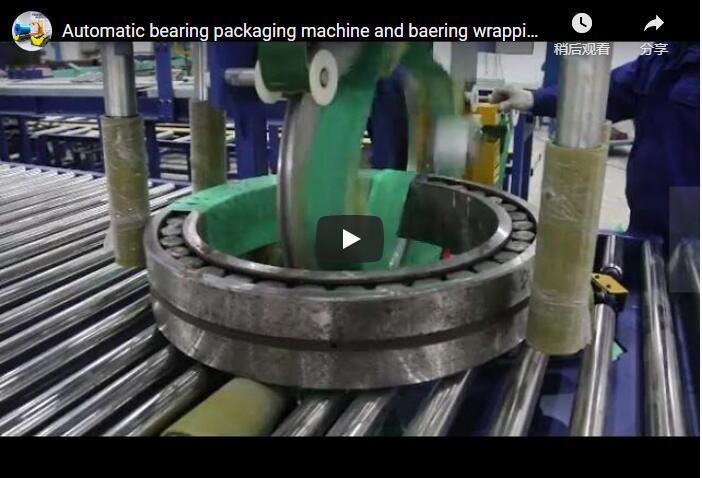
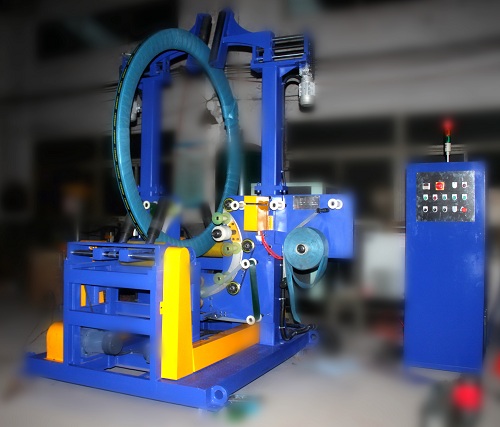
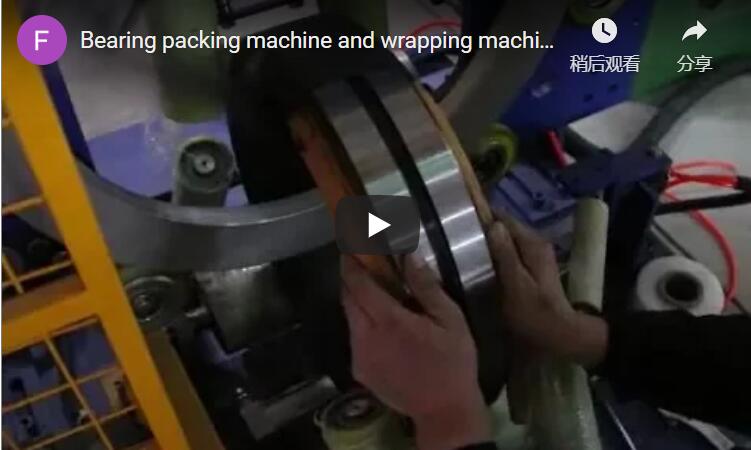
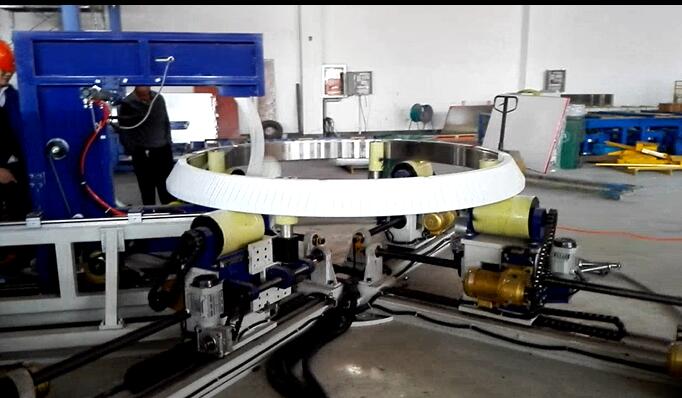
> Our machine in this video turns a large bearing on its table while the wrapping arm lays blue VCI film round the ring section inside a yellow mesh fence.
> Wraps per layer follow from the **mean circumference** and the **film width**, and film used from the ring section.
Table of Contents
- What the video shows
- How the bearing is wrapped
- Wraps and film per bearing
- Controls and safety
- Selection checklist for a bearing packing machine
- Engineering FAQ
- Next step
- Related reading
- Sources
What the video shows
A large wind-turbine-size bearing lies flat on the machine's turntable. The wrapping arm starts the blue VCI film, then lays it round the ring section while the bearing turns, so the film builds up evenly round the whole ring.
When the ring is covered the arm stops and moves back, leaving the wrapped bearing on the table. A yellow mesh fence surrounds the work area. The FHOPE GROUP watermark shows in the corner.
How the bearing is wrapped
Times are read from the video timestamps.
| Step | What happens | Video time |
|---|---|---|
| Load | The bearing is set on the turntable | about 0–8 s |
| Start | The arm starts the blue VCI film | about 8–16 s |
| Wrap | The bearing turns and film is laid round the ring | about 16–48 s |
| Finish | The arm stops and moves back | about 48–64 s |
VCI film releases a corrosion inhibitor inside the wrap, so the seal round the ring matters as much as the coverage.
Wraps and film per bearing
Illustrative example:
| Item | Value |
|---|---|
| Outer and inner diameter (illustrative) | 2,000 and 1,600 mm |
| Ring height (illustrative) | 200 mm |
| Ring section perimeter, 2 × (200 + 200) | 800 mm |
| Mean circumference, π × 1.8 m | about 5.65 m |
| Film width (illustrative) | 100 mm |
| Wraps for one layer, 5,650 ÷ 100 | about 57 |
| Film laid, 57 × 0.8 m | about 45.6 m before overlap |
These are zero-overlap baselines. With an overlap fraction f between wraps, wraps and film both rise by 1 ÷ (1 − f); set f from the sealing you need for VCI protection.
Controls and safety
The bearing turns on the table and the wrapping arm moves round the ring. Keep people outside the yellow mesh fence while the machine runs, and load, unload or rethread film only with it stopped and isolated.
The standards that apply depend on the destination market. For CE markets, ISO 12100 sets the risk-assessment method and EN 415-10 sets general requirements for packaging machines.
Selection checklist for a bearing packing machine
- [ ] Bearing outer and inner diameter and height.
- [ ] Heaviest bearing.
- [ ] VCI film or other wrap material.
- [ ] Overlap and number of layers.
- [ ] How bearings are loaded and unloaded.
- [ ] Bearings per shift.
Engineering FAQ
Q: Why VCI film?
A: It releases a corrosion inhibitor inside the wrap to protect the bearing surfaces.
Q: How many wraps make one layer?
A: Mean circumference over film width: 5,650 ÷ 100 mm gives about 57 wraps with no overlap in our example; overlap raises it.
Q: How much film is laid?
A: Wraps times section perimeter: 57 × 0.8 m gives about 45.6 m before overlap in our example.
Q: Where is the safety guarding?
A: A yellow mesh fence surrounds the work area.
Q: Can it take my bearing size?
A: Send the diameters, height and weight and we size the table and arm.
Next step
We plan your bearing packing machine in three steps:
1. **Submit your layout drawing** with bearing diameters, height and weight to **info@fhopepack.com**.
2. **Receive a proposal within 48 hours**, with film type, overlap and layers.
3. **Book a site survey** to check loading method and bearings per shift.
Related reading
- [Bearing packing machine](https://www.fhopepack.com/Bearing-packing-machine/)
- [Video: automatic bearing packaging machine for steel](https://www.fhopepack.com/videos/automatic-bearing-packaging-machine-for-steel/)
- [Video: coil and roll stretch wrapping machine](https://www.fhopepack.com/videos/coil-and-roll-stretch-wrapping-machine/)
Sources
- Machine content: FHOPE engineering team, 2026-10-04
- Wrap and film example: our worked example, illustrative values
- Machine in action: [our video on YouTube](https://www.youtube.com/watch?v=4mu-sf2lZm0)
- Standards scope: [ISO 12100:2010](https://www.iso.org/standard/51528.html), [EN 415-10:2014](https://www.nen.nl/en/nen-en-415-10-2014-en-191845)
Last reviewed: 2026-10-04