Manual wrapping of extra-large slewing rings and wind turbine bearings creates critical quality risks on your plant floor. Workers walking in circles around a three-to-five-meter ring cannot maintain constant film tension or an even layer overlap. This inconsistency leaves air pockets and unsealed seams that allow moisture ingress during long ocean transit. When fine raceways finish-ground to tight precision standards arrive with surface rust or transport scratches, the entire workpiece faces immediate rework or scrap.
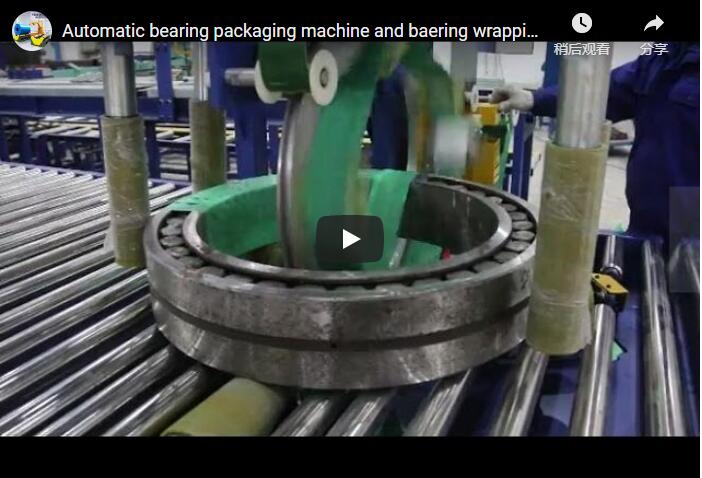
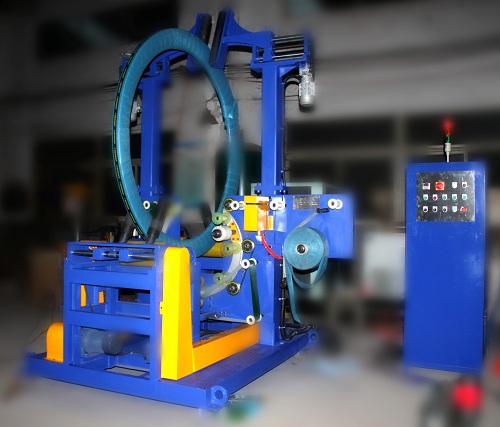
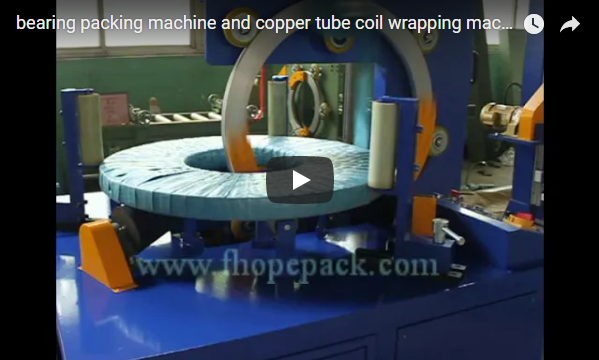
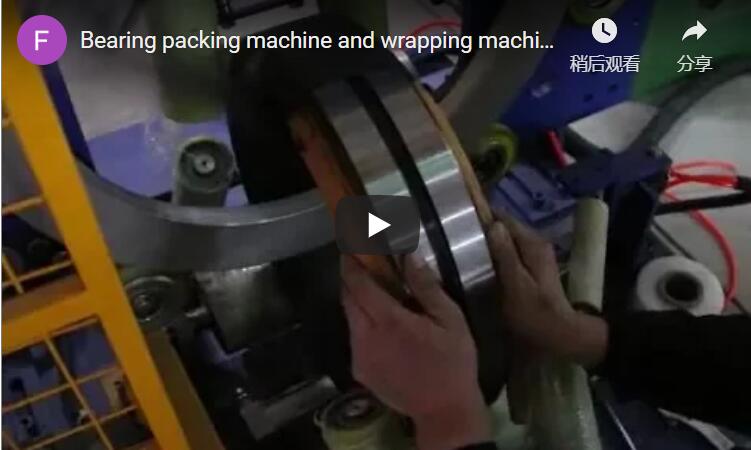
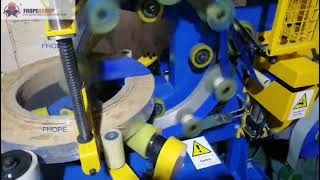
A large size bearing packaging machine rotates the heavy ring horizontally on driven polyurethane rollers while an orbital shuttle ring passes packaging film directly through the inner bore. The FPCA-6000 wraps bearings with outer diameters from 2,900 mm to 5,000 mm and weights up to 12,000 kg, applying active VCI rust-inhibiting film and dual stretch film layers in a single continuous cycle.
I have spent over 15 years engineering and commissioning heavy-duty orbital packaging systems for large bearing manufacturing facilities. Below is the mechanical breakdown, structural envelope limits, worked sizing formulas, and practical selection checklist you need to confirm fit before requesting a machine layout.
Table of Contents
- Why does a bearing ring need a dedicated wrapper?
- How does the orbital head wrap through the bore?
- What does the FPCA-6000 envelope actually cover?
- How do you check a 6.4 t slewing ring against that envelope?
- How are VCI, stretch layers, oil and cut sequenced?
- What should you confirm before requesting a quote?
- Which standards and guarding apply at this size?
- What else do bearing buyers ask?
- Conclusion
- Related reading
- Sources
Why does a bearing ring need a dedicated wrapper?
Large bearing rings require dedicated orbital wrapping because manual film application cannot maintain hermetic tension across large outer diameters, creating moisture pathways that destroy precision raceway tolerances during transport. An automated orbital machine rotates the ring horizontally while applying uniform film overlap across every surface in a sealed, repeatable pass.
Wind turbine bearings and heavy-duty slewing rings are machined to extremely tight tolerances, frequently within ISO tolerance class P6 or P5. These finished components travel across continents through humid marine environments and fluctuating temperature zones. Even minor rust spots or hairline handling scratches on raceways require complete teardown and re-grinding.
Manual packaging exposes large rings to inconsistent protective barriers. When two or three workers walk film rolls around a four-meter ring, mechanical tension varies with operator fatigue. This creates irregular overlap ratios, loose edges, and trapped air pockets containing ambient moisture.
A dedicated orbital wrapping machine stabilizes the entire packaging sequence:
- Consistent film tension: Mechanical friction spindles or power pre-stretch carriages maintain uniform film elongation.
- Calibrated overlap: Synchronized motor drives lock the orbital shuttle speed to the ring drive rollers, eliminating gap exposure.
- Single-operator control: One operator manages the full process from an external console without walking near rotating steel.
How does the orbital head wrap through the bore?
The bearing lies flat on heavy-duty motorized rollers coated with polyurethane at 85–90 Shore A hardness. This high Shore rating supports extreme radial loads while preventing surface denting on finish-ground bearing faces. A variable-frequency drive (VFD) controls the roller rotation speed to ensure smooth indexing without slippage.
An orbital shuttle ring stands vertically, passing directly through the open internal bore of the bearing. As the driven rollers rotate the bearing horizontally around its vertical center axis, the orbital shuttle spins through the bore, over the top face, around the outer diameter, and under the bottom face in a continuous spiral envelope.
                  [ Orbital Shuttle Ring ]
                           │   ▲
                           ▼   │ (Spins through bore)
               ┌───────────┴───┴───────────┐
               │    Bearing Ring Section   │
               └───────────┬───┬───────────┘
                           │   │
           [ Polyurethane-Faced Driven Rollers ]
                   (Horizontal Rotation)
The wrapping sequence follows these specific mechanical stages:
- Centering and clearance check: The operator loads the bearing onto the roller bed, and motorized actuators position the wrapping head vertically and horizontally to match the ring profile.
- Spiral layer application: The orbital head applies the inner layer of VCI film and outer layers of stretch film simultaneously as the bearing completes a calibrated 360° turn.
- Pneumatic cut and wipe: Once the 360° rotation finishes, a pneumatic cutter and clamping assembly catches the trailing edge, severs the material, and presses the film tail securely against the wrapped ring.
- Shuttle parking: The orbital ring decelerates and locks into its baseline home position, leaving the bearing fully sealed and clear for crane unloading.
What does the FPCA-6000 envelope actually cover?
The standard FPCA-6000 covers bearing outer diameters from 2,900 mm to 5,000 mm with face widths between 150 mm and 600 mm, supporting total piece weights up to 12,000 kg. Its primary physical clearance restriction requires the radial section (OD − ID)/2 to measure 475 mm or less.
Operating windows depend directly on the structural clearance of the vertical shuttle frame. Rings with extreme radial wall thicknesses cannot pass through the inner carriage opening. The table below lists the engineering ratings for the standard FPCA-6000 configuration.
| Item | Technical Specification | Engineering Detail |
|---|---|---|
| Bearing Outer Diameter (OD) | 2,900–5,000 mm | Adjustable wrapping head positioning |
| Bearing Inner Diameter (ID) | 2,500–4,200 mm | Minimum bore clearance for shuttle pass |
| Maximum Section Height (OD − ID)/2 | ≤ 475 mm (Radial section ≤ 950 mm total) | Ring clearance envelope |
| Bearing Face Width | 150–600 mm | Height capability of shuttle frame |
| Bearing Weight Capacity | 500–12,000 kg | Driven PU roller load rating |
| Wrapping Cycle Time | 60–110 s per bearing | 3 layers applied simultaneously in one pass |
| Line Conveyor Speed | 2–4 m/min | VFD inverter control |
| Layer Overlap Ratio | 10%–90% adjustable | Calibrated based on OD rotation speed |
| Operator Requirement | 1 person | Panel operation clear of moving ring |
| Total Connected Power | ≈ 4.5 kW | 380V/440V, 50/60Hz 3-Phase |
| VCI Film Roll Spec | Core 50 mm, OD 100–300 mm, width 200 mm | Active vapor-phase rust inhibitor |
| Stretch Film Roll Spec | Core 50 mm, OD 100–300 mm, width 300 mm | PE stretch film (200% pre-stretch ratio) |
Note: Custom frame configurations allow the positioning adjustment to cover extended bearing sizes from 1,000 mm up to 6,500 mm OD.
How do you check a 6.4 t slewing ring against that envelope?
A 6.4 t slewing ring with an outer diameter of 3,200 mm, an inner diameter of 2,600 mm, and a face width of 300 mm clears the FPCA-6000 envelope because its 300 mm radial section stays under the 475 mm limit, and its total mass is well within the 12,000 kg roller rating.
Before placing an oversized bearing onto the roller frame, verify the radial wall thickness, total steel mass, and material consumption using standard geometric checks.
| Parameter / Check | Mathematical Formulation | Engineering Result | Verification Status |
|---|---|---|---|
| Radial Difference (OD − ID) | 3,200 mm − 2,600 mm | 600 mm | Pass (Radial section = 300 mm ≤ 475 mm limit) |
| Cross-Section Dimension | (3,200 − 2,600) / 2 × 300 mm | 300 mm × 300 mm | Pass (Fits shuttle clearance envelope) |
| Solid Steel Section Mass | π × 2.9 m × 0.3 m × 0.3 m × 7,850 kg/m³ | ≈ 6,430 kg (6.4 t) | Pass (Within 12 t roller capacity) |
| Wraps per Layer (300 mm film @ 50% overlap) | π × 3,200 mm ÷ (300 mm × 0.5) | ≈ 67 revolutions at OD | Nominal wrap calculation |
| Film Path Distance per Wrap | 2 × (300 mm + 300 mm) | 1.2 m per shuttle turn | Cross-sectional perimeter |
| Stretch Film Consumed per Layer | 67 wraps × 1.2 m | ≈ 80.4 m film on bearing | Net usage (excluding pre-stretch) |
Engineering Analysis of the Bore Geometry
The target bearing falls comfortably within all structural and load limits of the FPCA-6000. Each stretch film layer consumes approximately 80 m of film. Because the inner diameter circumference (π × 2,600 mm = 8.17 m) is smaller than the outer diameter circumference (π × 3,200 mm = 10.05 m), the film overlap percentage automatically increases inside the bore. This provides extra layer thickness directly over the internal raceway, enhancing corrosion and impact resistance where it matters most.
The orbital ring speed (n) is coordinated with roller speed using:
n = N ÷ t (where N is total shuttle wraps and t is target wrapping cycle time). Both parameters are programmed via the HMI touchscreen on initial setup.
How are VCI, stretch layers, oil and cut sequenced?
The FPCA-6000 applies protective media in a single continuous operational sequence to prevent handling re-contamination:
- Three-Layer Single-Pass Encapsulation: The orbital head houses three dedicated material dispensers: an inner VCI anti-rust film roll applied directly against the steel surface, followed by two outer PE stretch film layers for mechanical sealing and structural tightness.
- Integrated Anti-Rust Oil Spraying: An automated spraying system featuring a fluid tank, diaphragm pump, and atomizing nozzles coats the raceway and outer faces with protective oil during rotation prior to film application.
- Pneumatic Cut & Hold System: Automatically clamps, cuts, and wipes the film tail at the end of the wrapping cycle, eliminating manual intervention and hazard exposure.
[ Load Bearing onto PU Rollers ]
               │
               ▼
[ Anti-Rust Oil Atomization Pass ]
               │
               ▼
[ Single-Pass Wrap: VCI Inner + 2x PE Outer ]
               │
               ▼
[ Pneumatic Clamp, Cut & Tail Wipe ]
               │
               ▼
[ Unload via Overhead Crane / C-Hook ]
Pre-Quotation Engineering Input
To configure your line correctly, our engineering team requires:
- Complete bearing size spectrum (min/max OD, ID, width, weight).
- Layering sequence (e.g., VCI + stretch film + woven tape).
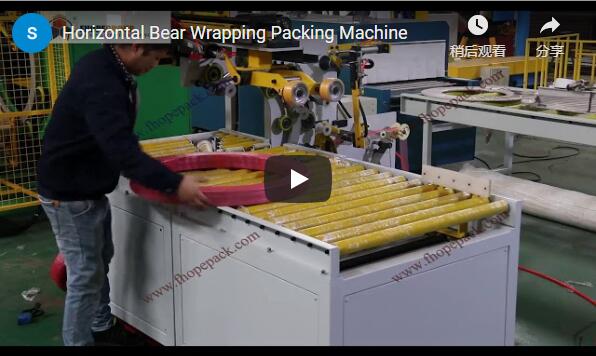
- Material handling method (overhead crane, C-hook, or inline conveyor). For smaller bearings under 2,000 mm OD, vertical ring wrappers are available for crane or trolley loading.
What should you confirm before requesting a quote?
Verify these six plant parameters to ensure proper machine sizing and drive calibration:
- Dimensional Profile: Minimum and maximum bearing OD, ID, width, and gross mass.
- Material Layer Sequence: Combination of VCI film, LLDPE stretch film, VCI paper, or PE woven tape.
- Rust Prevention Requirement: Integrated anti-rust oil misting unit required (Yes/No).
- Loading Strategy: Overhead crane with C-hook, forklift manipulator, or motorized roller conveyor.
- Throughput Target: Required wrapped units per shift (tact time determination).
- Electrical Standards: Plant voltage, frequency, and control voltage (e.g., 400V 50Hz / 480V 60Hz).
Which standards and guarding apply at this size?
The FPCA-6000 is engineered in compliance with EN 415-10 (Safety of packaging machines – General requirements) and risk-assessed under ISO 12100:2010.
Rotating multi-ton steel rings present crushing and pinch risks. The packaging station incorporates multi-level safeguarding:
- Zero-Access Loading Zone: Bearing loading and unloading occur exclusively while the machine is in a zero-energy state.
- Remote Operation Interface: Operators initiate and monitor the wrapping cycle from a pedestal-mounted PLC HMI panel outside the hazard zone.
- Perimeter Safeguarding: Heavy-duty safety fencing with interlocked gate switches or optical safety light curtains prevents access to the driven rollers and rotating orbital ring during operation.
- E-Stop & LOTO: Category 0 Emergency Stop button and OSHA-compliant Lockout/Tagout (LOTO) energy isolation points for maintenance.
What else do bearing buyers ask?
Can one FPCA-6000 wrap both 3 m and 5 m diameter bearings?
Yes. The motorized wrapping head adjusts vertically and horizontally along linear guides to match any bearing OD within the 2,900–5,000 mm range.
What is the typical wrapping cycle time per bearing?
Approximately 60–110 seconds per ring, applying VCI film and double stretch film layers in a single continuous pass.
What packaging materials can be used on the shuttle head?
Standard setups run VCI film, PE stretch film, and PE woven tape. Spindle tension dispensers are custom-sized to client roll specifications.
Conclusion
Use this sizing formula to select your wrapping configuration: if your bearing OD is under 2,000 mm, select a vertical ring wrapper with crane or trolley loading; if your bearing measures 2,900–5,000 mm OD with a gross weight up to 12,000 kg, choose the standard FPCA-6000; if your rings exceed 5,000 mm OD, opt for a custom frame configuration covering up to 6,500 mm OD.
To finalize your integration:
- Submit Specifications: Email your bearing size matrix, weights, and layer requirements to info@fhopepack.com.
- Engineering Sizing: Our engineers will configure the heavy-duty frame, PU roller drive, and shuttle ring kinematics.
- 24-Hour Proposal Delivery: Receive a full technical proposal, 3D GA layout drawing, and commercial quotation within 24 hours.
For complete machine specifications and technical inquiries, visit www.fhopepack.com.
Related reading
- Big size bearing packing machine (product page)
- Bearing wrapping machine FPB-300 (product page)
- Bearing packing machine with VCI and film (video link)
- Big bearing packing machine by VCI film (video link)
- Automatic bearing packaging machine for steel (video link)
Sources
- FHOPE technical specification datasheet: FPCA-6000 Large Bearing Orbital Wrapping System
- FHOPE Engineering Application Notes: Heavy Duty Slewing Ring Packaging & Kinematics
- Factory Acceptance Test (FAT) operational records
- Structural steel density standard (7,850 kg/m³) & bearing kinematics calculations
- European Machinery Safety Standards: EN 415-10; ISO 12100:2010
Last reviewed: 2026-11-05