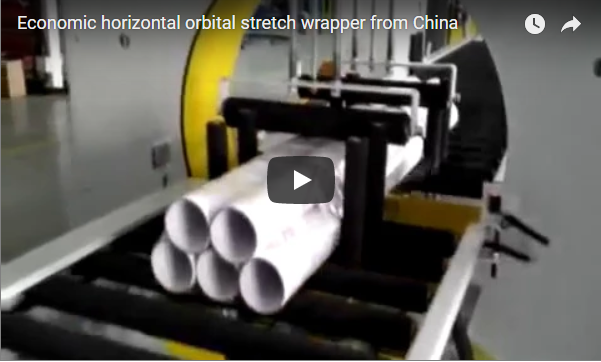
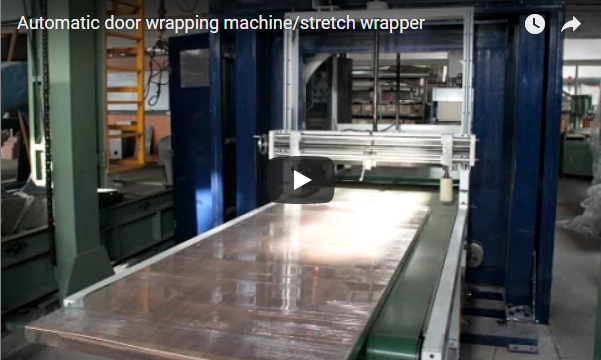
Executive summary We build horizontal orbital wrappers that spiral stretch film around a steel tube bundle while the bundle travels through a rotating ring, so the tubes never turn. Our pipe orbital wrapper handles 2000–8000 mm pipe lengths, 300–2000 mm bundle OD and 100–5000 kg bundles. Wrapping speed runs at 2–12 m/min with 20–90% overlap. This guide covers the process, specifications, material choice and a wrap-time method for your bundle.
Table of Contents
- Wrapping process
- Specifications
- Bundle sizing
- Wrap time
- Packing material
- Line integration
- Safety
- Selection checklist
- Engineering FAQ
- Next step
- Related reading
- Sources
How a steel tube bundle is orbital wrapped, step by step
We built the wrapper in this 142 s video for steel tube bundles. It follows one strapped bundle of round tubes through the machine. Each step below adds the engineering setting behind it:
- 0–20 s, infeed. The bundle arrives already strapped from the bundling line and travels on the powered infeed conveyor towards the ring, so the wrapper receives a bundle that holds its shape.
- 24–44 s, program set. Our operator sets ring speed and conveyor speed on the control cabinet beside the line before the wrap starts. Together they fix the film overlap on the bundle.
- About 72 s, centring and feed. Green side rollers close on the bundle and guide it into the ring, so the bundle axis runs through the middle of the ring.
- 76–108 s, orbital wrapping. The ring rotates around the bundle while the conveyor moves it forward. The tubes stay still; only the film carriage turns. Overlap comes from the ratio of ring speed to conveyor speed. The automatic film draw-back tension device keeps film tension steady on both small and big bundles.
- 108–140 s, cut and discharge. The film is cut at about 108–116 s, and from 120 s the bundle travels out on the outfeed conveyor fully covered in blue film, end to end.
The ring-turns, bundle-travels principle matters for steel. Long bundles weighing up to 5000 kg would be hard to rotate, and loose tubes would shift if they turned.
Steel tube orbital wrapper specifications
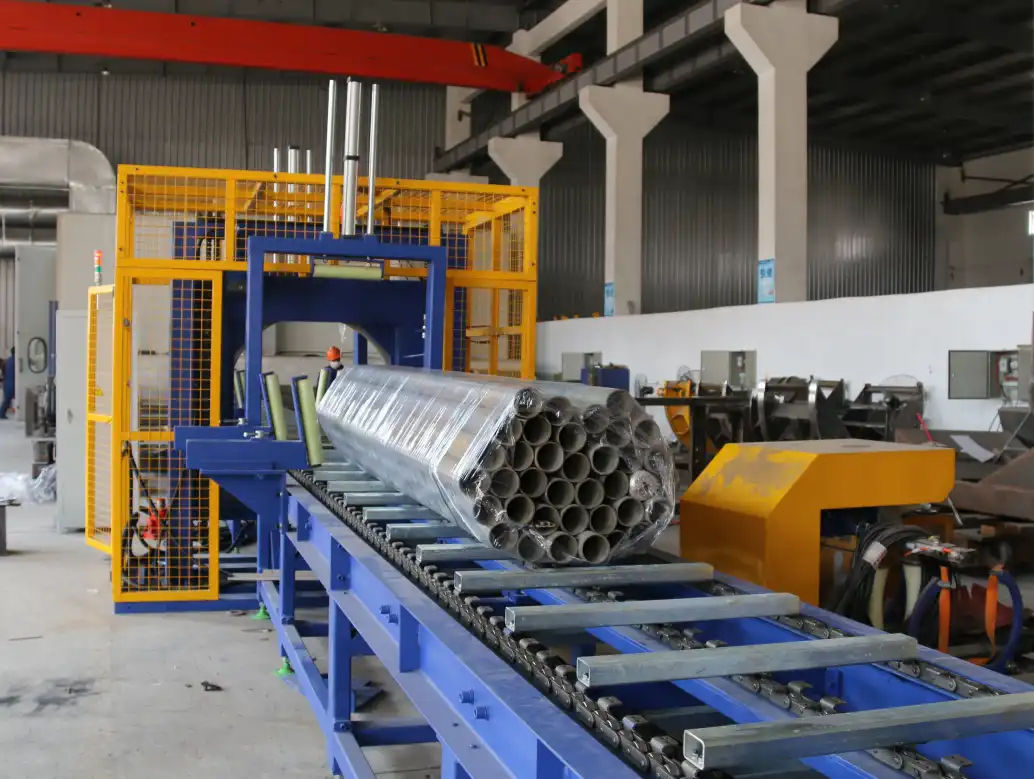
Values from our pipe horizontal orbital wrapping machine:
| Parameter | Value |
|---|---|
| Pipe length | 2000–8000 mm |
| Bundle OD | 300–2000 mm |
| Bundle weight | 100–5000 kg |
| Ring turning speed | 20–60 r/min |
| Wrapping speed | 2–12 m/min |
| Overlap rate | 20–90% |
| Power / supply | 6.0 kW, AC 380 V 50/60 Hz (other voltages on request) |
| Material and controls | Value |
|---|---|
| Packing materials | PE stretch film, knit belt, VCI paper |
| Stretch film width | 500 mm |
| Film tension | Automatic film draw-back tension control |
| Bundle range | Small and large bundles on one machine |
| Loading | Conveyor-fed inline, or forklift loading on a wrapping station |
Bundle sizing: measure across the corners
The bundle OD limit is a circle, so measure the largest dimension of your bundle cross-section:
- Hexagonal bundles: across-corners = across-flats × 2 ÷ √3. A bundle 500 mm across the flats is about 577 mm across the corners.
- Square or rectangular bundles: use the diagonal. A 400 × 400 mm bundle has a 566 mm diagonal.
- Range check: the largest dimension must sit inside 300–2000 mm, and the length inside 2000–8000 mm.
- Short bundles: below 2000 mm, the bundle must still bridge the gap between the infeed and outfeed conveyors.
Wrap time and throughput per bundle
Wrap time follows from three settings:
- Pitch per ring turn = film width × (1 − overlap). With 500 mm film at 50% overlap, the pitch is 250 mm.
- Travel speed = ring speed × pitch. At 40 r/min and 250 mm pitch, the bundle travels at 10 m/min, inside the 2–12 m/min range.
- Wrap time = bundle length ÷ travel speed. A 6000 mm bundle at 10 m/min wraps in 36 s.
Two worked limits:
- Fastest case: 8000 mm at the 12 m/min ceiling wraps in 40 s. At 60 r/min that speed gives a 200 mm pitch, which is 60% overlap.
- Heavy-protection case: 90% overlap gives a 50 mm pitch. At 40 r/min that is 2 m/min, so a 6000 mm bundle takes 180 s.
Add the head and tail wraps, film cut and conveyor transfer to get the full cycle. Then compare it with your mill’s bundle rate.
Packing material for steel tubes: film, knit belt or VCI paper
Our pipe wrapper runs three material types. Choose by transport route and storage:
- PE stretch film: dust and moisture protection for covered storage and road transport. Overlap of 50% or more gives two film layers over the whole bundle.
- VCI paper: a corrosion-inhibiting layer for bare carbon steel on long sea routes. Run it as the inner layer, then cover it with film. Both can go on in one pass when the ring is larger than the bundle: the ring carries two different materials, and even three.
- Knit belt: abrasion protection for heavy bundles that are lifted by sling or chain.
Coloured film, such as the blue film on our machine in the video, makes product grades easy to tell apart in the yard.
Line integration and layout with a tube mill
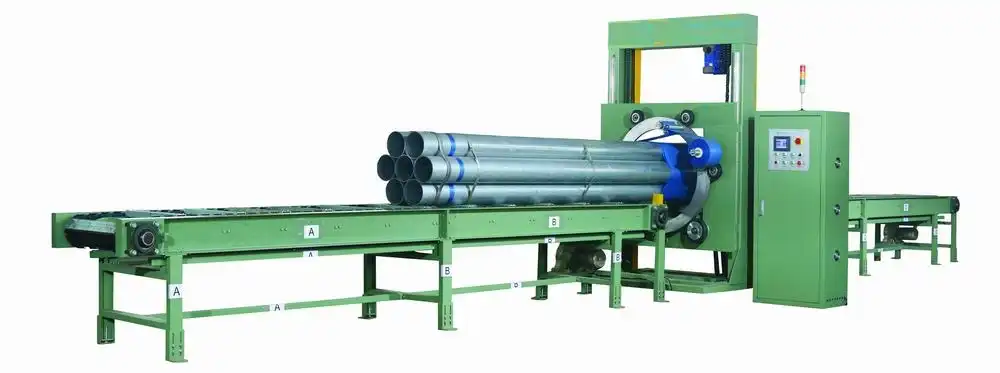
We place the wrapper after bundle forming and strapping, and plan the layout around three points:
- Strapping first: in our steel tube packing lines, bundle forming and strapping come before the wrapper. The film covers a bundle that already holds its shape.
- Conveyor length: both conveyors must carry the longest bundle, up to 8000 mm, on each side of the ring.
- Offline option: a forklift-loaded wrapping station handles lower volumes without connecting to the mill line.
Safety around a horizontal orbital wrapper
The rotating ring and the conveyors are the main hazards. Our layouts use:
- A fenced wrapping zone around the ring, with operators outside the fence during the cycle.
- Program changes made at the touch panel outside the fence, not at the ring.
- Gloves when handling bare tube ends, which have sharp edges.
The applicable standards depend on the destination market. For CE markets, ISO 12100 sets the risk-assessment method and EN 415-10 sets the general requirements for packaging machines.
Selection checklist for a steel tube wrapping machine
Send these values with your request:
- Tube OD, wall thickness and length range; bundle shape (hexagonal, square, round).
- Largest bundle dimension across the corners, and bundle weight range.
- Bundles per hour at the mill, and whether the wrapper runs inline or offline.
- Packing material: film, VCI paper, knit belt, and the overlap you need.
- Supply voltage and frequency at site.
- Space for infeed and outfeed conveyors, each at least one bundle length.
Engineering FAQ
Q: Does the bundle rotate during orbital wrapping? A: No. The ring rotates at 20–60 r/min around the bundle while the conveyor carries it through at 2–12 m/min. The tubes stay still, which keeps a strapped bundle in shape.
Q: What is the longest tube bundle the machine can wrap? A: The standard range is 2000–8000 mm pipe length, with bundle OD 300–2000 mm and weight 100–5000 kg. Longer bundles need longer conveyors on both sides of the ring.
Q: How long does it take to wrap one bundle? A: Wrap time is bundle length ÷ travel speed. A 6000 mm bundle at 10 m/min takes 36 s at 50% overlap with 500 mm film. Add head and tail wraps and transfer time for the full cycle.
Q: Can the machine wrap with VCI paper instead of film? A: Yes. The machine runs PE stretch film, knit belt or VCI paper. For sea freight, VCI paper goes on as the inner layer with stretch film over it at 50% overlap or more. Both layers go on in one pass when the ring is larger than the bundle, because the ring can carry two different materials, even three.
Q: What overlap should I set for export bundles? A: Start at 50%, which gives two layers everywhere. Go higher, up to 90%, for long sea routes or outdoor storage. Every overlap step slows travel speed, so check the wrap time.
Next step
We configure the wrapper for your tube mill in three steps:
- Submit your layout drawing with tube sizes, bundle shape, weight, length range and bundles per hour to info@fhopepack.com.
- Receive a machine proposal within 48 hours, with ring size, conveyor layout, material setup and a wrap-time check.
- Book a site survey to place the wrapper after your strapping station.
Related reading
- Pipe horizontal orbital wrapping machine
- Automatic steel tube packing line
- Video: economic horizontal orbital stretch wrapper for pipe and tube
- Video: automatic horizontal orbital wrapping machine for pipes and bundles
- Video: steel tube bundle packing line
- Video: how to set packing tension on an orbital stretch wrapper
Sources
- Pipe length, bundle OD and weight, turning and wrapping speed, overlap, power, materials, film width, tension control: pipe horizontal orbital wrapping machine page
- Process steps and timestamps: our steel tube wrapping video on YouTube, 142 s
- Standards scope: ISO 12100:2010, EN 415-10:2014
Last reviewed: 2026-10-03